Virtually every Saturday, my girlfriend and I make the hour-and-change drive to Shenandoah National Park from DC’s suburbs, where we rent a townhouse apartment with three other cash-strapped graduate students. She and I each went half in on the $80 it costs to buy an annual national park pass and have used it so many times that our trips now feel free. A routine visit to our favorite refuge looks like this: we do a six to eight-mile hike; we drive down Skyline Drive; we eat dinner at the lodge in Big Meadows (My “treat” is a craft beer. Hers is blackberry ice cream pie); we catch the sunset.
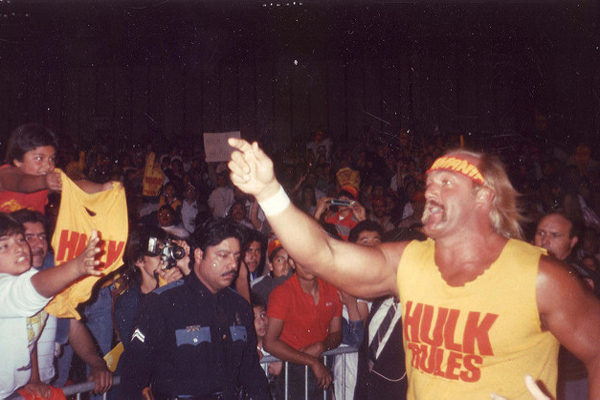
Read MorePerhaps the most contentious aspect of that initial statement is the number 93,000. On video of WrestleMania III, the crowd isn’t very well illuminated, so it is difficult to see how well they fill the expanse of the Silverdome; in the sections that are shown on film, nearly every visible inch is covered with thronging bodies. The din when Hogan walks down the long entrance ramp to the ring, and throughout the match whenever the tide turns in Hogan’s favor is constant and deafening.
Read More“Why listen to sad music if it makes one feel sad?” asks Stephen Davies, a professor of psychology at the University of Auckland, in 1997. I ask myself this not for the first time as I’m neck-deep into the Joy Division discography on the way to a job I do not dread, mourn, or fear. The singer sings “Don’t turn away / in silence” and I do not turn away, not as I drive past sunblasted car dealerships and burrito shops on Tucson, Arizona’s, Speedway Boulevard, a street Life magazine once called the “ugliest street in America.” I turn away in song, if not in silence.
Read MoreHe has heard people say this his whole life, even when he was a kid, even back when he was still trying, desperately trying, to be happy as a girl—and later, too, after he told people the truth of his gender (“Just trying to help,” they would say)—so he knows it must be true: He shouldn’t be afraid of anything.
Read MoreThere’s a wrong way to leave a husband. A bag with clothes for one night. Half a tank of gas. A man crying on the floor.
Read MoreMy partner is driving ninety miles per hour on our road trip from east to west coast when we’re pulled over to the side of an empty highway through Kansas. Her white, freckled skin is glowing in the early evening sunset, twists of pink and purple and orange billow uninhibited against the flat planes on either side of the highway. It is mostly quiet but for one or two cars passing us every dozen or so miles. They are mostly trucks, their drivers mostly older white men.
Read MoreIt was a wonder none of us were expelled for breaking broomsticks over each other’s backs in secondary school, for hitting each other with thick foldable chairs we scarcely blocked, for using the tiny library on the lowest level of one of the two classroom buildings in order to wrestle each other instead of returning home on the bus or cleaning the chalkboards as the Brothers who taught our school lessons had commanded was our duty for that day.
Read MoreI hear a tiny tap, the smallest of sounds like a thumbtack has fallen on the tile. Or, someone very small is tapping on the window asking permission to come in. I hear another tap making me glance toward the stove. But I see nothing. I turn back to rinse off my one plate, my one glass.
Read MoreMy father gave me my mother’s last name. Kirsch. A good, white-sounding name. I inherited nothing from him. I have gray eyes, light brown hair, skin that burns easily on trips to the gulf. They named me Chi, for the Cochiti pueblo, where my parents first met as part of a tour group. They didn’t name me Zara, my grandmother’s name. Zara was supposed to be an apology, because he missed his mother’s funeral, and because he was never going back to Libya, not after he tasted freedom, the sweat that beaded on my mother’s upper lip in New Mexico, and the fry bread they served at the pueblo, hot, drizzled in honey.
Read MoreMy hair speaks the language of conquistadors, the cousins of Columbus.
But it doesn’t tell the story of frijoles negro and yucca frita, ropa vieja and abuelas. My hair can’t tell you about my mother, age nine, boarding a plane with a doll in one hand and her brother’s palm in the other, destination unknown. My hair doesn’t tell you what my first words were after “Mami.”
Read MoreThe engine never failed on our mother’s rusty 1962 Studebaker Lark that drooled puddles of oil onto our driveway and shot black smoke from the tailpipe like an old musket, but most days I hoped it would so that my mother could shoot it dead like a crippled horse, and my brother and I could take the school bus instead.
Read MoreAs a freshman in the mid-1980’s, I acquired a reputation no college student really wants—that of a good listener. Lacking a love life of my own to speak of, I was doomed to hear others go on about theirs. By second semester, I feared succumbing to the fate of a eunuch, which I imagined was a slow death caused by constant exposure to second-hand romance.
Read MoreThis is not a poem about feelings.
This is an essay about six white rhinoceros. Six white rhinos and the misunderstanding of a mixtape.
This is not a poem about you making me a mixtape.
It’s an essay about the fastest routes to God. Frank Sinatra, the Bronx Zoo, and week old pots of coffee with the light still on. God.
Read MoreWhen inventor Oliver Evans first conceived of his “refrigeration machine” in 1805, he never dreamed it could be a killer. He, much like Jacob Perkins and John Gorrie (both of whom would soon improve upon the design), dreamed simply of extending the preservation properties of food.
Read MoreSo deep was my sleep on a recent flight from Moscow to L.A.— a complete darkness, as if I was where I should be—and yet when I opened my eyes, seeing instead the hard light of a plane and not that place I suppose I hoped I had finally found, I clenched my teeth, it having become clear yet again that we were neither here nor there, and it was with a bit of anger, some disappointment, and not a little bit of regret that I found myself thinking again about the Rome of a day before as much as I was anticipating the heat of the California I’d see tomorrow, all the while attempting to forget a Phnom Penh that had started it all, not to mention the various cities in between that my wife and I had tried and failed over 15 years of roaming—this long and more or less continuous effort to make some place the place.
Read MoreWe are always asking the question of resource. Will there be enough bread, meat? Will there be enough milk, water? Will there be enough clothes, shelter? To ask the question of resource is to ask how we will be sustained, how we will be able to thrive in a world when access to most goods and services and solid earth – the disappearing of clean drinking water, the melting of ice caps causing a raised sea level, the possibility for cataclysmic earthquakes, deforestation of rainforests, the building of telescopes on Hawai’i sacred ground, for example – seems to be dwindling. Dwindling because of the political economy that organizes and structures lives under these American skies.
Read MoreFrom L.A. to Phoenix, and Albuquerque to Corpus Christi—Cinco de Mayo is no longer “Cinco de Mayo” but Cinco de Morrissey. Don’t believe me? Check your hashtags, mijo. Search #MozdeMayo or #CincodeMorrissey and you’ll find the internet is littered with photos of the ex-Smiths lead singer set to the backdrop of serapes and the Mexican flag. You’ll find Instagram photos and Tumblr sites filled with pompadours and forlorn looks. You’ll even find a podcast from NPR’s Alt Latino show, celebrating this newfound holiday. Por qué? Well, that’s a good question. How does an Irish man from Manchester with no Latino blood get incorporated into such a holiday?
Read MoreIt all starts with a single mystery.
And then another. And another. And then another.
I can still remember seeing my mother crying as Agatha’s ending credits rolled. My mother said, “My tragic flaw: I hold no mystery.”
Read More3. My new wife sends me out for mousetraps and peanut butter, and I don’t
think there is anyone that doesn’t know what we’re doing.
Read MoreThe first two words I could recognize were LUCKY and STRIKE. My grandfather always had the cigarettes in his front shirt-pocket, as if he only bought shirts that came with Lucky Strikes. When he held me against his chest, in his muscled roofer’s arms, I heard the crinkle of the plastic-coated package in his pocket. After he died of lung cancer when I was twenty-two, I bought one of the familiar white packs, with its bold red circle and black letters. I kept it close in my bedside table that summer. Some nights, I reached into the shallow drawer to crinkle the unopened cellophane package.
Read More