

The cafés have a kind
of tea that is just
the temperature and taste
of air breathed in summer

Jamaal May is the author of Hum (Alice James Books, Nov 2013), two poetry chapbooks (The God Engine and The Whetting of Teeth), and the winner of the Beatrice Hawley Award. His poems have been published widely in journals such as The Believer, The New Republic, POETRY, Ploughshares, Kenyon Review, and New England Review. May's poem "Hum for the Stone" appeared in the Spring 2013 issue of The Normal School.
A Normal Interview with Jamaal May
By Stacey Balkun
Stacey Balkun: I re-read Hum during and after the Zimmerman trial and couldn’t read “Man Matching Description” without thinking about Trayvon Martin. This is an important poem about false accusations. What can we do? What’s next? How does this poem (or your poetry, or anybody’s poetry) play a role in ending violence and injustice?
Jamaal May: That re-contextualization happened for me as well. A few people reposted the poem, as it was readily available on <i>Blackbird</i>’s website, shortly after the shooting occurred. What is terrifying about how well the poem fit the moment is how long ago it was written, how many times before that a similar poem was written, and how many such poems will be written in the future.
I’ve been thinking a lot about poetry being pretty much the only art form in which the practitioners are regularly called upon to explain if and how their art will solve society’s ills. I’ve never seen or heard an interview with Jack White that asks him how his guitar solo on “Ball and Biscuit” will cure cancer and stave off the zombie apocalypse. I once worried about the fairness of this paradigm, but I’m starting to see it as a show of respect. That people keep wondering how poetry will change the world seems to start with the implicit assumption that it could. I believe it already does, but not in the singular immediate way that seems to be demanded by some to justify the creation of literature. It is one of many human endeavors that, taken together, help to repair our minds into more thoughtful devices.
Art, be it poetry, music, sculpture, puppetry—the whole of it, inspires change on a personal level rather than a global one. This is important because the individual is the whole. The creation of art argues that people are connected, ideas are connected, the past and future are connected by this moment. Meanwhile, exploitation of the poor, drone strikes that kill hundreds of children, slavery, genocide, land theft—these are all acts that depend upon convincing large groups of usually well-meaning people that “they are not us.” Dean Young once said, "The highest accomplishment of the human consciousness is the imagination, and the highest accomplishment of the imagination is empathy." Poetry, along with every other art, is a tool for teaching and expanding empathy. Violence and injustice cannot endure empathy.
SB: I keep thinking of Tracy K Smith’s poem “The Museum of Obsolescence” from Life on Mars. In “How to Disappear Completely,” you acknowledge the idea of obsolescence and the fear of the human (or old machines) becoming obsolete. The poem urges the reader to “become origami. Fold yourself smaller than ever before. Become less.” Meanwhile, our culture continuously urges “more more more.” What’s going on here? Can we, as humans, resolve this conflict?
JM: Before delving into your question, I would like to comment on my fascination with the way association works in a collection of poems. Like you, I think of “How to Disappear Completely” as a poem about obsolescence, but I didn’t quite think of it as such until it was in a collection with “Mechanophobia: Fear of Machines.” It’s one of the more exciting aspects of putting together a collection of disparate poems and figuring out how they speak to each other.
It’s worth noting that the poem goes on to say “more in some ways but less in the way a famine is less,” which is to say quietude stands out in a cacophony. What’s more noticeable than a famine, meaning lack? I suppose the inverse truth of this is that “more more more” can equal less and less. The poem is trying to do a lot of things at once, but a center of gravity can be found in the simultaneous distress and solace that comes from solitude. Another is grief. I often render emotions by creating the space around it rather than going right at the thing. “How to Disappear Completely,” engages the weight and significance of loss by reifying an absence. The reader is promised she will finally be seen when she is missing from our world.
Can the “more more more” societal conflict be resolved? I’m not sure if this makes me a cynic or an optimist, but I’ve stopped looking at conflicts as things that either will or won’t be resolved, at least the kinds of conflicts good art tends to engage. The demand for more is just another way to say “desire.” Humans will never resolve desire and want. With the myriad ways we are exposed to greed and selfishness through all our media access, it’s easy to think of “more more more” as a modern phenomenon. But as a person of color writing in a country built on colonialism, genocide, and a vast slave workforce, I’m not allowed such delusions. So rather than wring my hands over how the conflict will be resolved, I investigate how we can live with such conflicts and work to become better humans inside of it.
SB: Technological advancement often makes obsolete people's knowledge and livelihoods. “On Metal” addresses a group of mechanics huddled “around a car, admitting some small defeat” because “Detroit’s building’em like robots now,” and they cannot fix it. For me, the theme obsolescence ties the book together. What were your intentions for this poem and this collection as a whole?
JM: Technological advancement is perhaps less frightening to me than to many of my peers. I’m not terrified of the presumed oncoming apocalypse facilitated by Facebook or the new Playstation. Television didn’t end the world and neither will Tumblr. I believe in something intrinsically human that will always exist outside of popular culture and the latest grown folk bugaboos. That intrinsically human thing is often ugly, narcissistic, and petty, but it was there before status updates and anonymous comments existed. Before our current age, “trolls” would just show up at your lunch counter, sit-in protest and dump ketchup and sugar on your head.
The other side of this paradigm is that some of the cooler things about people have also been around for a while and aren’t going anywhere. For example, our ache for the connection we find through art only seems to have been brought into relief by the modern era of immediate, low-effort gratification. If technology was as capable of short-circuiting what is at the core of humanity, there’s no way in hell I’d be able to walk into classroom after classroom of teens and preteens and get them excited to write poems. There wouldn’t be more poetry readings and journals and more Americans writing than ever before in the country’s history.
The focal point of “On Metal” is a kind of resignation about the decline of our machinery, but it is not nostalgic. If anything, the poem is reaching towards acceptance. The point isn’t that the men can’t fix the car because of time’s relentless march, it’s that we eventually have to choose between peace and stubborn arrogance when faced with mortality. The speaker hopes for that kind of grace (“a diminishment I’ll live with”) while also understanding the impulse to fight decay to the last cell: “...I get this...why my dad once fiddled daily with a dead Camaro, refusing to believe its silence.”
I’m not sure Hum hinges on the idea of knowledge and livelihoods becoming obsolete in the face of new technology, though abandonment and mortality are definitely key features. My intentions for the collection were to let the writing of individual poems guide the making of a book because ultimately, I’m trying to say something about dichotomy, the uneasy spaces between disparate emotions, and by extension, the uneasy spaces between human connection. For these reasons, if the collection hinged on a single idea, it’d be a failure of my broader project (which it very well may be, mind you, but art should risk failure). I’m crossing my fingers in hopes that I’ve written a many-hinged book with several possible openings.
SB: Hum weaves together the human with the robotic, and also formal poems with more open forms. What was your thought process in both crafting the formal poems (“Hum of the Machine God” and “Neat” particularly”) and including them in this collection?
JM: I think of all poems as having a formal project that must be defined by the needs of the particular poem. Sometimes a received form fits those needs perfectly, which was the case with “Neat.” I wrote it as free verse but realized quickly that the form was working against the emotion I wanted to evoke. I was looking for something that felt more cyclical and lingering, which the pantoum form is great for. The work of fighting the poem into the form gave it the torque I needed to get where I was going. This is typical of my process; when a poem doesn’t have a sufficient level of trouble, I look for something that threatens its safe little nest.
On other occasions, which are somewhat more rare, the received form gives me a launching pad for working out a concern. The mind tends to seek patterns and repeat them reflexively, so starting with a formal project can be useful in drawing out the untapped subconscious.
“Hum of the Machine God” started off as a challenge from my thesis advisor, Rick Barot, to help me see the core tropes and textures of Hum. He suggested I write a sestina using the six phobias that appear in the book as the six repeating words (machine, waiting, snow, etc). After submitting to the Beatrice Hawley Award, I put the manuscript away for 7 weeks. When I returned to it I wrote a second sestina from scratch, “The Hum of Zug Island,” using the same six words. The new poem illustrated what the first sestina was missing. I rewrote “Hum of the Machine God,” and now the two poems act as a pair of subtle bookends that tie the phobia thread together and, by extension, the core tropes of the collection.
Redundancy and tedium are always a danger with such an insistent form. Though it may seem sensible to use the most flexible words possible in a poem that demands they appear seven times, more inflexible words actually work better. This can be seen in Bishop’s “Sestina” with her use of “stove” and “almanac.” More recently Jonah Winter’s hilarious “Sestina: Bob” uses “Bob” as all six repeating words. What happens when the poet isn’t caught up on trying to use the words in various ways is the rest of the line demands more nuance and deftness. It relieves the pressure on repetition to carry all of the resonance and lets the repeated words do their more important job of cycling around in a more subtle, incantatory way.
SB: “I Do Have a Seam,” appears in two columns stitched together by the word “here” in the center. The poem can be read down either column, or across both—leaving the reader with three variations on the same theme, maybe more. Can you talk a little about the process of writing this piece?
JM: This poem falls into the same category as “Neat,” in that I originally wrote it as free verse and saw that it could be doing more formally. The form screamed at me one day in the editing process and the work that followed brought into relief what I saw as a paradox of healthy romantic engagement: the maintenance of individual self in midst of a certain, necessary vulnerability. As a student pointed out when I visited Indiana University (wish I had her name), the seam that splits the poem is also the space that holds it together. I couldn’t get at that kind of simultaneity in the free verse version.
The form is called “contrapuntal.” Its history, as I know it anyway, is that a poet who had also been a choral singer, Herbert Woodward Martin invented it. He wanted to capture an approximation of what happens in the contrapuntal musical form. Poet Tyehimba Jess in his collection Leadbelly, which contains several masterful contrapuntal poems, brought it into the contemporary American poetry spotlight recently. An exciting aftereffect is the popularity the form has enjoyed among younger writers and on the poetry slam scene for the past year or so.
Jamaal May is the author of Hum (Alice James Books, 2013) and The Big Book of Exit Strategies (Alice James Books, 2016). His first collection received a Lannan Foundation Grant, American Library Association’s Notable Book Award, and was named a finalist for the Tufts Discovery Award and an NAACP Image Award. Jamaal’s other honors include a Spirit of Detroit Award, the Wood Prize from Poetry, an Indiana Review Prize, and fellowships from The Stadler Center, The Kenyon Review, and the Civitella Ranieri Foundation in Italy.
Photo Credits. www.jamaalmay.com
One night, while on a train, Normal School Editorial Assistant Leslie Santikian asked Contributing Editor Adam Braver six detailed, slightly-rambling questions on the nature of fiction and truth, Marilyn Monroe, and myth-making compulsions. Graciously, he answered all.
A Normal Interview with Adam Braver
By Leslie Santikian
Leslie Santikian: Your writing blurs the line between fiction and journalism, creating a hybrid that somehow touches both worlds; I think that's what makes me most enjoy reading your work. In light of the recent controversy surrounding John D'Agata and his philosophy that the search for truth doesn't necessarily mean accuracy and "fact," where do you think your work stands? Do you feel you have fewer boundaries to worry about because your work is technically "fiction"? Do you feel any obligation to "truth" or "fact" when crafting your books?
Adam Braver: In terms of this subject, my interest is not so much about a Truth that supersedes all else. Nor is it in the competition between fact and fiction. In fact, I’m most intrigued by how fact and fiction work together to create a so-called truth. Facts are facts. But it’s how they are arranged and linked and filled in that makes them become a truth or a history. And I just can’t help but believe that it is really the product of combining fact and imagination that get us to those truthful places. For the most part, I do feel obligation or allegiance to facts in my books. However, I also recognize the power of omission, as well as how a fact can have different implications when it is abutted or juxtaposed against other facts or imagined reactions, etc. That said, decisions do need to be made; and I strive to make them all from a position of strength, meaning if/when I might stray from the so-called factual, I know that I am doing it and have a definite reason (as opposed to it being from laziness or disregard). But the bottom line for much of this (in terms of my current thinking), is that I am much more drawn to collage—as opposed to linear storytelling. In part, it’s because I’m more interested in the ideas that attract me to the projects (as opposed to the storylines), and also because I’ve become more and more interested in space and spatial relationships in my writing. A more “collaged” style helps me get there. But as with a visual collage, the story and experience and theme it tells is all based on the relationships of the images to one another. And while all of those images are “real,” very often they’re only “real” in the most relative sense—meaning, that a cigarette advertisement from a magazine is just as fictitious as some made up story that might come from my head. But juxtapose that ad against a horrific wartime photograph, and suddenly they now are working in tandem to tell a real story that transcends their individual parts. Essentially, that’s what I’m trying to do with my writing these days. So, indeed, that the facts remain as facts is critical. But equally critical is recognizing that they only are facts, still waiting to be part of a story.
LS: Part of what makes your writing compelling is how far you take us into your character's lives: into their innermost thoughts, fears, wants, needs, memories. How do you get inside such iconic figures as Jackie Kennedy in November 22, 1963, and Marilyn Monroe in your newest work, Misfit, and show us who they are beyond their public personas? Do you have a process for doing this?
AB: One of those oft-quoted aphorisms about literature is that it can either show us the extraordinary in the ordinary, or show us the ordinary in the extraordinary. Obviously, with the two books we’re talking about here, the latter is the territory I’m wandering in. In as much as I have a process for this (and I use the word process loosely), it is about trying to access the ordinary in these people with whom we have anointed as extraordinary. So, for example, in writing about Jackie Kennedy on the plane ride back from Dallas, I am not trying to locate Jackie Kennedy and her persona, in as much as I am trying to identify with that base emotion that to me is universally human. By that I mean that one does not need to be Jackie Kennedy to understand grief and loss, or the fear at losing one’s sense of place in the world. Frankly, I’m finding those places inside of me, more than trying to identify them in these mythical figures. As I alluded to earlier, part of this stems from the fact that I’m less interested in the stories of these people as public figures, as opposed to making some kind of art out of their experiences to understand more universal themes on culture and humanity.
LS: Your new book, Misfit, feels especially timely, considering the recent, reinvigorated interest in Marilyn Monroe's life in popular culture—the movie My Week With Marilyn, the TV show Smash, etc. What drew you to Monroe for this book?
AB: Well, the timeliness is somewhat accidental. I had been challenged to write a short story about her—a challenge I accepted. I didn’t know much about her; she wasn’t someone who was ever on my radar, other than the basic biography. But as I began to research a bit about her for the story, she became intriguing to me as a character to work with. In part, I was drawn to her constant reinventing of herself, which seemed to me to be emblematic of how we view the dream of our culture. And perhaps most fascinating to me was the idea that one can reinvent one’s self to the point where the reinvented persona begins to overwhelm or overtake the person; in Monroe’s case, it was the idea that the persona of Marilyn Monroe became larger than the person who inhabited it. I saw this both a phenomenon of the larger culture, but also one that symbolized the struggle for individual identity.
LS: A prominent theme in Misfit is the tension between Monroe's public persona and private self—and, even beyond that, the love/hate relationship she had with that private self. What made you want to explore those tensions? Do you consider these tensions particularly powerful when you're writing iconic characters?
AB: I think that is a tension that I am generally interested in exploring—the negotiation between the private and the public self. In her case (as with most iconic figures) it seems to be greatly exaggerated, as that chasm often is what is so intriguing about them. Also, as with any character, I find those who are most enigmatic to be most interesting (I’m saying that, of course, as a writer). That unknown private world is the place I want to get to—often the place that I imagine has been buried or denied or forgotten; those moments where the people are stripped bare and ordinary and often at their loneliest because they have come to believe they are not allowed to be that person anymore. Or so I imagine it.
LS: You also seem drawn to how people become mythologized, shaped into a larger-than-life version of themselves. I'm thinking of Monroe, but also John F. Kennedy, Sarah Bernhardt, etc.—all subjects of your work. Are you speaking to our larger need for god-like figures in our society? To other compulsions?
AB: I think it’s more about being intrigued by the idea of mythology—both the notion of self-created mythologies, and culturally ordained mythologies (and perhaps the intersection of the two). You know, it’s a funny relationship between having these god-like mythical people (or at least reifications), because on the one hand they can validate some sense of who we are culturally, but individually it can also make us feel really small and wanting and not enough.
LS: Do you have any idea or person in mind for your next book? Anyone you've been waiting to write about?
AB: I’ve been researching (and doing some writing) about a woman named Kay Summersby, who was Eisenhower’s driver during WWII. There were rumors of an affair between the two of them—although that’s really the least of my interest. At this point, I’m much more intrigued by how this seemingly unlikely Irish woman would find herself regularly with a front row seat at major, worldwide historical shifts.
Adam Braver is the author of Mr. Lincoln’s Wars, Divine Sarah, Crows Over the Wheatfield, November 22, 1963, Misfit, and The Disappeared. His books have been selected for the Barnes and Noble Discover New Writers program, Border’s Original Voices series, the IndieNext list, and twice for the Book Sense list; as well as having been translated into Italian, Japanese, Turkish, and French. His work has appeared in journals such as Daedalus, Ontario Review, Cimarron Review, Water-Stone Review, Harvard Review, Tin House, West Branch, The Normal School, and Post Road.
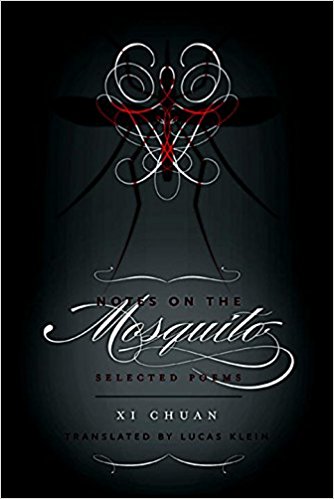
Editorial Intern Michael Gray asks Chinese poet Xi Chuan and his translator Lucas Klein tough questions concerning process, navigating translation, and the relationship between literature and reality. Xi Chuan is one of contemporary China’s most celebrated poets, having won the Lu Xun Prize for Literature (2001) and the Zhuang Zhongwen Prize (2003). Lucas Klein performed the English translation of Xi Chuan’s book Notes on the Mosquito: Selected Poems (2012).
A Normal Interview with Xi Chuan and Lucas Klein
By Michael Gray
For Xi Chuan: What elements of your original text do you find are most altered in the process of translation?
XC: 我自己写的东西,尤其到后来,有时会非常“直截了当”,而“直截了当”的东西其实不好翻。我自己也做翻译。据我的经验,意象相对来说容易翻;音乐性,特别是旋律,虽然译文与原文不好完全吻合,但还是能够找到相应的解决办法。但直截了当地表达思想观念的东西翻译起来很容易丧失诗意。直截了当,是晚年Borges看中的品质,因为他早年玩过巴洛克。表达观念是Milosz所赞成的,因为他来自东欧。这两人都把脚迈到了抒情诗的门槛之外。我曾对一位加拿大诗人讲过,我的诗,容易的地方我会尽量容易,但难的地方我也会尽量难。难,我指的是我会在中文中通过词语、语式传递尽量大的信息量。我的诗向着现实和历史敞开。现实和历史的跌宕起伏以及浑浊,会被我变成语言方式。我喜欢将当下口语和古老表达、松弛和紧张、日常和古怪、透明和浑浊、绝然和暧昧混合在一起。翻译者不得不经常进行脑筋换挡。还有,中文和英文毕竟是两种语言,两种语言牵带出的文化记忆,所面对的诗歌上下文并不完全一样,所以个别在中文里有意义的表达也许在英文里没有意义。但Lucas已经尽了力。他的工作很出色。
Lucas Klein’s translation: In my own writing, especially recently, I’m often very blunt, but bluntness can be very hard to translate. I’ve done a lot of translations myself, and in my experience imagery is relatively easy to translate; with musicality, or particularly rhythm, though it’s hard to match the translation perfectly with the original, it’s still possible to find comparable solutions. But with ideas expressed bluntly it’s easy to lose the poetry. Bluntness is a quality of late Borges, because in his early years he was playing with the Baroque. It’s also a notion of expression Milosz was fond of, coming from Eastern Europe. These two stepped outside the bounds of lyrical poetry.
Talking to a Canadian poet one time, I said that with my poetry, when it’s easy I try to have it be as easy as possible, but where it’s difficult I try as hard as I can to make it difficult. By difficulty I mean that I try to transmit as much information through vocabulary and expression in my Chinese as possible. My poetry opens up to reality and history; the uninhibited undulations and turbidity of reality and history will turn into modes of language. I like to mix up contemporary slang and antique elocution, the slack and the tense, the quotidian and the bizarre, the opaque and the clear, the direct and the ambiguous… the translator has to find ways to stay alert. English and Chinese are two very different languages, each bringing along its own cultural memories, facing two different poetic contexts, so any expression that might be significant in Chinese may end up being insignificant in English. But Lucas did a great job. His work is outstanding.
For LK: A line in the poem "Three Chapters on Dusk," reads "a ray of light, we become history" from Chinese: "作为一种光线,我们就是历史." I literally translate "就是" to mean "is" or "are," specifically emphasizing a certain state or existence, but in the context of the poem, "become" makes more sense. Why did you choose that word?
LK: I wrote in the introduction of Notes on the Mosquito, “I am motivated by a belief that the reader not only wants to know but can know both what Xi Chuan says and how he says it, both his images and his style, both his allusions and his elusiveness.” At the same time, too narrow a conception of how limits the work. There’s a long history of philosophizing about "being and becoming," but I’m not sure that such discussion is relevant to a judgment about whether, in this translation of this poem, I should have said “as a ray of light, we are history,” instead of “a ray of light, we become history.”
It’s easy to go too far along these lines, but sometimes, to be faithful to the source text you have to be unfaithful to the word. Words often have more than one meaning, so we have to pick the right one. For instance, I noticed in one of Xi Chuan’s recent translations of Gary Snyder that he took the word "shop" and translated it into shangdian 商店. Well, that’s a shop, certainly, but I think Snyder is referring to the shop you might have in your garage, where you’d keep your hatchet, if you had one. But not many Chinese people have a "shop" like that in their homes, so even if it’s a mistranslation, it’s a mistranslation that helps Chinese readers access the poem. I noticed a similar moment like that in one of my translations of Xi Chuan: I translated a line of "Rereding Borges’s Poetry" as "annotat[ing] the aporia of history." More accurately, it would be "the lacunae of history." "Aporia" and "lacuna" are not quite the same (though they’re related), but ultimately I not only felt that "aporia" alliterated better with "annotated," but also that it worked into how Borges has been read by critics in the west, who tend to see his writings more defined by the aporia—or paradox or puzzle—than by what they leave out, or their lacunae. Technically, it’s a mistranslation. But I think it resonates with readers in English this way. Of course, at other times the opposite is true, and you want to insist on difference, to keep all notions of the poetic or literary from being subsumed into a common cultural ignorance.
For XC: You comment on a writer's engagement with a broader landscape, that "one's sense of reality is shaped by one's tradition." How does this statement relate to the poem "Notes on the Mosquito"?
XC: 我文章中讨论的是文学、诗歌与历史、文化、现实的一般关系的问题,表达的是我的基本态度。文中我主要是在寻找创造力的来源和创造性工作的坐标。而《蚊子志》是一首具体的诗(同时也是偶然成为了这本书的书名)。在具体写作时我不曾想到那么多理论性的问题。当我面对“蚊子”,我面对的是一套世界背后的逻辑。那套逻辑有它的荒诞性,而发现这种荒诞性让我愉快。当然回过头来想,这种荒诞性是与我的生活密切相关的。蚊子,就我的记忆,在古代,几乎不曾被诗歌书写过。它们等我到今天,进入我的诗歌。我热爱中国古代文化,但我反对“寻章摘句”式地运用古代的文化资源。我不需要着意向任何人显示我的中国文化身份,我只需对周边事物和我的经验保持一份诚实即可。中国古代文化以及历史和政治,已然自我转化为我身边的事物。我无法像个不在此地的人在一定距离之外表达赞成或批判。在这首诗中,蚊子当然不仅仅是蚊子。它像一个小寓言中的主角,但又是一个蕴意不明的主角。
LK’s Translation: My essay is about problems concerning the relationship between literature and poetry on the one hand and history, culture, and reality on the other, making plain some of my basic attitudes. It’s me looking to coordinate the sources of creativity against the work of creation. “Notes on the Mosquito,” meanwhile, is an individual poem (which happened to become the title for the whole book). In writing any particular poem I don’t tend to think about theoretical problems. Looking at the “mosquito,” I’m looking at a whole logic in back of the world. That logic contains its own absurdity, and discovering this absurdity makes me happy. When I look back, I find that this absurdity is intertwined with my own life. Mosquitoes, as far as I can recall, were never written about in poetry in ancient times. They’ve been waiting for me so they could appear in my poems! I love ancient Chinese culture, but I can’t stand the hackneyed way ancient culture gets used as an embellishment to discourse. I don’t need to demonstrate my Chinese cultural identity to anyone; I just need for there to be sincerity between my experience and the things around me. Ancient Chinese culture, history, and politics have transformed into those things around me. I have no way of expressing judgments of praise or blame from afar. In this poem, the mosquito isn’t just a mosquito; it’s a protagonist in an allegory, but the meaning of its role is unclear.
For LK: What English do you have in mind when you translate from Mandarin? How does this choice affect the translation of poems and audiences' possible interpretations?
LK: This is the kind of question I wish people considered more often when thinking about translation. This really defines the difference between translations, the version of the target language the translator has in mind for her or his translations.
The English I have in mind is the American English used in poetry of a certain kind for the past century or so. This is an English recognizable as in the tradition of avant-garde poetry, but it’s got a wide range—the kind of range that allowed, for instance, Ezra Pound to write “The gew-gaws of false amber and false turquoise attract them. / ‘Like to like nature.’ These agglutinous yellows!” one year and “But you, Sir, had better take wine ere your departure” the next. This is how, I think, I was able to translate in a way that Jennifer Kronovet described, in her piece on why Notes on the Mosquito should win the Best Translated Book Award in poetry, as not having “made these poems American, but rather allowed us to hear Xi Chuan’s poetics and ideas in an American idiom, in an English that is alive with personality.” (We’ve been very fortunate in the published reviews our book has received—they’ve been very enthusiastic about both the poetry and the translation—but this was one of my favorite moments).
I mention Pound on purpose, not only because one of these lines is from his invention “of Chinese poetry for our time,” as T. S. Eliot put it, but also because he’s the father figure of American avant-garde poetry (what a complicated man to have as your father!) and the father figure of the press New Directions—which of course is our publisher for Notes on the Mosquito. Some other press might have published Xi Chuan into a different English (on my xichuanpoetry. I have links to other translators’ work), but I want to emphasize that I have in mind an English that descends from the Pound line not only because of my tastes or the heritage of our publisher, but also because I find Xi Chuan’s Chinese to occupy a similar space in the layout of contemporary Chinese literature. Pound and the poetic movement he was part of were important in the formation of modern Chinese poetry, too, and more specifically for Xi Chuan, as well.
For XC: What is your reaction to seeing your work in another language?
XC: 我很高兴看到我的诗歌被翻译成外语。翻译使我的诗歌有了更大的飞翔范围。借助Lucas的翻译,这些诗得以找到另外一些工作着的大脑。如果它找到了,那么,这就是对于作者的最大的回报。另外,通过阅读译文,我也得以获得了观察自己的陌生的眼光。《蚊子志》不完全是我的书,而是Lucas与我,我们的书。
LK’s translation: I’m very happy to see my work translated. Translation gives my poetry a much wider flight radius, and with the help of Lucas’s translations, these poems were able to find a greater number of active brains. And if they found them, well, that’s the greatest reward a writer can have. On top of that, reading these translations has given me new eyes with which to observe myself. Notes on the Mosquito is not just my book, but is our book, mine and Lucas’s together.
For LK: How do you start your translation process? What responsibilities and difficulties do you encounter when trying to maintain the authenticity of the original language's meaning?
LK: I start the translation process by reading the poem in Chinese, mentally converting certain words and phrases into English as I go. Then I put it into English line by line, after which I go over it and correct any mistakes I can find. Then I read it again in just English and try to smooth it out, make sure it sounds right in English with the Chinese still fresh in my mind. Then I put it aside for as long as possible, and after forgetting it go back and read it in English to make sure it sounds right with the Chinese not in my mind at all. Then I’ll go back and check it against the Chinese to see if I’ve made any mistakes. Then I’ll share it with as many different kinds of readers as I can—readers of Chinese, readers of poetry in English, readers of translation (whether they know Chinese or not)—and take in their comments. At some point, I decide that there’s nothing else I can do, and that the poem in English is the right translation for the poem in Chinese. As I said, I believe translating to be not only about the what of a poem but the how, as well.
One thing that comes to mind is Xi Chuan’s phrase 穷尽一个人, in “Exercises in Thought,” where he talks about Nietzsche’s philosophical aims. It’s straightforward enough in Chinese, but the most available translation into English would be “the exhaustion of a person”—but “exhaustion” more colloquially has to do with being tired out. I had to come up with something else, and eventually settled on “The depletion of a person, that was Nietzsche’s work.”
I adamantly do not see translation as defined by “difficulties” or “problems.” Sometimes it’s hard, but the words I use to describe translation—and particularly this translation—have more to do with joy, excitement, discovery, interest, and necessity.

Published by Lookout Books in March of 2013, Ben Miller’s River Bend Chronicle: The Junkification of a Boyhood Idyll Amid the Curious Glory of Urban Iowa is a collection of essays that ultimately comes together to form a pulsing, beautifully chaotic memoir. Some of the essays have appeared in magazines like The Antioch Review, Ecotone, and AGNI. Part of the prologue, “Bix and Flannery,” was selected by Louis Menand for inclusion in Best American Essays. The sixth essay/chapter of the book, “In Hickey’s Havana,” originally appeared in The Normal School #3.
A Normal Interview with Ben Miller
By J. J. Anselmi
J. J. Anselmi: I’ve been thinking about your style as a mixture of David Foster Wallace-esque maximalism and Barry Hannah-style absurdity, conveyed in sentences that mimic the bizarre beauty of Davenport, Iowa. But your prose is also markedly different from any writer I’ve encountered. Who were some of your stylistic influences for this book?
Ben Miller: I’ve always admired those books that have “a sound” just as bands are said to have “a sound.” The prose of Virginia Wolf, for example, possesses a sound that unforgettably envelops readers. So does the work of W.G. Sebald and James Agee. To me the act of writing, on one level, has always been an effort to tune a page so that it resounds as experiences do in my particular mind, and heart. Locating this sound has been an intensely personal endeavor, but a process fed, as tributaries feed a river, by authors mentioned above, and others, including Welty and Turgenev.
JA: I’m a student of writing, so I continuously found myself enjoying the challenges the book presents through both form and unique sentence constructions. But do you worry about accessibility to a larger audience?
BM: I am a student too! It’s good, always, I think, to remain a student in the best sense of the word: open to learning, eager to be surprised. When you stop being a student the discoveries end. And if you think about the reading life, it is often those books which overturn our assumptions that most excite. Accessibility is a concept created anew with each work of literature, on each page—and if the prose tends to be dense, as mine sometimes is, the author must expend effort creating alternative ways for readers to enter and comfortably remain in the space of the book. Mood (via an accumulation of the right details), for instance, can be a powerful aid, as well as the sheer raw rhythmic momentum of sentences. Think of Dostoyevsky and his complicated riffs on universal themes—passages hold readers via galloping rhythm and a weight of ideas lifted by gusts of feeling far above the realm of the dry and conceptual. The sensation of wordiness is blown away.
JA: You mention originally attempting to capture your life through fiction a few times in River Bend Chronicle. When did you start writing creative nonfiction, and what prompted the shift?
BM: I still write fiction of various sorts. In fact, during the ten plus years it took me to create River Bend Chronicle I concurrently developed a long novel entitled Meanwhile, in the Dronx… which explores the meaning of place with equal detail/ferocity but from completely different angles. (Excerpts from each project have appeared in The Normal School.) Every form is a flipside of another form. In our minds opinion and fact, fantasy and sensory impressions, co-exist in the forever shifting matrix of consciousness that—in toto—produces what we come to consider our “understanding.” The choice of form, then, is a choice to tilt the equation one way rather than another for vital reasons. A choice followed by critical self-questioning required to fulfill the given form’s potentialities—questions which acknowledge the form’s limits while recognizing the importance of pressing against them, stretching them, to obtain a firmer grasp on the vagaries of existence. Any nonfiction work excluding the role imagination plays in forming a life would be sadly lacking, and any fictional work that entirely skirts facts would necessarily be starved.
JA: You paint both your mother and father in an amazingly vibrant way. They also seem to have some tragic mental problems, yet you don’t use psychological diagnosis as a way to explain their actions or who they are. Why?
BM: My parents were creative but stymied people, shadowed by childhood traumas often hinted at but never quite identified, and this relentless sense of mystery about the exact source of their difficulties thickened the atmosphere of our home. At times—to me, at least—the place resembled a gothic extension of a fume-puking English moor. It was important, in River Bend Chronicle, not to tidy up confusion in retrospect—to let hints hover eerily in front of the reader as they hovered in front of children, tormenting and tantalizing. That haze or smog was us: a morass of dissolving identities, stories only partially told, censored by fear and shame. And, frankly, to this day the stories of my mother and my father are little clearer than they were back then. Any facts that emerge are swiftly engulfed by more fog. One truth tends to devour another.
JA: Among other things, your book seems like an examination of how our past shapes us and whether or not humans can consciously shape identity. Some people say it’s all free will. Others say it’s all determinism. What do you think?
BM: This is a good last question, striking to the core of the long roar that is River Bend Chronicle. My experience with experience is one of tension—a brutal entangling battle, really—between the shapelessness of evolving internal forces of intellect/emotion and those harder, less dimensional realities of the outer world—its insistent rules and structures designed to create an artificial efficient order, its history that counts each individual while rarely taking into account what it means to be a unique individual from a particular family, with all the complexities that entails. I’d contend that any shape we manage to attain is the result of no conclusive and permanent victory of identity, but a lucky fleeting by-product of the continuing process of push-and-pull between our ferociously tender internal realities and the equally ferocious, if brittle, conceits applied by the larger society. There is no winner. There can be no winner. If energy lasts, and determination exists, a person can cull ample dignity from a lifelong struggle to be who exactly they are, not who they are assigned to be, or thought to be, or even who they dearly wish to be.

Sarah Gerkensmeyer, author of the short story collection What You Are Now Enjoying, on resisting epiphany, magical realism, and the loneliness of fictional characters. What You Are Now Enjoying won the 2012 Autumn House Press Fiction Prize.
A Normal Interview with Sarah Gerkensmeyer
By Nicole Lassen
Nicole Lassen: The title story, “What You Are Now Enjoying,” is about a group of women who struggle with the ethical problems of breastfeeding orphan infants as a form of therapy. What is the relationship between the themes in this story and the themes in the rest of the collection?
Sarah Gerkensmeyer: When I was trying to think through how to organize the collection, I decided to begin with “What You Are Now Enjoying” because I liked the idea of beginning with younger characters (20-something-year-olds who are finished with college and trying to figure out what their lives might look like now) and ending with “The Cellar”--a story that features an elderly couple near the end of their life together. I liked the idea of following some kind of lifespan arc in that way. I've also realized that all of my characters, no matter how different they are from one another, are facing some kind of emptiness in their lives. And I noticed that beyond the somewhat superficial aesthetic of beginning with younger characters and ending with elderly characters, the first story introduces people who are trying to grapple with and even recognize that emptiness and loneliness, etc.--while the two characters in the final story have faced that emptiness head-on and challenged it and even shaped it into something to cherish and hold onto and protect. A kind of “been there done that” experience, but in a much more lyrical fashion, I hope.
NL: Because your characters often cannot pinpoint their inner conflicts, your stories seem to subvert traditional understandings of narrative arc. Your stories’ resolutions seem more like explorations of the purposelessness of the characters’ inner conflicts. Do you ever worry about disappointing readers with your less traditional form of conflict resolution?
SG: I have just fallen in love with this bold question. And I won't answer it, directly, because I'm too scared to think about how these stories might disappoint readers. Writers are too vulnerable for that kind of reflection.
I often look at Charles Baxter's fantastic essay “Against Epiphanies” with my students. He doesn't exactly argue that all fiction writers should rule the possibility of epiphany out at all times. But he throws up so many wonderful red flags for us to consider when it comes to that impulse that we all have to help our characters “figure it out.” He tells us to be wary of language like “Suddenly I realized...” and “I finally recognized...” He tells us to be wary of that neat and tidy moment, often a couple pages before the end, when the cogs and whirligigs in a character's brain neatly click into place and she “gets it.” Her problems are suddenly accessible to her, easy to identify and easy to understand and easy to slide beneath and fix up with a little hammering and screwing and bracing and ratcheting into place. I agree with Baxter that we should be wary of the impulse to give our characters complete access to understanding, even after running them through the horrible, emotional wringer of our stories (although I do identify with that impulse—to nurture them after the things we put them through!). But aren't we suspicious of neat answers and neat resolutions? Shouldn't we be suspicious of sudden tidiness after a massively destructive storm?
I align myself with Flannery O'Connor's ideas about “grace.” She said that she wanted to give her characters the opportunity to recognize and make sense of their screwed up lives, but that those characters didn't have to take that opportunity (and they often didn't even recognize that it was there, staring them in the face). So I guess I'm glad if my characters' inner conflicts come off as “purposelessness,” in a way. I'm terrified of giving the reader a character who suddenly just seems to get it. Because then I think that character becomes something less than human, and I don't want to take that authenticity away from her.
NL: Your collection is full of extraordinarily ordinary—dare I say, “SuperNormal?” —characters. Some of which include a superhero, a talking baby, a ghost, and a monster. All of them struggle with everyday problems. What made you decide to create these types of characters?
SG: The first few times I dipped into magical realism and the fantastic in my stories, it wasn't a conscious decision I had made. I had no idea what I was doing, at the time, or even what someone might call it. The strange and the weird and the bizarre sneaked up on me and insisted on sticking around. For a while, I felt like I had two sets of stories with a horrible chasm running between them, setting up what felt like an uncrossable boundary between the real and the unreal, the ordinary and the unordinary.
I was worried for a while there, thinking I had two separate writerly voices and personas and hearts. It took me a few years to recognize (beware—the language of epiphany!) that I was writing the same kind of story over and over again, in very different ways. Recently I've found myself gravitating toward the fantastic side of that chasm, but I also know that there is a very solid bridge between the ordinary and the unordinary in our lives and in the stories we tell. I'm writing about real characters using a surreal slant because to me that's become the most effective way to focus in on their lives and get a good, thorough look.

Mama Loved the Ways of the World by Joe Bonomo
Genuine? It’s hard to tell. What does the kid singer know? Does he really understand the burden about which he sings, that his mother’s naked shame buys him his clothes, the complications at that intersection?
Read More
Two Poems by Gary Jackson
Men smoke on Hagwon-ga, eyeing
the dark borders of my body.

"I have a feeling if I went online right now and looked at any news or commentary website, I could find something that would stir me to a Hulk-style rage." - William Bradley
Panel Discussions: Just Imagine by William Bradley
Just imagine—there I was, standing in line at the Shop-N-Go convenience store across from the country club where my parents played golf. My dad and I were running some errand that evening. Most likely, we were getting milk. We rarely bought groceries at the Shop-N-Go—they were cheaper at Kroger’s, but Kroger’s was farther away from our house. If I had to guess, I’d say my mother had discovered that we didn’t have enough milk for breakfast, and so my dad was sent on a quick trip to remedy this. I went with him because we had recently spent a long time apart—he had moved to West Virginia ahead of us, several months before the school year ended. I had missed him terribly and took any opportunity to be near him. This was the fall of 1987, and I was eleven years old.
Read More
Two Poems by Shelley Puhak
I’ve seen and Ginny, darling, I can no longer breathe. I got off
the interstate, cut through an industrial park, throbbing.

At a Loss by Jacqueline Lyons
Maybe I was always going to be divorced, turning away from marriage before marrying.
Read More
Field Recordings From the Inside by Joe Bonomo
My younger brother Paul developed a phobia of listening to records played at the wrong speeds. We’d be listening to a 45 or an LP, and if I moved the rpm knob one way or the other and the song lurched into nasal, pinched hysteria or growled down to a menacing dirge, Paul would cover his ears, his eyes flashing. Sometimes he’d dash from the room; sometimes he’d cry.
Read More
Critical Mass by Roxane Gay
Jean-Richard and Elsie Moreau had lived in Palmetto Landing for nearly seven years when they heard the news, by way of Ellen Katz, that another Haitian family was moving into the community—doctors, three children, two still at home, new money and a lot of it.
Read More
Communication Breakdowns By Elena Passarello
We expect sonic vigor from someone who promises change. We expect Reveille and bombast. We expect jock jams.
Read More
Disturbance, Seaside, and Storm: Poems By Dorianne Laux
What were their names?
The ones who left us
willingly, stepped away
from our phone calls

Max Roach & You Are the Carpet, and I Am the Drapes by D.A. Powell & Ryan Courtwright
We turn and ferret,
vengeful and assaulting.

I am the Devil by Laura Pritchett
I use an oven, not a hairdryer. It blows my mind. Happy. Obviously, the fumes from this are gonna make you sick.
Read More
Gone by Joe Bonomo
Jackie was an ugly girl. At age twelve, I could see it: the doughy, mottled face, the bulbous and hooked nose, the fat legs, the stringy hair. I confidently assumed the general playground condemnation of her, joined in the ranks of those who intuited, somehow, that she was less fortunate than the rest of us.
Read More
Dear Lady of Perpetual Something by Nick Flynn
Behind my eyes a lake of fire
Behind your head a birdless sky

Becoming Darth Vader by Lydia Millet
Rabbits, donkeys; I was approachable and familiar, the opposite of lovely and serene. I wanted to be liked by everyone.
Read More