Avoid heavy cottons.
Embrace the blend into a moonless night.
Necessities only: medicine, make-up, moisturizer.
Leave lugging to the muscle.
Read More

Avoid heavy cottons.
Embrace the blend into a moonless night.
Necessities only: medicine, make-up, moisturizer.
Leave lugging to the muscle.
Read More
I first came to Coney Island Avenue as a bride. I didn’t know anything about Brooklyn at the time. New York was crowded and noisy, I knew, but it would still be part of the gleaming white First World. We lived above a Pakistani restaurant that fried samosas in stale oil, fumes rising up to our apartment. A sign just under our window proclaimed “Income Tax, Overseas Transfer” in Urdu. I hung my head out the window and read the sign upside down, a pattern without words.
Read More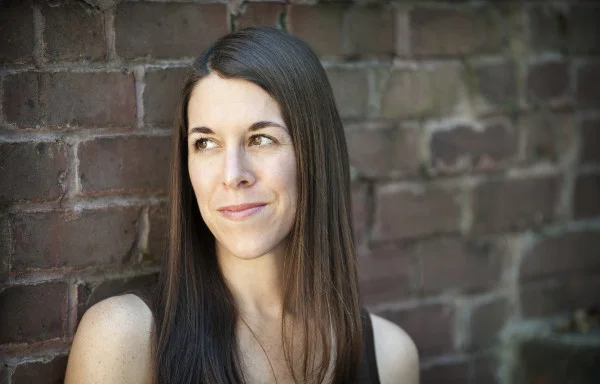
Catherine Pierce talks about her latest book of poems, The Girls of Peculiar, how she uses form to convey urgency, poems that wrestle with identity, and amping up her inner critic. Her collection The Tornado Is the World is forthcoming from Saturnalia Books in Fall 2016.
By Stacey Balkun
“I hesitate to assign poetry one particular job, as there are, of course, amazing poems that succeed by accomplishing all sorts of different things—effecting political or social change, moving or comforting a reader, offering surprise and satisfaction at the level of language, being genuinely funny, rearranging a reader’s brain furniture for an afternoon…”
Stacey Balkun: The Girls of Peculiar begins with a demand: “Give us back that simple guilt,/ that red ache that comes from lying/ to our mothers.” Who is this poem addressing? Who does this collection imagine as its audience? (Is audience even a thing you think about?)
Catherine Pierce: That particular poem is titled “Poem to the Girls We Were,” and I imagine it being spoken from the perspective of women looking back on their younger and—to their minds, now—more dramatic selves. In that poem, the narrators accuse their younger versions of, essentially, not appreciating their self-created drama while they had it. (Later in that section of the book, the younger girls get a chance to rebut their older selves, in “Poem from the Girls We Were.”) It’s a fitting opening poem for the collection, as so much of The Girls of Peculiar deals with questions of identity. Who am I now? Who was I then? What about all the versions in between? And what would happen if those multiple versions could speak with one another?
It would be disingenuous to say that I don’t think about audience at all, because of course I do—I hope that readers will connect with my poems, I hope that editors will see something of merit there. But I didn’t conceive of any particular audience when I was writing the book, and I don’t keep the idea of audience at the forefront of my mind as I’m working on poems. That said, I think a lot of people are interested in, and sometimes consumed by, ideas of identity, and I hope that those people are able to imagine themselves into this book in some way.
SB: Several poems in The Girls of Peculiar take the shape of postcards. What does the form of a postcard mean to you? How is it (or isn't it) poem-like?
CP: I do think postcard messages are inherently poem-like. That small white space requires us to choose only the most relevant or interesting details, forces us into a concision of language not required by letters or emails or even texts. For me, the postcard poems were a way to consider the question of urgency: if someone (here, a future or alternate version of the self) had only a tiny space in which to convey crucial information, what information would she choose?
SB: The poem “A Short Biography of the American People by City” lists several oddly named towns—Dismal, Climax, Peculiar—are these real places? What was your inspiration for this poem, and how did The Girls of Peculiar become the title of this collection?
CP: They are real places! I grew up not too far away from the town of Intercourse, PA, which is only about eight miles from the town of Blue Ball. I always knew those towns and their proximity to each other as a sort of running joke (rest stops in the area sell key chains, mugs, etc., with the local map), but it didn’t occur to me to write a poem about odd place names until I moved to Mississippi, which has a town named Hot Coffee. I started to think about the significance of names, and of how, if the world worked the way it sometimes seems like it should, we’d learn something significant about a place based on its name, and, in knowing that something, maybe have a better sense of where we belong.
The original title of the collection was Someone Already in Flames, from the poem “Fire Blight,” but when I sent the collection to my editor (the brilliant Henry Israeli at Saturnalia Books), he suggested that I look for a title that might be more thematically in line with the book’s focus on, in particular, the constructions of a distinctly female identity. There are a whole lot of “girls” in this book, and I thought that sounded like an apt suggestion. I pulled out a number of possible titles before settling on the one that stuck. Although I don’t know if the poem it’s taken from is actually particularly representative of the collection as a whole, it seemed like the right title for a book about people, many of whom are girls, searching for the place (in themselves, in time, in the world) that feels most like home.
SB: Several of these poems are acts of witness to personal memory, geography, climate change, and the overall shape of the world. Are poems of witness inherently political? What do you think the “job” of poems of witness is—does poetry ever have a “job?”
CP: I hesitate to assign poetry one particular job, as there are, of course, amazing poems that succeed by accomplishing all sorts of different things—effecting political or social change, moving or comforting a reader, offering surprise and satisfaction at the level of language, being genuinely funny, rearranging a reader’s brain furniture for an afternoon… That said, yes, I suppose I would say that poems of witness are inherently political, insofar as they ask readers to engage with and in some way respond to the challenges the poem sets forth.
SB: So much of The Girls of Peculiar deals with self-doubt and guilt (“Dear Self I Might Have Been,” “Train Safety Assembly,” “The Universe is a Madam”). As poets, we all have an inner critic, for better and worse. How do you manage your inner critic? What is your writing process like?
CP: For me, managing the inner critic has been about figuring out when to amp it up and when to tamp it down. The tamping down happens first, when I’m trying to get an initial draft written. I learned a long time ago that the stakes are wonderfully low for early drafting—no one has to see anything I don’t want to show, so I write a lot of junk, trying to get to the good stuff. If a poem feels like it has a spark of something worth stoking but currently isn’t working at all, I’ll see what happens if I try to completely revamp it—I’ll copy and paste into a new document and hack away, cutting lines, moving stanzas, trying to assess in a clear-eyed way what it’s really trying to do and why it isn’t currently doing that. Distance is a key part of this process for me—although I occasionally luck into a one-sitting poem, more often than not I’ll get a draft written one day, return to it the next, return to it again a week after that, and come back until it has the shape I want. I have some poems that I’ve saved for years, reworking them every few months, until they finally get where I want them to be (others, of course, I scrap long before getting to that point).
Once I’ve got a draft that feels like there’s something to it, I try to amp up the inner critic. The strategy I rely on most these days is to read my poems out loud and assess, as honestly as I can, where I get bored. Dullness, for me, is a poetry cardinal sin. I also try to decide—again, as dispassionately as possible—if the stakes of a poem are high enough to be sent out into the world, or if they’re at least rendered high enough (by language, by detail, by the leaps the poem makes, etc.). If not, then it’s back to tamping down the critic and trying again.
SB: Is the “The Tornado Knows Itself” (TNS 7.1) part of a series? What are you working on now?
CP: Yes: my forthcoming collection The Tornado Is the World centers, in part, around an EF-4 tornado that devastates a small Southern town. Poems in the series follow a handful of recurring characters, one of whom is the tornado itself, though the destruction and its aftermath. This series makes up the core of the book, though there are a number of other poems in the manuscript that don’t directly connect to that narrative but still share some similar themes. The Tornado Is the World will published by Saturnalia Books in the fall of 2016.

Walking hard on a stone beach, both of us
(as we joked) literally around the bend,
we came to where once upon a time a cliff
collapsed-- the wreckage of what had been
a cottage with a view
Read More
Spent bullets sparkle on streets grimy with the thud of winter.
Knives bulge odd angles in children’s pockets, and any one
of their upturned words could bring us another you.
Read More
Cartwright’s history in bands is vast and eclectic, a testament to his tireless energy, his craftsman’s work ethic, and his love of playing live and with others.
Read More
June awakens to an echo. The farmhouse and surrounding woods are swathed in darkness punctured only by pinhole stars. What was that sound? It might have been a dream, or the house settling, or a loon in the swamp beyond the woods. The loons scream like women. Their screams shiver and die on the wind. What if someone were dying out there? The sheet has twisted around her legs, and when she peels it from her nightgown, static sparks against her skin. What if someone were dying, and she just pulled her covers over her head?
Read More
In that full second before flight finds stillness, before head fills with quarters and lungs stretch with dirt and blood, before bone tips split skin, before windshield splinters into stars and car completes its first rotation is everything physics needs to prove: a body in motion will remain in motion unless acted upon by the gravity of youth; only matter can’t be created or destroyed.
Read More
Constant state of what. Word for word for what.
what wounded. Thirst of what, tending the fires of what.
Read More
The first two words I could recognize were LUCKY and STRIKE. My grandfather always had the cigarettes in his front shirt-pocket, as if he only bought shirts that came with Lucky Strikes. When he held me against his chest, in his muscled roofer’s arms, I heard the crinkle of the plastic-coated package in his pocket. After he died of lung cancer when I was twenty-two, I bought one of the familiar white packs, with its bold red circle and black letters. I kept it close in my bedside table that summer. Some nights, I reached into the shallow drawer to crinkle the unopened cellophane package.
Read More
Things are not always dead. Dad’s elbow, for instance, I thought I saw it folding in the shallows among the orange tree scraps. Mom dumps them off the end to float the creek.
Read More
Today I had a lunch appointment with my old boyfriend who married someone else. I’d called the meeting because I had a discovery to divulge, but he ended up talking the whole time. Then our hour was up, and he left. I’d been too overwhelmed by the physical fact of him to speak.
Read More
I can't tell why I think the dried corncobs
in the gravel and the mattress under the tree
were not put here by children who bite so fast
they leave rows of kernels.
Read More
OBJECTIVE
An employment opportunity in marketing, business, hotdog sales or funeral operations (anything with health insurance), or the type of thing that might impress an ex, make her think about things
Read More
The first one hopped the fence into the lion pit. We almost thought it was an accident, what with... you’d be amazed at the stunts people pull for photographs. But then we found a note in the guy’s shoe.
Read More
And it darts across the street with the speed
of a rumor’s shadow – a dark and discreet beast
about his size, small configuration of bones
that he is.
Read More

An agave can be many things, its tough gray-green spikes frozen in their waving like the stilled arms of an anemone in the desert’s long-parched sea. The bison of the Aztecs, it proffers its lathering innards as soap, its vicious brown-pointed tips to men as arrowheads or to women as threaded needles ready-made (with a strand of fibers left attached), its deep rubbery layers as condoms, its thinner dry sheets near the surface as paper, and its fibers as the thread for weaving, tough but softening with washing and time.
Read More
In the avocado night, lit green by the avocado light, we wait, suddenly, for the sun to break bright, binding us together in the avocado dawn. In the repetition of our words, of our sounds, of our songs, of our thoughts made from music from our mouths, we love what binds us together.
Read More
Using too many adjectives
is no different than leaving
the price tag
on
a designer sports jacket
you purchased second hand.
Read More