
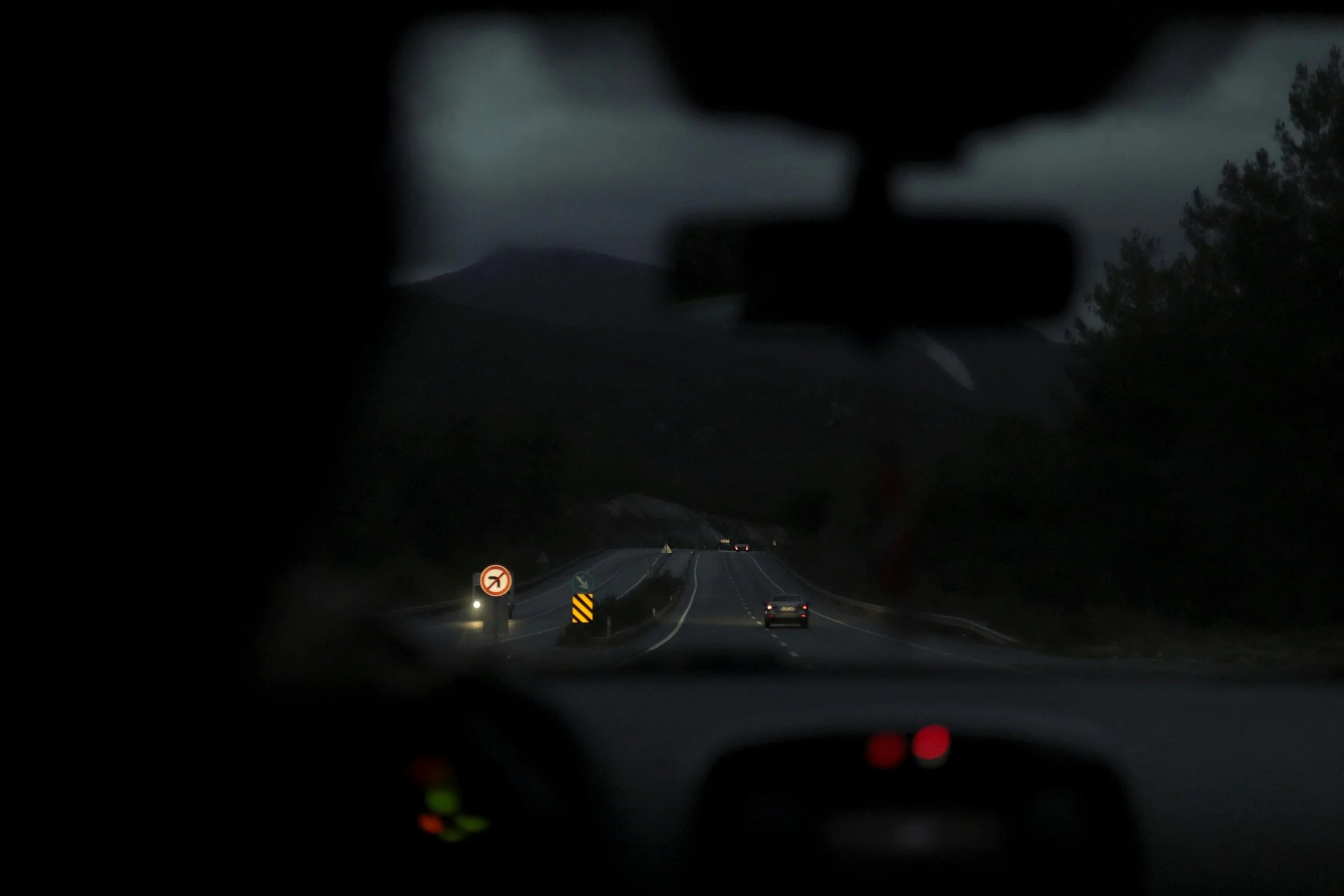
after nothing happened
I chased some wild nights in West Virginia, followed the margins and kept on looking… I didn’t know where you dressed to leave, but I felt the potholes in the road. What did Freud say about two people who don’t want the night to end? On a long car ride back from Maryland, back from Pennsylvania, or a Thursday night back to your apartment, the sweeping thrill hung between us, the boulevard stretched and straightened, the long mountain slopes hacked with angles, until the earth beyond the dash mimicked the questions moving inside us, into the lives where we were people… We swallowed the interviews, all the clean things we save and discard which get in the way, not unlike ordering Champagne or entering that white bedroom we jokingly called our fog in heaven. Then it was quiet, where we were still. How two people sit in a car after one gives the other a ride home—do you know where the story goes after we tell it or where the high notes take flight in the evening? How breathing slows and repeats—the passing headlights, the windshield dotted with rain, each moment, the moment—how waiting becomes so tempting. Again? Before the snowfall… The safety of a parked car is always a running invitation. For a life... More hard looks. The sound of a train’s horn moving through the dark. And then your hands trembling… All of it trapped in the canyon. No wonder it’s called Falling Run. The playful possibilities under a sharp copy of Winter Stars… How we shift our bodies at a party so someone can see us better, our secret nothings, teasing out our wildest dreams, those intangible future narratives. We follow a circle. Some nights hold on… Before the shoes we once wore. Before the world we left behind. Delayed goodbyes over a center console. Radiant confessions in parked cars… Secrets kept. So much pretend on display. Sometimes it was hard to remember what was real and who was counting. Some lists are best when nobody is watching. What did he say? What did she say? A thousand nights dissolve into one memory…The buzzing phone can’t be found on a map. Nothing can. Not even my name in your mouth. What else do I remember… After you returned to the place we never went together, you texted: Hi. So many times, it began like that. So, that’s your bed…? I wish you would. Hi.
after the first day of school
We huddled up in the trailer’s bathroom, and Oscar’s mom passed out cigarettes, saying, Hurry up. We deserve it. At 13 years old, you’d never heard the truth like that. But everything illegal, wrong, and dangerous felt like a special invitation—breaking and entering, vandalism, theft… It’s true: I pumped my bb gun, fired it, and lit a syrup-dipped joint, because nobody handed me a playbook for how to grow up, and so for a long time I didn’t. I’m not proud of that—while my braids were on point, my grades were not… But how else do you remove the soft pink insulation to see the world beyond a trailer park in southern Illinois? I memorized capitals on a map, and for what? I just googled how to spell Pythagorean Theorem, so you know that didn’t pay off. Still, in those days, other parents looked at me like I was Kurt Cobain crashing their kid’s sleepover with a heroin kit tucked in a cigar box. So, it should be no surprise that after my first year of college I sold my textbooks and dropped out, and each night I found myself in service of cheap tricks… Back in the bathroom, though, we lit up. It wasn’t the first time, just the first with someone’s mother. Later, the stars came out… Feral nights… Sharper inventories… When that fire crackled, I squinted and smoke curled around all the juicy secrets I begged life for. I’ve always struggled to find the right words at any given moment, and when I was younger, it was no different. I puffed that square until Oscar’s mom said, I know he’s smoked before because he’s French inhaling. Finally, when all eyes were on me, with two plumes of smoke pouring from my nose like a damn bull, I smiled like the little shit I was, because I hadn’t learned yet, the realest thing I could ever say was help.
after the strip in carbondale
The air is thick with dreams… I want to tell these people to listen: there will always be a moon or a horse or a mural if that’s what you want. I want to tell these people: forget the ones who spend their time hiding from you. I want to tell these people: whatever you need is out there, but you don’t need their bullshit. I want to tell these people: the secrets we earn are sometimes different from the ones we can’t forget. I want to tell them: home is a ghost you’ll never shake. None of us do. We float on by. And when we think about it, sometimes it’s too much. I want to tell all of you: it starts out with the fear of leaving, followed by the hope of it. I want to tell you: there’s a shape to life, although we don’t see it at first. It’s in the way some people smile with their eyes. I swear they could make every star break apart at once. And the life we imagine and the life that happens, it’s within reach. You can find it in that brief millisecond of time, between a hand and a tossed apron landing in a basket before going out on Friday night. If you’re open to it, you’ll find it elsewhere, too—in the wind rearranging itself into a slow, unfurling sky that asks for nothing but attention. Other times, I find it late at night… When I wake from a dream to the sound of gunfire and reach across the bed to touch my girlfriend’s back. And I know there’s a humdrum quality to the ordinary life we live. I know this. Still, the branches reach across the window pane, and dance like fingers playing keys on the blinds. Sometimes, other times, I crack open the window to hold the sky near me, anyway I can. And when I return to bed to name the world, all that we’ve inherited, it goes something like this: ice on the flowers in the garden, tomorrow’s grind and hustle, the sprinkler spitting joy on neighborhood kids, and the rest of us holding and unfolding a map to two distinct worlds: the soft edges of everything that used to be, everything we once knew, all that does and does not need fixed… We aim so high: after a while, we forget we’re already living what used to be our dream.
after domingo
You can’t trust memory, not any more than Stockholm Syndrome, pharmaceuticals, the version of yourself you tell at parties. But this is how it happened: on a sidewalk between sodium lamps, half-lit, buzzing, flickering in and out… I was in a parking lot, selling a pair of electrician’s pliers, a flashlight, breaking a hundred-dollar bill into something manageable. Domingo was talking: a rough childhood, sour friendships, a supercharged backhoe, his ex-wife, a 40-volt battery-powered auger, an offer to help build my fence—tools are more reliable than people—and last, his grown children. I hear what he’s saying. Life is not simple. We all got here through a series of bandages and jokes, through the quiet, shattering spectrum between how we project ourselves in public and how we protect ourselves in private. So, we tweak the past, alter the narrative, inflate it to mythic proportions, because that’s how it feels. And how it feels is sometimes more real than what actually happened. So maybe this is what it means to search the nighttime sky for falling stars, and manage, against the odds, to find one or two. But what do we have to show for it? Two thumbs, retirement accounts, Facebook Marketplace. What we don’t have—what we never have enough of—are people who love us, people who count us in their small, unshakable circles. The real thing. The way headlights split the dark, stretch and disappear, illuminate far-off towns and distant places—the way day swallows night, like it always does, like it always will. Back in the parking lot, in that part of town that feels borrowed, someone says he was a preacher’s kid, another a pool hustler, another hocked meat at a deli until he figured out salvation doesn’t fall under a warranty. And I nod, because I get it. We’re all searching for a way to feel less lost. Someone hands me a business card that smells like burnt paper. I flip it over. The numbers shift in the light, as if they’re waiting to be dialed. At the top, it says something about faith or trust, what awaits tomorrow… I take it, slip it into my pocket. Later, across from a gas station, a woman with my mother’s face leans against the levee, staring at her bottle like it owes her something. Maybe it does. I think about asking where she’s been, where she’s going next, but I already know. She’ll be right here, waiting for an answer that never comes. Some nights, I swear I’m still walking home—through back roads slick with rain, through bars where nobody looks up, through the hands of a woman who never knew my name, through the hum of a radio station playing static and songs about escape until morning comes, soft and inevitable. The sky turns a peach color that makes me believe: I could get in the car, just drive.
Bryce Berkowitz is the author of the collection Bermuda Ferris Wheel, recipient of the AMC TV Pilot Award at the Austin Film Festival, and Co-Director of the MFA Creative Writing program at Butler University. His writing has appeared in Best New Poets, The Sewanee Review, The Missouri Review, and other publications. Find him at: www.bryceberkowitz.com
Photo credit: Sami Aksu