
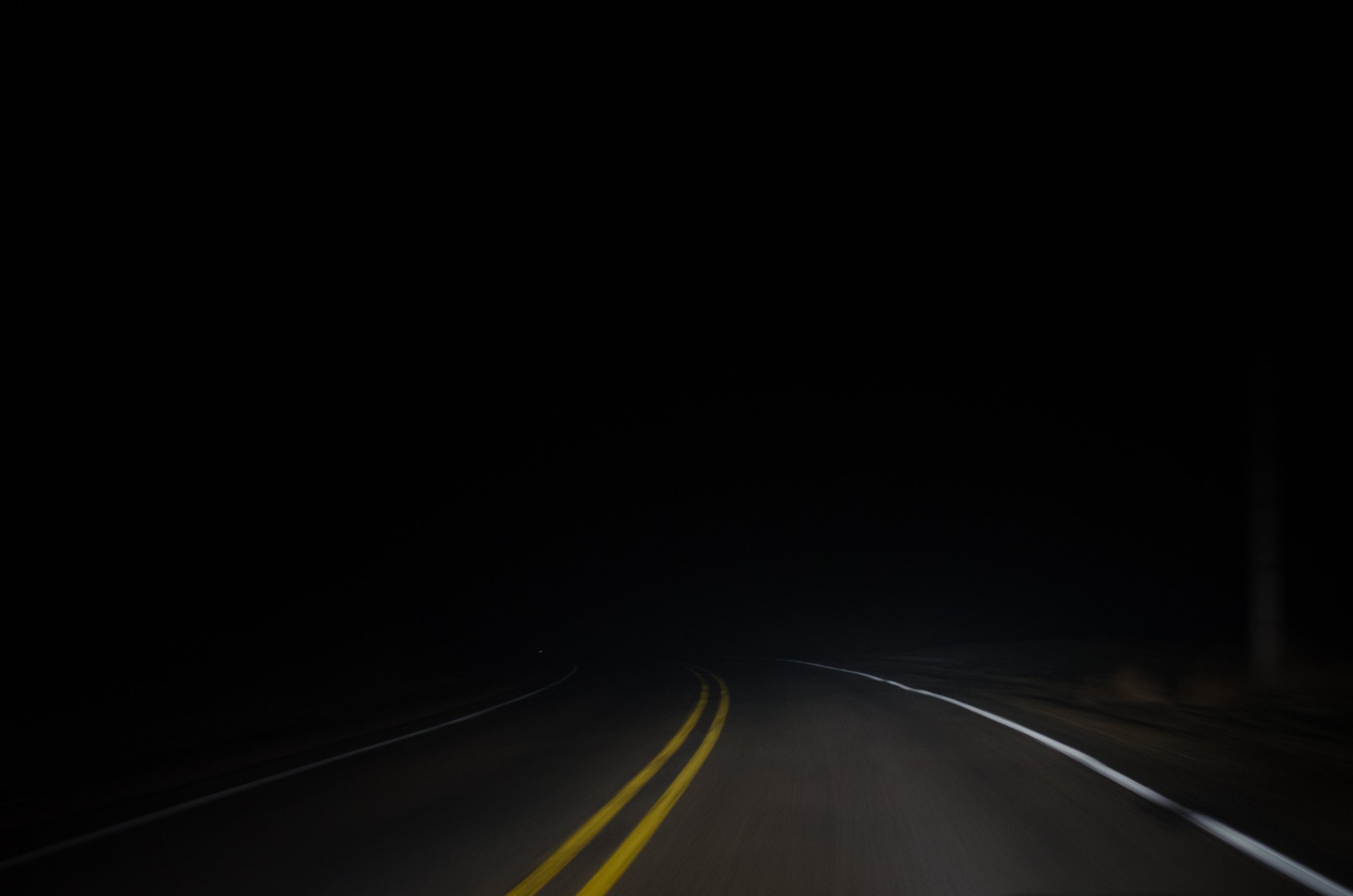
Sound is a huge influence on peoples’ attention, Walter Murch
The songs begin, dwell, or end up in the dark: inside the songwriter, on the ceiling at 3 am, in the vastness outside of his window. “If there’s a theme that runs through the record, it’s the thin line between stability and that moment when time stops and everything goes to black, when the things that connect you to your world—your job, your family, friends, your faith, the love and grace in your heart—fail you… I thought of John Lee Hooker and Robert Johnson—records that sounded so good with the lights out.”
That’s Bruce Springsteen in Songs, his essential 1998 book about where his music starts and where it goes. Here he’s reflecting on the songs on his album Nebraska, released in 1982 between The River (1980) and Born in the U.S.A. (1984). Last October, Springsteen released Nebraska ‘82, an expanded edition of the album featuring demos, live tracks, and the ill-fated, pre-Born in the U.S.A. attempts by the E Street Band to record Nebraska’s songs in full band arrangements; also that month, director Scott Cooper released his feature length film Springsteen: Deliver Me from Nowhere, a biographical musical drama adapted from Springsteen’s 2026 memoir and Warren Zanes’s ‘23 book about the process of Nebraska coming together during a fraught period in Springsteen’s personal life.
Four decades after its release, Nebraska’s having a moment, but that’s not why I’m writing this. I want to go back to the dark.
He’s driving on the Jersey Turnpike, out past the refineries. It’s been raining. When he pleads with the cop—“Mister State Trooper,” he begs, “please don't stop me / please don't stop me / please don’ t stop me”—we don’t really know where we are. But we know that the driver’s fucked; he’s got neither a driver’s license nor a vehicle registration, and his head’s hazy from the hypnosis of the endless radio towers, the talk shows on the radio trying his patience. Who knows what he’s running from, or if he’s running away at all—he says that he’s got a clear conscience about what he’s done, yet he’s on his “last prayer.” He needs deliverance.
The conversation’s in his head, or he’s saying this part out loud. Maybe the cop’s about to pull him over, maybe the singer’s imagining the whole thing, triggered by a police car going in the other direction. On Nebraska, Springsteen wanted us to “hear the characters think, to get inside their heads, so you could hear and feel their thoughts, their choices.” Though “State Trooper” is acoustic—like each of the ten songs on Nebraska, recorded by Springsteen in his bedroom in his home in Colts Neck, New Jersey, perched on his bed with an acoustic guitar, singing into a rudimentary four-track tape machine—it rocks hard and desperate. These songs were “narrative, restrained, linear, and musically minimal,” Springsteen said. “Yet their depiction of characters out on the edge contextualized them as rock and roll.”
The song ends with a whoo hoo whoo!, a hi ho, silver, oh!, and a plea for anyone, anything, to get the singer from nowhere to somewhere. Springsteen’s whoops and cries at the song’s close are harshly recorded—you can practically see the needles on his TEAC Portastudio pushing into the red—and graphically translate the singer’s aguish, pushing the song into a different place, with only seconds remaining, that dark horizon endlessly expanding.
Alan Vega was a Brooklyn-bred visual artist who banged around Manhattan in the 1960s and ‘70s, driven by an impulse to make art. A proto punk, he assembled street castoffs, junk, and debris into aggressively loud artworks, blending sonic and cultural noises. In 1970, he met Martin “Rev” Reverby via the Art Workers’ Coalition, an activist visual arts organization. Eventually, the two would form Suicide, an experimental and confrontational electronic noise outfit; in its most recognizable form, Rev, lurking behind bug-eyed shades, played a Farfisa organ, synthesizers, and a primitive drum machine, while Vega was out front, moaning, yelping, hollering, whispering, banging a motorcycle drive chain on the stage and sometimes on the tops of patrons’ tables. A wholly original outfit, Suicide haunted the Lower East Side during the Street Rock revolution of the mid- and late-‘70s, screeching mongrel, proto-industrial/electronic songs, cultivating and encouraging divisive reactions from crowds, sometimes locking the doors of the venues they were playing to trap everyone inside of the dark noise they made.
Suicide released its challenging debut album, co-produced by Craig Leon and Marty Thau, on Red Star Records, in 1977. The second side of Suicide opens with “Frankie Teardrop,” a ten and a half minute cinematic-narrative song about a young, impoverished man who’s burdened with a shitty factory job, a hungry family, and a looming house eviction. One night, he grabs a gun, and, in a scene that’s difficult to imagine yet given full voice in the song, shoots and kills his infant son, wife, and himself. Based on a newspaper account that Vega had read, and essentially improvised in the studio, “Frankie Teardrop” skirts with melodrama, but is finally so horrific and so graphically rendered that it ends up a genuine nightmare, its tones evoking rural, small town Gothic horror filtered through spacey reverb effects, grimed-up with Lower East Side punk nerve.
Vega’s commitment to darkness makes the song nearly impossible to listen to: we hear—from the inside—the boy’s shrieks of anguish and guilt and hatred as he slaughters his family. I’m forever grateful that some bully didn’t grab me when I was twelve years old and force me to listen to it; the horrors would’ve settled in my DNA. In 31 Songs, Nick Hornby wrote that, though “Frankie Teardrop” is “in all sorts of ways an extraordinary piece of work,” he has no use for the song anymore; “I listened to it once upon a time, when I was in my twenties and my life was different, but I probably haven’t played it for a good fifteen years, and I doubt whether I’ll ever play it again.” He dismissed the song as a shock-art con job. I can’t agree. Vega’s embodiment of the young man is so visceral that it requires we see the world from that man’s perverted perspective, a perspective as real, and, so, as meaningful, as any. “We’re all Frankies, we’re all lyin’ in hell,” Vega demands at the end, a notion that felt debatable at the start of the song, grimly possible by the end.
But who wants to face that? Who wanted to listen to “Frankie Teardrop” more than once? Springsteen did. “One of the most amazing songs I ever heard,” he remarked in Rolling Stone in 1984.
The yelps at the close of “State Trooper” are spiritual cousins to Frankie’s shrieks, one yay-saying, the other negating. Strange stuff can happen in the dark, where things collide surprisingly before your eyes can adjust. I’ve long wondered on the intersection of Bruce Springsteen and Suicide, because it seems unlikely on the surface. In the conventional telling, Suicide's sound and theatrical approach originate in noise, experimental, electronic, New York/No Wave punk, and avant-garde songwriting, Springsteen’s in formalist, ‘50s, blues-based, hook-filled, heartland guitar rock songwriting—that’s a pretty wide interval of aesthetics and influences. Suicide was a commercial bust, Springsteen a mammoth success. The New York/New Jersey stage-and-studios turf that Vega, Rev, and Springsteen worked made it likely that the three musicians would at some point run into each other, yet it happened only on rare occasions.
In 2020, Andi Coulter wrote Suicide for the 33 1/3 book series. “The influence of Suicide on Springsteen is more varied and longer-lasting than most people know,” she remarked to me. The musicians “were likely aware of the other. In the 1970s, both bands recorded albums at 914, a recording studio on the New Jersey line, about halfway between both bands’ sonic geography.”
When Suicide was working on their second album with producer Ric Ocasek in 1979 and ‘80, Springsteen was recording next door. “Rev recalls Springsteen coming over on occasion to tell them how much he liked their debut album, especially ‘Frankie Teardrop’,” Coulter said. “Bruce and Alan got along so swimmingly that Alan would sneak Bruce out of his studio into the bathroom for a nip of alcohol, away from the prying eyes of his label. Both musicians shared a love of Hank Williams, Gene Vincent, and Elvis Presley. There always seemed to be a fraternal quality to the relationship between Alan and Bruce, as if the elder electro-pioneer felt protective of the New Jersey native, acting as a guide by exposing him to new sounds and scenes.”
Caryn Rose, who has written extensively about Springsteen for many years, reminds us that Springsteen considered those tracks he was cutting in his New Jersey bedroom as simply demos, songs awaiting band arrangements and the sometimes surprising, unpredictable changes that can happen in that process. “He never had any intention of releasing that demo, and so the way it sounds on record doesn’t necessarily mean he heard the Suicide record and borrowed from it,” she remarked to me. “The minimalist arrangements that he worked up with the E Street Band for what was gonna be ‘electric Nebraska’ owe more to the Tennessee Three than anything else.” She added, “I always felt that what he liked about Suicide is that it was so far removed from anything he knew how to do, his brain didn’t work that way, but that doesn’t mean that he couldn’t recognize genius when he saw it.” “I think Springsteen made Nebraska almost as an unconscious companion piece to Suicide,” Coulter said. “The narrative structure is a double helix, genetically linking the two albums through songs that reflect one another. While on the surface these bands sound sonically worlds apart, there is a clear throughline in subject matter.”
“The real overlap lies in their idiosyncratic approach to instrumentation,” Coulter added, pointing to “a primitivism” in both artists, “Suicide finding intensity and Springsteen finding authenticity in their stripped-down sound.” Springsteen once observed that “If Elvis came back from the dead, I think he would sound like Alan Vega.” Rose feels that Presley is the crucial link between Springsteen and Vega, “how Alan interpreted that and how Bruce saw him in that.”
I asked Marty Rev for his thoughts on the sonic and spiritual kinship between “State Trooper” and “Frankie Teardrop.” “I hear the fact that Suicide’s sound was heard, adapted, and assimilated into another perspective,” he said. “There’s a resemblance to Alan’s vocal style and my approach to a repetitive bass line,” but, he added, “those aspects are all on the surface. It’s what’s inside those approaches that is the essence.” If there’s an intersection between his old band and Springsteen, “it might be the musical tastes of the artists involved and their influences in terms of growing up with rock and roll, as well as other music. In this case, possibly also common inclination to recognize the alienation and tragedies often inherent in working class life.” Springsteen wrote about cold-blooded serial killers and down-on-their-luck murderers on Nebraska, his characters inhabiting the same brutal space as Frankie Teardrop.
Scott Cooper allegedly described Springsteen: Deliver Me from Nowhere as an “anti-biopic,” yet his film traffics in the expected. Jeremy Allen White as Springsteen and Jeremy Strong as Springsteen’s manager Jon Landau rarely move out of Brooding Mode (there’s nary a sliver of joy in creating music) and the relationships among Springsteen’s unhappy childhood, spiritual restlessness, depression, commitment to his art, literary influences and his Nebraska-era angst are made clear and unmissable, in the Cause-and-Effect clarity unfortunately common to the genre. Yet, though the film flirts with melodrama, it ultimately tells a sobering story convincingly. And is faithful to the biographical facts, if Springsteen himself is to be believed.
Deliver Me from Nowhere does make the Springsteen/Suicide connection explicit, however. In one scene, Springsteen cranks a tape of “Frankie Teardrop” in his car as he drives on a two-lane rural road at night, speeding recklessly and surviving a harrowing spin out. Later, we see him in his home at Colts Neck, lying on his back, playing Suicide, entranced by the darkness and violence in the song.
In the mid 2000s, Springsteen paid a more specific tribute. He covered Suicide’s “Dream Baby Dream,” a Vega and Rev song produced by Ocasek and released by Island Records as a single in 1979. Essentially an angular, synth-pop pep talk (“Keep them dreams burnin’, oh baby / Keep them dreams burnin’, oh forever”) the song’s cheery and optimistic sentiment rubs up perversely against Rev’s tinker-toy keyboards and cheap drum machine, and the fact that Vega, nervy, audibly smirking, sounds uncannily like Lou Reed. (There were secret handshakes all around during this era: Springsteen made an uncredited spoken word appearance on Reed’s Street Hassle album in 1978.) When Suicide’s second album was reissued in 2000, Billboard described “Dream Baby Dream” as “hallucinatory,” apt for a song that conjures a spell out of an unlikely brew.
Allegedly, R.E.M.’s Michael Stipe turned Springsteen on to “Dream Baby Dream,” and Springsteen, feeling kinship with the song, began playing it to close down shows on his 2005 Devils and Dust acoustic tour, often extending it to ten minutes or more, the phrases “open up your heart,” “we gotta keep on dreaming,” and “I just want to see you smile” repeated into the venues’ darkness, reducing want and desire to bedrock. At the time, Springsteen remarked that “Dream Baby Dream” was “an interesting song at the end of [a concert], because the night is so filled with dense lyrical imagery that the nice thing is when the night ends, it ends on just three or four phrases, you know, that just sort of repeat, like an incantation, or a chant, or it’s like a trance feeling. So everything gets, at the last song, very, very simple.”
Asked by the interviewer about his own dreams, Springsteen chuckled, gazed down, and then slipped in to the troubadour persona that he’s believed in for so many years. “It’s human nature to want to look over the rise and over the next hill and see what's there,” he said. “I look at myself as like I’m sort of a spiritual adventurer, you know, with the pack on his back. And I just keep heading over the next hill to see what's there, to see who I find, and what I find out about myself, and what I find out about the world I live in and the audience that I have. And really my ambition is just to make it over the next hill. And that’s what I try, that’s what I hope my music helps people do. Just get up and make it over the next hill every day. And it’s just ‘dream, baby, dream.’ That’s it, you know. That’s why, at the end of the night, that’s all there is to say. You got to kind of just keep putting one foot in front of the other and see what the next day brings.”
Springsteen carried “Dream Baby Dream” in that pack on his back for years, weaving spells with it in public, finally recording a version for his album High Hopes, released in 2014. His vocal lacks Vega’s devilish irony (I don’t know that Springsteen really “does” irony; his earnestness is too strong an antidote) and instead offers, in the singer’s sixty-fourth year of spiritual adventuring, a depth and a weariness that touches on wisdom and gratitude. Springsteen sings tenderly, grateful that these words and this simple melody exist; his singing on lines like “we gotta keep the fire burning” feels airlifted from any number of his own songs. Recording in Los Angeles with producer Ron Aniello, Springsteen plays a mandolin, synthesizer, piano, and a harmonium, moving elegantly around a few chords, erecting a sturdy song in nearly transparent layers. (Onstage, he’d play it on an old pump organ.) The tune never modulates, and yet it ascends, Springsteen by the close reaching toward the top of his register, Aniello and Tom Morello layering in guitars, the New York Chamber Consort Strings, choral voices, and horns adding restrained drama. Aniello’s percussion loops turn a ghostly quiet, solitary, Nebraska-like prayer into a light jog up that hill, the pack heavy yet growing lighter.
About playing “Dream Baby Dream” live, Springsteen said that the song’s appeal lies in it containing “most of the ideas that I sing about the rest of the night in just those few phrases,” adding, “It's a lovely piece of music.” Around the time Springsteen began covering “Dream Baby Dream,” Rose asked Vega in Backstreets magazine for his reaction. “This is the first time this has ever happened to me,” Vega enthused. “A lot of bands have done my stuff, Suicide stuff, and they basically try and copy and do it the way that you do it. Thank god, finally somebody did their version of it. He interpreted my song, he did it his way.”
I was driving across the Brooklyn Bridge one afternoon in the early ‘00s, heading into Manhattan. As I approached the span’s midpoint, Suicide’s “Rocket U.S.A.” came up on shuffle. At first it was difficult to make out the electronic buzzing of the opening moments, Rev’s synth line and insistent drum machine beat indistinguishable from the noise of the car and the road. And then Vega’s jittery, breathy vocals materialize right next to me, hot on my neck, and Rev’s playing becomes a heartbeat, and then a rapid heartbeat. Rocket rocket U.S.A., shooting on down, I’m on my way. I’m already apprehensive about driving over a body of water when Vega grabs my elbow and whispers to me that we’re riding around in a killer's car, it’s nineteen hundred seventy seven, whole country is doing a fix, it’s doomsday, doomsday. The bridge is sturdy beneath my wheels, yet I wasn’t prepared to be behind the wheel of a runaway car, Rev’s keyboards and percussion a smooth glide down into terror, to look up and imagine the streets between the brown buildings pockmarking FDR Drive as my getaway lanes. Then: a three-note keyboard sequence that sounds like a peculiarly cheery theme to a sideshow circus tent. Vega gasps. There’s no turning back for me now, literally. The East River moves implacably below and I’m stuck inside Suicide’s joyride, forced to listen to a speed freak playing with mortality like a toy, or a man’s final moments before he crashes. The song’s over in four minutes, yet because it’s essentially a drone on top of which, with heavy reverb, Vega moans, whispers, and shrieks, moving between joy and despair, it feels as if it never starts and will never end.
Alan Vega died in July 2016. Soon after, Springsteen posted on Facebook, praising “one of the great revolutionary voices in rock and roll. The bravery and passion he showed throughout his career was deeply influential to me. I was lucky enough to get to know Alan slightly and he was always a generous and sweet spirit. The blunt force power of his greatest music both with Suicide and on his solo records can still shock and inspire today. There was simply no one else remotely like him.”
I’m amazed that Springsteen never covered “Rocket U.S.A..” Not only is it a great driving song, but its dark tones—fearful and edgy—and the stoic reckoning with death and emptiness (“speeding down the skyway / 100 miles per hour / gonna crash / gonna die / ooh yeah / and I don’t care”) echo much of the desperation and bleakness on Nebraska, and in many of Springsteen’s songs in his five-decades long career. (Springsteen: “I wanted the blood on [Nebraska] to feel destined and fateful.”) “I don’t think it’s as anodyne as ‘Bruce heard the Suicide record’—which was hard to find even if you lived in NYC!—‘and it influenced him’,” Rose observed. “I don’t think it didn't influence him, but this was still a guy trying to be successful and have hits and he’s smart enough to know that wasn’t where he should go.”
Yet I hear a strong spiritual kinship between “Rocket U.S.A.” and Springsteen’s Nebraska songs (especially “Johnny 99”). Vega and Rev’s grainy and jittery mini film tells the story of a guy riding around in a car that’s likely to fly off into a building if not off of the Skyway first; he’s recklessly escaping a crime, probably, or anyway a place of desolation, and what he’s driving toward is salvation and freedom, the same journey that Springsteen narrates in countless of his own songs. Vega moans the phrases “riding high,” “riding around with my babe,” “riding around in my Chevy ’69,” and he could’ve lifted them from Springsteen’s notebook. (The Fleshtones, a fellow East Village/Lower East Side band, co-recorded a version of “Rocket U.S.A.” in 1978 with Vega doing his spidery lead vocal and Fleshtones front man Peter Zaremba providing some rootsy, Springsteen-like harmonica. At the time, Zaremba remarked that Suicide “is the only group I know that is actually louder between songs.”)
Perhaps, ultimately, “Rocket U.S.A.” is too ugly or dark, something that Springsteen could only ricochet off of into his own like concerns, yet someday I’d love to hear his take on the song, how he’d arrange it, maybe make it bleakly pretty, redemptive even, find himself and his characters inside of it, make it his and also Suicide’s, but ours, too.
Joe Bonomo's most recent books are Play This Book Loud: Noisy Essays, No Place I Would Rather Be: Roger Angell and A Life in Baseball Writing and Field Recordings from the Inside: Essays. Find him online at No Such Thing As Was and on Instagram at @__bonomo__.
Photo by: Joe Bonomo