
The headscarf-wearing nurse is holding upright in the palm of her hand what looks like a dildo, a transparent eight- or nine-inch-long cylinder with a rounded tip slathered with what appears to be Vaseline. I am seconds away from this torpedo-like object being inserted into my body. Judging from the nurse’s bored expression, you wouldn’t guess something so drastic was about to happen. For all the gravity she displays, she might be a hand model for a medical supply company. Meanwhile, the urologist performing my biopsy, a tall, balding man in his fifties, is explaining what he is about to do to me. Just before he came into the room, the nurse injected me in the arm and the buttocks, then instructed me to remove my pants and underwear and draped a large sheet of white paper around my waist.
I am sitting on a low bed in my paper skirt, trying to focus on what the doctor is saying, hung up on the part about his need to numb the area in question, which he compares to a dentist numbing a patient with Novocain. Since that shot of Novocain is often what I dread most about going to the dentist, I am not reassured. The urologist tells me to lie down on my side, face the wall, and pull my knees into my chest. I’m fetal.
He lifts the paper, urges me to relax, and inserts what he says is only two inches of the cylinder. It might as well be the entire eight or nine, considering the discomfort. Then I feel a prick: the numbing agent. My dentist always waits five or ten minutes after giving me Novocain before beginning to drill. There is no hiatus here.
The doctor proceeds to extract the first of twelve tiny tissue samples from my prostate, each of which feels like a bee sting. The bee sting sensation is accompanied by a very loud noise, which sounds like a fist coming down hard on a stapler. This occurs again and again, the nearly simultaneous plucking of my tender flesh and the blast in my ears. It’s harrowing. Bearable, but just.
We’re at least half way home—I have lost count, though there can’t be too many more—when the comparatively gentle sting of the doctor’s needle takes on the thrust of an ice pick. My body spasms. I cry out. This elicits from the doctor an apology (“Sorry”) and a commiserating pat on my bare thigh.
At last it’s over. The doctor, peeling off his gloves and dropping them into a waste bin, hurries off to his next patient. I am dizzy when I sit up. The nurse has me lie back down and takes my blood pressure. She can’t let me leave until it falls below a certain level, she explains. I can’t help but partially blame her for what just transpired, for what felt like a surprise attack, an ambush. Why hadn’t she said something before the doctor came in? Why hadn’t she warned me? Maybe it’s the headscarf. Maybe I expect more from the religiously affiliated.
“Did someone bring you?” she asks after removing the cuff from my arm. My blood pressure is still a little high, but she has decided I can go. I tell her no, I’ll be fine, thinking, finally, a bit of caring: she’s worried about me driving myself home. Or is this just protocol? Whatever the case, does it matter? Should it matter?
Around the time everyone started calling me “Sir”—my mid-century mark—I began to experience some of the usual symptoms of bodily decline: kidney stones, sciatica, atrial fibrillation, hair loss, hearing loss, vision loss, tooth loss, and now, perhaps, cancer.
All of these ailments required medical attention—doctors’ appointments, tests of all sorts, hospital stays. Growing up, I was often ill. My parents were forever taking me to doctors for the flu, measles, mumps, croup, constipation, bad colds—and to hospitals for my tonsils, adenoids, an undescended testicle, and a hernia.
After nearly four decades of good health, I am once again being submitted to frequent medical attention. With this vital difference: it is not going to let up. The uninterrupted march of the healthcare professionals has begun.
I don’t hear from my urologist until two weeks after the biopsy, an entire week longer than he said he’d call with my diagnosis. The receptionist I talked to at the end of the first week tells me the doctor has just left on vacation. It so happens that I have just returned from vacation. Two ships in the night. I don’t say this to the receptionist, but couldn’t the good doctor have left a number where I could reach him in Cancun or wherever?
It’s the morning of July 13 when I finally take his call on my landline phone. He begins the conversation with, “Unfortunately…,” so it’s not good. He’s telling me that I have “intermediate-risk prostate cancer” when we’re suddenly disconnected. I hang up and wait for him to call back, which he does, immediately. I can hear in his voice a smidgen of residual panic as he jokes about me jumping out a window. I take some pleasure in his discomfiture.
After he schedules an appointment to discuss treatment options, he makes a kind of apology for the delay in sharing this disappointing news, explaining that he tried twice to call me before he left on vacation. I have no doubt he did, but what this says to me is that more important than my worrying about an extra six or seven days that I might have inoperable cancer, that I might have only months to live, is his enjoying a solid week of patient-free vacationing.
I am shocked by the news, though not surprised. So many people close to me have had cancer my sister (breast) and my oldest friend (also prostate), my father (bladder). But it is a blow. I take heart from the fact that my cancer is only stage one or two, that it is not just treatable, my urologist assures me a few days later when he is going over treatment options—surgery or radiation—but curable.
He likes to tell his patients bad jokes to reduce the tension, and every few minutes gets off a real groaner. “A horse walks into a bar. The bartender says ‘Hey.’ The horse says ‘Sure.’” I give him credit for trying to lighten the mood, and it almost does. At the end of the forty-five minutes, I put to him the obvious question. “What would you do?”
“At sixty-five?” he says. “Surgery.”
The following week, I meet with the surgeon who will perform my operation.
He’s young and handsome, with a martial air, clipped and confident. Crossing his arms in his clean, crisply- pressed lab coat, he informs me, as if I might be holding his youth against him, that he has performed “thousands” of Da Vinci robotic prostatectomies.
It’s an improvement, he tells me, on the old laparoscopic procedure, with a shorter recovery period, less blood loss, and minimal scarring. Instead of cutting into the abdomen to reach the prostate, the surgeon uses finely controlled robotic instruments to perform the operation.
(Later that day, I find an on-line video of the procedure, tiny robotic arms inserted into the abdomen and manipulated by the surgeon who cuts away layers of tissue before reaching the walnut-sized organ with pincers that slice and dice it before pulling the prostate out piece by piece through the navel.)
I have no trouble believing this man’s hands will remain steady throughout the surgery. Nevertheless, I ask him how many of these surgeries he performs a week, wanting assurance that he hasn’t gotten rusty, that he hasn’t gone too long between prostatectomies. Two or three, he says. I’m assured. I’m reassured. Hell, I’m gladdened.
But something is still bothering me, and I think I know what that is. It’s the surgeon’s professionalism: his practiced delivery, his smooth demeanor.
He’s done thousands of prostatectomies, which means he’s done thousands of these pre-surgery confabs. And it shows. I feel the rote quality of it. I hear the scripted lines.
I have this spiteful thought: I may not be young anymore, I may be the one with cancer, but give it twenty or so years, and, considering that one in five men gets prostate cancer, you, Mr. Surgeon, could find yourself where I am now.
We may be at different stages in our health and in our lives, but we’re in this together.
Friends drive me to the hospital the morning of my surgery. As happy as I am that I only have stage one or two cancer, I worry about the possibility that they’ll find it’s worse than the biopsy indicated (three or four) and/or that it has spread to other organs; to use the medical term, that I will not have “clear margins.”
I’ve read several online accounts of patients who are victims of the dread false-negative. Biopsies are prone to a false-negative rate that ranges from 10 to 20 percent. You go into surgery thinking you’re fortunate they caught it early, and wake up to some really bad news.
The only way to know for sure what’s what with prostate cancer is to get in there and look around. There can come a point in internet searching when you wish you’d never started.
I proceed to the Short Stay Wing of the hospital, where I am asked to step into a room, remove all my clothes, and get into the hospital gown laid out for me on the bed. In addition to the gown, I don tight-fitting hose that go up to my knees to prevent blood clots and what resembles a shower cap.
As instructed, I have not had food or drink since midnight (not even water). When the woman overseeing this part of my prep asks whether I have abided by these strictures, I confess that I took half a tab of Klonopin to help me sleep.
“You what?” She does not use these words, but her attitude says as much.
I have yanked her out of what is typically an unvarying routine. She leaves the room to consult with someone (a nurse? my surgeon? hospital security?) about this violation of pre-op protocol.
I am alone in my granny outfit, faced with the unthinkable possibility that I might have to do this all over again—the fasting, the sleeplessness, the tamping down of fear and panic necessary to maintain a certain dignity before major surgery, the pretending that this is business as usual for people for whom this is business as usual.
I don’t feel like I could do it all again, though, of course, I could, and I will if I have to. The woman never returns. Only when a young orderly enters the room, pushing a gurney, eases me onto it and rolls me into the corridor, do I understand I’ve been given the okay.
The orderly takes me to a large room with other patients awaiting surgery. A middle-aged nurse attaches an IV to my arm; actually, two, in case the other fails, she tells me. As I’m waiting to make my appearance in the operating theater, I spot my urologist out in the hall, chatting with someone at the nurses’ station.
I feel a little hurt that he doesn’t know I’m only a hundred feet away, and I hurry on over. Hasn’t he kept abreast of my case? I wouldn’t expect him to make a special trip to the hospital on my account, but couldn’t he have made a note to himself that one of his patients was going under the knife (knives) the same day he was at the hospital, a patient who might appreciate a surprise visit while being prepared for surgery?
I could use a joke right now.
A different orderly rolls me out of the room, down the hall, and through double doors, then left into the OT. The actors are waiting for me, half a dozen nurses and doctors in scrubs, surgical masks, gloves, and skull caps.
Their identical costumes make it difficult to pick out my surgeon. This will be everyone’s second prostatectomy of the morning, I recall. I could have chosen to be operated on at seven, which meant I’d have to be at the hospital by five a.m., clearly an impossibility. Was it also a mistake? Is this like the evening show that follows the matinee? Should I have chosen seven when the cast was fresh and rested?
A prostatectomy lasts between two and three hours, I remember, with no intermission.
Was everyone tired? Had they failed to pace themselves? Had they expended so much of themselves on the previous surgery that their energy is depleted, their finely honed skills eroded?
The orderly slides me off the gurney and onto the surgical bed, my bare buttocks cool against a blue slab of hard plastic.
It has been placed there, I realize, to make it easier to swab up the blood.
I tell myself not to worry. They’ve done this hundreds, no, thousands of times before. But therein lies the danger—the boredom that comes from repetition, the performer’s enthusiasm for his or her role waning to the point of undermining the production’s success.
The anesthesiologist arranges the oxygen mask over my mouth and asks me to breathe deeply.
Break a leg, everyone.
The first thing I do upon regaining consciousness is ask for water. I have a terrific thirst. I don’t remember making this request. What I do remember is sipping ice water through a bendy straw, and my friends, who have generously taken time out of their morning, wishing me well before leaving me with a building full of strangers. For this, I don’t blame them. We all lead busy lives.
I peek under my hospital gown. Most of my pubic and chest hair has been clipped. Several small scabs dot my abdomen. A transparent tube runs from the tip of my penis to a transparent plastic bag at the foot of the bed. Like everyone who has this operation, I’ve been dreading the foreign object inserted into that tiny hole, its endpoint my urethra, where it will reside for a week. And what goes in must come out, an inevitability I try not to think about. For the moment, I’m distracted by the sight of my urine inching toward the slowly filling receptacle.
Later, a well-dressed woman steps into the room and shares with me a preliminary report on my surgery. It’s good news. My margins, she says, seem to be clear. I won’t get the official word, however, until the surgeon releases me tomorrow morning.
I’m very pleased, of course, greatly relieved, and I thank her, but the pleasure I feel is short-lived, replaced by the reality of being hospital-bound.
I skip the light dinner delivered to my room early that evening. With zero appetite, I can’t stomach another bite of gelatin or sip of strained chicken soup, all I was allowed to eat the day before my surgery. Encouraged to walk to prevent blood clots, I have my first ambulatory experience with the catheter. A young nurse helps me out of the bed and onto my feet. I am woozy but soon regain my balance and off I go, holding the urine bag in my left hand as I shuffle up one corridor and down another, the tube tugging at my diminished member. Yes, diminished. Between a quarter and half an inch, I guesstimate. I know from the internet that catheterization causes shrinkage in the penis’s flaccid state. As for its erect state, there won’t be an erect state for one to two years, if then. For me, this is not of paramount concern. I don’t have a relationship about to take a major hit in the bedroom.
Thanks to my hospital stay sixteen months earlier for atrial fibrillation, I am prepared for some of the ordeal to come. As before, rarely do fifteen minutes pass without someone entering the room to take my blood pressure, draw blood, inject me, grill me with questions, empty my urine bag, test this, palpate that, making sleep, or even rest, impossible. Traffic slows somewhat toward midnight when the third-shift staff arrives, two or three young nurses (maybe more) who are indistinguishable, all of them pleasant, pretty, smiling. I think: There was another patient in this bed last night, perhaps another man minus a prostate, and there will be another one in it tomorrow. We too are indistinguishable.
But with this crucial difference: we are undergoing a once-in-a-life-time experience while these healthcare professionals are doing what they always do. For them, it’s just another day at the office, a job with all the routine and the tedium that goes with any job. But we—or at least I—have to admit to wanting more from them than I do my butcher, my baker, my candlestick maker. These doctors and nurses are replacements for those who tended to us at home before the revolution in modern medicine, friends and family members who hovered helplessly over our sick beds with only their succor to offer. Those well-meaning but ineffectual folks have been supplanted by academically- trained pros who work in facilities stocked with the latest, up-to-date medical equipment. We have exchanged the personal for the impersonal, genuine caring for cutting-edge expertise, and reaped the benefits: longer lives, pain reduction, better overall health, and quality of life. It’s a trade-off. But it’s one I find hard to accept. Would it matter so much to me, I wonder, if I didn’t live alone? If I hadn’t resigned myself years ago to being single and unattached? Is it unfair to expect the perks of intimacy—first priority status, exclusive focus, unlimited handholding, literally and figuratively—from these highly skilled life extenders? Is it bad faith on my part? Or is it a foolish old man looking for what he doesn’t have in the wrong places?
I hiccup. It is no ordinary hiccup. It feels like a knuckle being driven into my sternum, pushing me back against the bed. Another soon follows, then another. I hold my breath to stop them, hold it until I can’t hold it any longer, but it’s no use. Finally, though, after half an hour of repeated attempts, after holding my breath until I think I will pass out, they cease.
But not for long. I only have to take a sip of water or shift my body a certain way, and the racking begins again.
I ring the nurses’ station, explaining to the young woman what I’ve been experiencing.
“Is this—hic—normal?” I say.
“It happens sometimes after abdominal surgery.”
I prepared myself, I thought, for any eventuality. I read over and over the thick stack of literature provided by my surgeon about what I could expect from a Da Vinci robotic prostatectomy. There was nothing about violent hiccups.
“They’re very painful,” I tell the nurse.
“Would you like one or two Vicodin?”
“Two.”
She brings me the pills and a cup of water. While she’s in the room, she empties my urine bag. Before leaving, she smiles and says, “Thank you.”
It is the peculiarity of these nurses that they thank me when I might be thanking them.
It is getting on toward three a.m. and I’m afraid to move even to turn on the TV mounted high on the wall to my right. But whether I move or not, the hiccups come.
I ring the nurses’ station.
A different young woman—I think—enters.
“I have these terrible hiccups,” I say. “I took Vicodin but it doesn'’t seem to be doing any—hic—good.”
“I can give you Toradol if you’d like?”
I recall being injected with Toradol ten years ago when I showed up at the emergency room at six a.m. with a kidney stone that had me throwing up from the pain.
“I’d like very much,” I say.
She leaves and comes back with a vial she inserts into the apparatus that runs to my IV. “Thank you,” she says, backing out of the room.
It’s almost five. Still no relief.
I ring the nurses’ station again.
Which nurse this is, I haven’t a clue. They are so uniformly pleasant and dutiful, but I am annoyed with them all the same, mainly, if I am honest, because I have failed to impress them with my suffering.
“My hiccups still hurt,” I tell her.
“Let me see about giving you morphine,” she says.
I also recall being given morphine in addition to Toradol when my stone was at its worst.
I am approved for morphine and await sweet relief. It never comes. Like everything else I’ve been given, it is about as effective as two aspirins against the pain of a large rock being dropped on your big toe.
My hospital room window is brightening with the dawn. All I can think about is getting out of there, beginning my week of living with a catheter, my months of being incontinent, my years of being impotent. But I can’t do any of that until my surgeon approves my release.
At last, just before seven, he strides into the room with a clipboard in hand. The erect posture, the close-cropped and perfectly-groomed hair, the freshly-laundered and sharply-creased baby-blue lab coat, put me in mind of a lieutenant colonel (I can almost see the medals on his chest) reporting to inspect the troops.
I have been waiting the entire night for this moment. “I don’t know if the nurses told you,” I say, “but I’ve been having these awful hiccups.”
“When did they begin?”
“Not long after surgery.”
“That’s not uncommon. Have you passed gas yet?” Already, we are off topic.
“No.”
“We can’t release you until you do.”
He goes on to reaffirm that I have clear margins, that the surgery appears to be a success. All the while, I am hiccuping to beat the band.
“Do you think you need a laxative?” he says. “Should I ask the nurse to give you one?”
“Sure,” I say. “But about these hiccups. How long do you think they’ll last?”
“It could be the rest of the day. It could be longer. It varies from patient to patient. I can prescribe something for the pain.”
He is looking straight at me when the next hiccup hits. I give it my all, bucking, grimacing.
Nothing.
“I’ve made an appointment for a week from today,” he says, and leaves to complete the rest of his rounds.
Seven days later, I arrive at the surgeon’s office to have my catheter removed. As much as I look forward to no longer living with a tube dangling from my penis, I’ve been anticipating with escalating fear the searing pain that will surely accompany its extraction. Ever since my hiccups stopped late on the day I was discharged from the hospital, I have thought of little else. As I imagine it, after a week of living inside my urethra, bits of flesh have adhered to the rubber lining. They will be torn screaming as the catheter is yanked out of my body.
“RRRRRIIIIIPPPPPP!!!!!”
Though the waiting room is packed, I find a seat under a television monitor no one is watching. Having had experience with panic attacks, I make sure to take deep breaths. Under my loose-fitting pants, attached to my right leg, I’m wearing a small plastic bag that catches my urine. The catheter tugs at me whenever I move, reminding me it’s still there, affixed and firmly rooted. Some of the people here are around my age; most are older, slumped in their seats, silent and weary-eyed. I may be a little younger and they may be a little farther gone, but these are my people, the ailment-prone, late-life crowd. Every few minutes, a woman in a green lab coat comes out of the door that leads to the interior offices and calls for the next patient. My surgeon, like my urologist, that blithe torturer, is somewhere back there.
My name is finally called. I’m led to a small room and told to take off all my clothes and put on the gown folded neatly on the examination table. I’m sitting on the edge of the table, swinging my legs, rocking in place, counting my breaths, when, instead of my surgeon, a middle-aged woman enters and introduces herself as Yolanda. No doubt she has other duties, but one of them is wrenching a long rubber tube from the male member. She tells me to lie back.
The table paper crackles as I stretch out. I stare up at the ceiling tiles.
She asks me how I feel.
“Anxious.”
“You shouldn’t be.”
I don’t believe her. I squeeze my eyes shut; I grit my teeth.
“Relax,” Yolanda says.
I take a deep breath. I clench my fists. Then I feel it, the slightest, briefest discomfort, but that’s all.
I look down at myself. It’s out. It’s over. I’m thrilled, giddy with relief. Have I been too critical? Have I been unfair to these highly skilled professionals, these dedicated health workers whose only purpose is to prolong my life and ease my pain?
“The doctor will be right with you,” Yolanda says and drops the catheter into a trash bin.
She slips out the door before I can say anything, before I can thank her, before I can tell her I love her.
John Picard is a native of Washington D.C. currently living in Greensboro North Carolina. He has published fiction and nonfiction in New England Review, Narrative Magazine, Iowa Review, Alaska Quarterly Review, Hayden’s Ferry Review, and elsewhere. A collection of his stories, Little Lives, was published by Main Street Rag.
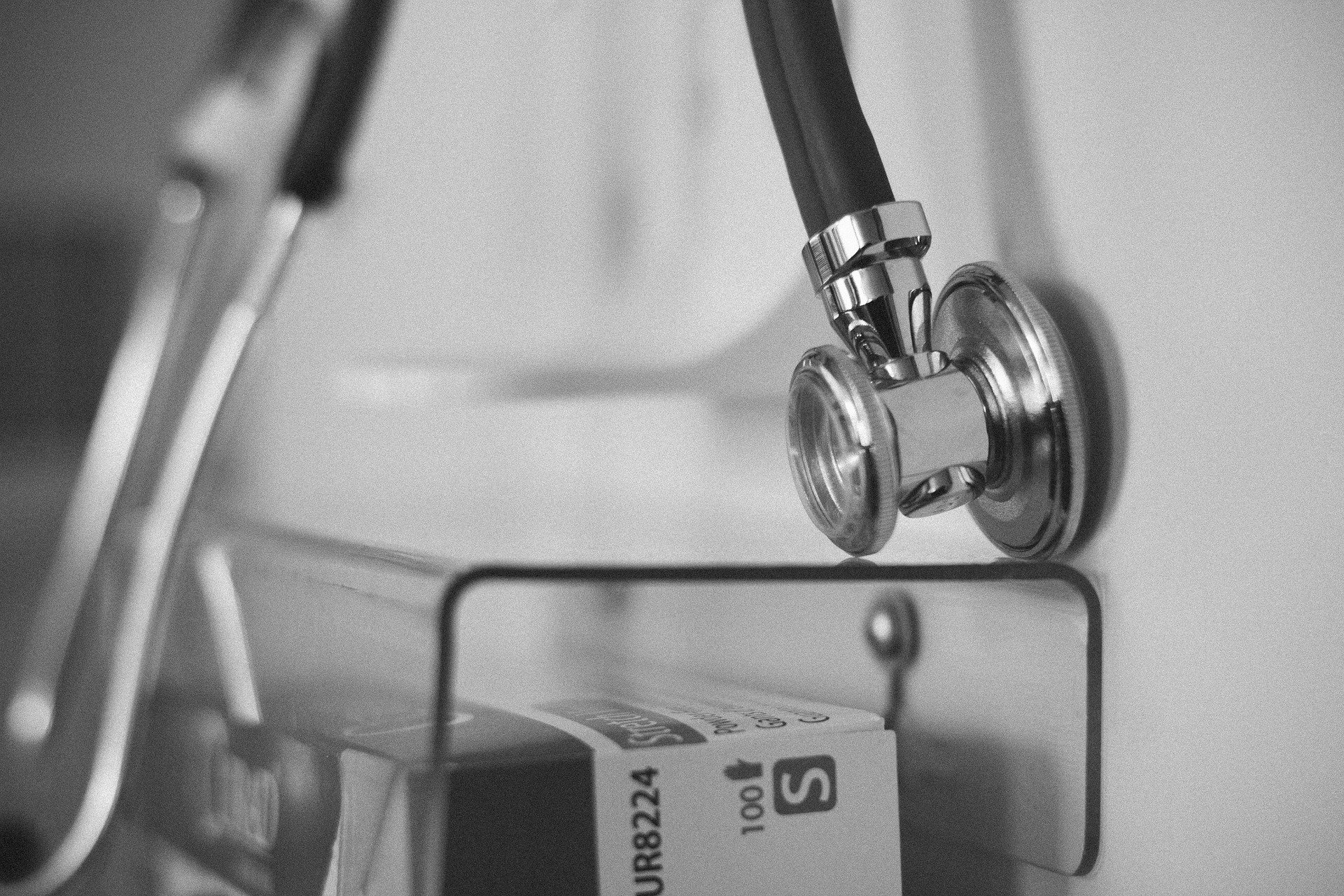
Photo by: Parentingupstream on Pixabay