
Cher first appeared to me when I was on the phone with the coroner’s office.
“Heart attack. She was at Walmart, but it was too late by the time the paramedics got there,” the woman, who had introduced herself as Lashawna, said. She said this in a voice I assumed was meant to be solemn but sounded detached and bored.
“Oh,” I said, because what else do you say when you are informed your estranged mother has died of a heart attack. There really is nothing to say. Only acknowledgement.
Lashawna paused, waiting for something else. Tears, perhaps. Anger, maybe?
“I imagine this is a difficult call to receive,” Lashawna said, prompting me. “I’m very sorry for your loss.”
I looked over at Cher, who was standing next to my refrigerator in the black Bob Mackie ensemble she wore to the 1986 Oscars. She looked like a raven or a crow in her towering, feathered headdress. Her midriff was bare, her body covered in black bejeweled angular shapes and grids. I looked down at my old, grey shirt that always retained a bit of body odor, no matter how freshly it was washed. There was a toothpaste stain above my sternum.
Cher inspected the family portrait Lilly drew in crayon. One stick figure for me, one for her, and two round blobs for our cats, Gilda Radner and Jim. Cher’s eyes narrowed, really taking in the artistic vision.
I couldn’t remember if Cher had children. Even if she did, perhaps she was not well-versed in what constitutes quality in a children’s drawing. I wanted to blurt out that the blobs were remarkably well-drawn circles for a four-year-old. Especially a four-year-old whose mother spent more time working at a strip mall hair salon than at home doing normal things like teaching her child how to draw circles or love correctly.
“Mrs. Freeman?” Lashawna said.
“Oh. It’s Ms.”
“Oh. My apologies, Ms. Freeman.”
I immediately regretted correcting her.
“It’s okay,” I cringed at the way my voice went high and breathy. I looked over at Cher, who had moved from Lilly's drawing to inspecting the chintzy scallop shell magnet that held the paper to the fridge.
The magnet was from a long-ago trip to Sarasota. I think it was after my second round of failed IVF, when the doctor suggested I “do something nice for myself”. I had maxed out my measly insurance coverage, taken out a loan. Then a second loan. I was so far in the red that numbers barely meant anything to me anymore. What was a few hundred more for a cheap flight and hotel deal? Maybe the salt air would help me heal, help the next pregnancy finally stick.
I spent most of my time alone on the balcony, sipping Coronas and watching cars stream down the four-lane highway below, thinking about how my mother—who was, for all intents and purposes, dead to me—lived just sixty miles north.
“So, I need to decide what to do with the body, right?” I said, still in that high, breathy voice.
“Yes, that’s correct. You are her next of kin. We’ll need you to make arrangements within forty-eight hours.”
Arrangements. I turned the word over in my head. “Do you…have a recommendation?”
“For…?”
“What to do.”
Lashawna paused. “I mean, it depends on what you want to do with your mother’s remains. Cremation versus burial and all that. Are you religious?”
“No.”
“Oh.”
“I don’t know what she wanted. I never asked.”
“Okay.”
We were silent. My eyes slid back to Cher. She had now opened my fridge and was inspecting its contents with a bizarre focus. Milk. Eggs. Apple juice. Mayonnaise. Ranch dressing. A half-orange covered in white fuzz that I had been meaning to throw out for weeks and just couldn’t. The black feathers of her headdress brushed the popcorn ceiling.
“I’m happy to give you a list of funeral homes around Tampa. You’re out of state, correct?”
“Yes. I’m in Minnesota. Which is not Florida,” As if that wasn’t incredibly obvious.
“So the folks from the funeral home can walk you through your, uh, options. We just need them to get in touch with us about, uh, you know…how you want to move forward.”
“How I want to move forward,” I repeated back. “Yeah, okay.”
First, I needed to throw out the orange. Then, I would start calling funeral homes.
*****
We are on the floor, belly-down on the matted maroon carpet that smells faintly of dust and grape soda. The AC died days ago, a quiet mechanical suicide. Dad has promised to buy a new one when his paycheck hits at the end of the month.
In the meantime, Mom has wedged a box fan into the window, keeping it propped open with a copy of the Yellow Pages. The fan throbs like a slow heart. The heat shimmers around us, bending the air in soft, dizzy waves. It feels less like a living room and more like the inside of someone’s fever dream. We are giddy.
It is perfect.
Between us, a bowl of cherries oozes juice, slick and red as blood. The pits pile up in a cracked ashtray. Our fingers are stained the color of bruises, our mouths ringed with red like we’ve been kissing vampires. I know Dad would be mad if he saw us like this, but he’s at work and won’t be back for hours. The TV buzzes and glows, an old Zenith that looks like it belongs in a spaceship. The screen stutters and bleeds color at the edges—greens like chemicals, blues too blue to be true. It’s a rerun of The Sonny and Cher Show. It feels more like a séance.
Cher shimmers in a silver dress that moves like mercury, like if you stare too long you’ll see your own reflection warped and writhing in it. Her hair pours down her back, black and endless, rippling with the breath of something not quite wind.
She doesn’t walk. She glides. When she turns her head, I swear the room tilts.
“Look at her,” Mom whispers, reverent, almost afraid. “Isn’t she everything?”
*****
I wasn’t disturbed by the sudden appearance of Cher in my life. Despite how she was dressed—always glitzy and shiny and usually wearing Bob Mackie, but once as Loretta Castorini in Moonstruck—she was very unobtrusive.
She seemed very uninterested in me, which I didn’t take personally. I wasn’t very interested in myself either.
Cher came and went. Reading Cosmo in the salon’s waiting area desk while I swept up hair from the floor. Sitting on my front stoop as I pulled into the driveway. Watching me order pizza for the second time that week. Watching me watch Lilly watch a third episode of Cocomelon. I told her she could only watch one but didn’t have the energy to get off the couch and put her to bed.
If Cher had any judgments, she didn’t show them.
I called the first funeral home Lashawna listed. A jovial man with a thick Greek accent introduced himself as Mr. Christos Maliotakis, CEO of Maliotakis Memorial Services.
“If you don’t know what she wanted, I highly recommend burial over cremation. It’s the safer option,” he said with an air of authority. “Many people have strong feelings about cremation. My own aunt survived a house fire when she was a little girl and none of us knew until she was on her death bed. She told us that she would haunt us forever if we cremated her instead of burying her whole!”
I knew it was a naked attempt at upselling me, but I didn’t have the will to fight back. What was a little more debt?
I chose a plain pine casket—the second least-expensive option. Mr. Christos Maliotakis said it was a great choice. He assured me he would personally handle the body: pick it up, do whatever it is they do, place her in the casket, and meet me at the cemetery— the one Google Maps said was closest to the nursing home where she’d lived. Then we’d bury her.
Was I choosing convenience? Sure. But what was the point of making a big deal out of something that had already happened? Besides, I didn’t pick the cheapest casket. Wasn’t that fucking enough?
I’d already called the nursing home and told them to get rid of everything. Clothes, toiletries, books—whatever she still had. She’d sold her house three years ago.
The last time we spoke—if you could call it that—was a voicemail, telling me she was moving into "Sunrise Palms Senior Living" and giving me her new address in a cheerful voice.
I never called her back. I told myself I was too busy with work and Lilly and whatever else, but I didn’t know what I’d even say.
“Congratulations?”
“Thanks for the new address, but I’m still mad?”
The message sat in my voicemail for months, then years. I’d never deleted it. I just didn’t listen to the end. From an early age, I recognized my mother had a talent for subtle cruelty. It didn’t leave bruises but left you raw anyway.
She was an expert in disappointment: birthdays forgotten, insults wrapped in concern, silence used like a weapon. But things didn’t officially break until I was an adult. Remarkable, really, given how much of her I’d had to endure.
The proverbial final straw was when I wanted to have a child on my own. I’d made the decision after years of relationship wreckages. For the first time in a long time, I felt sure of something. It took months to work up the courage to call and finally tell her. She was horrified I wanted to be a single mother. It was selfish, she said. Unnatural. I would “ruin my child’s life forever.”
The irony almost knocked the wind out of me. My own life had been ruined, or at least cracked down the center, by the man she chose and stayed with. If my mother was bad, my father was even worse. He was a bully with a temper that turned rooms electric. He never hit me, but he didn’t have to. Doors slammed inches from my face, plates shattered during dinner, threats murmured so close to my ear I could feel his breath. He called me names so often I started answering to them.
My mother would sit on the couch and stare straight ahead—tell me not to provoke him, not to “make it worse.” She never left. When he finally did, she made excuses for him like muscle memory.
I wanted to scream when she told me I was going to harm my child by raising her alone. But there was no point. Instead, I told her I didn’t need her approval. She told me I didn’t deserve to be a mother. That was the last conversation we ever had.
I didn’t even want to travel all the way to Florida to bury my mother. When I talked to Mr. Christos Maliotakis over the phone, he just assumed I would attend the burial, and I didn’t have the heart to correct him. It was one of those acts so obviously moral, so clearly right. To avoid it would mean living with the knowledge that, deep down, I was an awful person. This was something I already suspected about myself, but letting strangers bury my mother would confirm it: I was a bad daughter, a bad mother, an all-around bad person.
I booked my flight to Tampa, believing that hitting “PURCHASE,” getting my shifts covered, and arranging for Lilly to stay with a friend would help maintain the illusion that I was good. Or trying, at least. Given the circumstances, I thought I was doing an okay job.
*****
Lilly was on the floor in front of the TV, building a lopsided tower out of plastic blocks, singing softly to herself. From across the room, I felt Cher watching.
She was curled in my worn reading chair, dressed in a shocking pink floor-length gown. Her sleek, black hair hung around her face like a curtain, and her bare feet were tucked under her like a cat. She was holding a mug of tea from God knows where in both hands. Steam curled around her cheekbones, and her eyes were locked on Lilly, giving her the air of a malevolent fairy. I had discovered that Lilly couldn’t see Cher. In fact, no one but me could see her. This both comforted and frightened me, but mostly I was relieved I wouldn’t have to explain Cher’s presence.
The end credits of Paw Patrol rolled across the screen, and before Lilly could beg for another episode, I kneeled beside her.
“Hey, sweet pea,” I said, brushing a curl behind her sweet, tiny ear. “Can you pause your tower for a second? I need to talk to you.”
She blinked at me with the serious expression she used when trying to count past ten. “Am I in trouble?”
“No, no trouble,” I forced a smile. “It’s just... I need to go on a little trip for a few days.”
She frowned, arms wrapping protectively around her knees. “Why?”
“Because,” I said, carefully. “Grandma—the one in Florida, remember? She passed away. That means she died.”
Lilly’s eyes widened, and her mouth twisted, uncertain whether to be sad or confused. “She died like Mr. Jeffries’ dog?”
I nodded. “Yes, kind of like that.”
“Oh,” Then, after a beat: “But I never met her.”
“I know.” My throat tightened. “That’s not your fault.”
I reached out and held her little hand, warm and slightly sticky from God knows what. “I have to go to Florida to take care of some things. It won’t be long. Just a couple of days. You’ll stay with Maya and her mom, like a little sleepover. I’ll call you every night, okay?”
“Are there mermaids in Florida?”
I smiled, despite everything. “I don’t know. Maybe. I’ll let you know if I see any.”
“Are you going to the beach?”
“Maybe. If I have time.”
“If you go to the beach, can you bring me a seashell?”
“Sure, I can bring you a seashell.”
Lily nodded slowly, watching me with those searching, too-wise eyes. “Okay. So you come back?”
“Of course I come back,” I said, kissing her forehead.
I looked at Cher. Her face was unreadable, but there was a glint of something in her eyes. Not pity or approval, but something quieter. Like she’d seen this scene before, in a hundred versions, and knew exactly how it ended.
I looked back at Lilly.
“It’s just for a little while,” I said again, mostly for myself.
*****
I’d hoped Cher would come with me to Tampa, though I hadn’t said that out loud, not even to myself.
It was ridiculous, of course—she wasn’t real, or at least not real real—but still, I caught myself scanning the airport terminal for a flash of feathers, gold lamé, something impossible.
Nothing. Just people in sweatpants and neck pillows, dragging roller bags and frustration. I tried to shake it off, to pretend I hadn’t expected to see her, but the hollow feeling in my chest betrayed me. I boarded my budget flight alone, wedged into a window seat that smelled strongly of recycled air and faintly of farts, and felt a sharp, stupid panic.
I’d been counting on Cher without realizing it. It was like leaving behind a part of myself I hadn’t realized I needed. What if I came back from Florida and Cher was gone for good? What if I’d imagined the whole thing, and this—this cramped, fluorescent-lit reality—was all there ever was?
I fumbled with my seatbelt, trying to breathe normally, trying not to cry. I didn’t want the man sitting next to me—wearing cargo shorts and chomping on a Slim Jim at seven in the morning—to see me cry. I pressed my head against the window for the entire flight, knees jammed against the seat in front of me. Get a grip. Get a grip. Get a grip. I repeated to myself like a mantra. This was just grief. Or exhaustion. Or maybe both. Either way, I was alone now.
The moment I stepped out of the airport, a blast of Florida air hit me as a punishment. It was thick and wet, like walking into a washing machine mid-cycle. The sky was painfully blue. The sun was high and aggressive. The heat of the rental car pavement turned the rows of beige and silver sedans into desert mirages.
I picked up the keys to a cement-colored Kia Soul from a disinterested attendant. The driver’s seat was scalding—I let out a little yelp when the back of my thighs touched it. The air conditioner coughed out a blast of warm air before sputtering into something cooler and vaguely moldy. I adjusted the vents and sat there for a minute, letting the hum of the engine and the artificial cold give me something else to focus on.
The budget hotel, only five miles from the airport, wedged itself between an all-you-can-eat seafood buffet and a vape shop that advertised “KRATOM INSIDE” in red neon. The building, long and squat, was painted a tired coral pink with doors that opened onto an outdoor walkway.
The sign was emblazoned in red block letters: “Welcome to Tampa’s Friendliest Stay!”—except the “r” in Friendliest had either fallen off or been stolen, so it read: “Welcome to Tampa’s F iendliest Stay!”
My room was on the second floor. The carpet had the crunch of something that was once sopping wet and never fully recovered. The AC unit under the window rattled, but churned out gloriously cold air. Kicking off my sneakers, I laid on top of the floral bedspread, and stared at the yellowed ceiling tiles. Outside, I could hear the rush of cars on the highway, the faint bark of a dog, the high-pitched whine of cicadas in heat.
My first impression of Florida was that it was loud in a way Minnesota could never be. Even the plants were louder—oversized palms waving obscenely in the breeze, bougainvillea blazing like neon against the dull strip-mall skyline. The whole place shouted in color and heat and sound.
I thought I should feel something—grief, maybe, or at least a sense of dread—but mostly I was sticky and disoriented. I turned on the TV and let a Food Network rerun fill the room. Guy Fieri cheerfully dunked onion rings into a fryer.
For a moment, I was glad Cher wasn’t there to see me wilted and aimless in a clammy hotel room, five miles from where my mother’s body waited for me.
*****
“Look at her,” Mom whispers, reverent, almost afraid. “Isn’t she everything?”
I nod, but I’m watching her. Mom’s face is flushed and glowing, like she’s swallowed a lightbulb whole. The usual shadows—worry, fatigue, whatever lives behind her eyes—have fled.
When she laughs, it’s a wild, unhinged sound that makes the windows tremble. On-screen, Cher is chasing a man in a gorilla suit around a disco rink. The studio audience cackles along with us. Except—I swear—the voices are subtly wrong. Too slow or too fast, like they’re laughing underwater.
I lean my head against Mom’s shoulder. Her skin is slick with heat and smells like cherry pits and drugstore shampoo and something electric. She doesn’t flinch.
We are molten.
Timeless.
Like two girls in a godless Eden, red-mouthed and starry-eyed, worshipping a television deity in sequins and bone structure.
Cher looks straight at the screen then. Straight at us, her eyes full of some impossible knowledge. The TV flickers once, twice. Then it winks out, just as the fan sputters and dies.
*****
On the morning of the stupid fucking funeral, the sun was too bright for mourning. It bounced off the windshields rushing behind us, glinting in staccato flashes that made me squint.
I can’t imagine my mother would’ve wanted this sad excuse for a funeral—or anything at all, really. But Mr. Christos Maliotakis said I should do something, so here we were: me and two men from Maliotakis Memorial Services, in matching baby blue short-sleeved polos, who didn’t introduce themselves. I don’t know why I was surprised, but Mr. Christos Maliotakis hadn’t even deigned to show.
Beach Grove Cemetery sat just off the frontage road, boxed in by chain-link fence and the steady roar of the highway beyond. Plastic flowers faded to dust in the sun, their colors leeched by years of brutal heat. The patchy, stubborn grass was more weed than lawn, and the soil beneath it cracked like old porcelain. Headstones leaned at odd angles, some barely legible, their dates rubbed down by time and wind. A few graves had folding chairs parked beside them, rusting into the dirt—signs of people who still came or once did. Despite the cemetery’s name, it was twenty miles away from the closest beach. The whole place was a forgotten margin, something tacked on after the fact. The kind of cemetery where even the dead sweat.
“Can we just — wait a minute?” I asked the men. I looked around. The men looked at me quizzically but said nothing. I’m sure their sensitivity training was kicking in.
Normally, I would be mortified, but the realization was sinking in. I was burying my mother. It was my day. If I wanted to wait, we would wait. If I wanted to be a diva about it, I could, and no one could tell me shit.
It’s not like I was expecting Cher to attend my mother’s funeral. That would be crazy, like those people who send their wedding invitations to celebrities and actually think they will attend. I wasn’t crazy. I just wanted to give Cher a chance.
My mother wasn’t a huge fan, but Cher always hovered quietly in the background of our lives. A familiar voice on the radio, a flicker on the TV, a glossy face in the tabloids my mother occasionally indulged in. She always liked how Cher looked and sounded—glamorous, confident, a little rebellious—but it was more casual admiration than obsession.
What made Cher feel so much larger to me, as a child, were the few, quiet afternoons when my mother and I watched reruns of The Sonny and Cher Show on our half-broken TV. They were some of the few memories I had of her smiling, without tension or frustration. Those moments were probably nothing to her, but for me—knock-kneed and buck-toothed and starving for love—they were everything.
Then — there she was. Striding across the crabgrass in stilettos, like she was walking toward a stage to accept an award. Cher.
Of course, she looked spectacular in a midriff-baring halter jumpsuit—red sequins glinting like fish scales in the sun, a sheer cape fluttering like smoke around her arms. After days of wondering if I would ever see her again, here she was.
Cher took her place next to me, and I breathed a sigh of relief before telling the men to go ahead. If they noticed Cher, they showed no sign.
She and I watched in silence as the men worked the winch, the coffin groaning once before settling at the bottom of the neatly carved hole. The grave was shallow, the earth around it pale and sandy. Cher slid her hand into mine — fingers slender and cool against my clammy palm. She squeezed once but didn’t let go.
I nodded to the funeral men. “Thank you,” I said. One nodded. The other gave a small, grim smile and informed me the guys from the cemetery would come in the afternoon to finish the burial process.
“And then it’s done,” he said.
“And then it’s done,” I repeated back, nodding.
I thanked the two men, and then they left, boot heels crunching over dry grass and gravel.
Cher and I stood there for a long time, longer than I meant to. Long enough for the shade to shift and the traffic to become background noise, like waves.
I didn’t cry. Why would I? I thought maybe the heat would do something—soften me, melt something loose. But it just sat there. Heavy and flat and mean.
Cher didn’t say a word. She just stood, her hand still in mine, and looked at the hole in the ground, like she was waiting for her cue. Her updo—a towering cascade of lacquer black curls—didn’t move in the breeze. I couldn’t tell if she was bored or reverent or both.
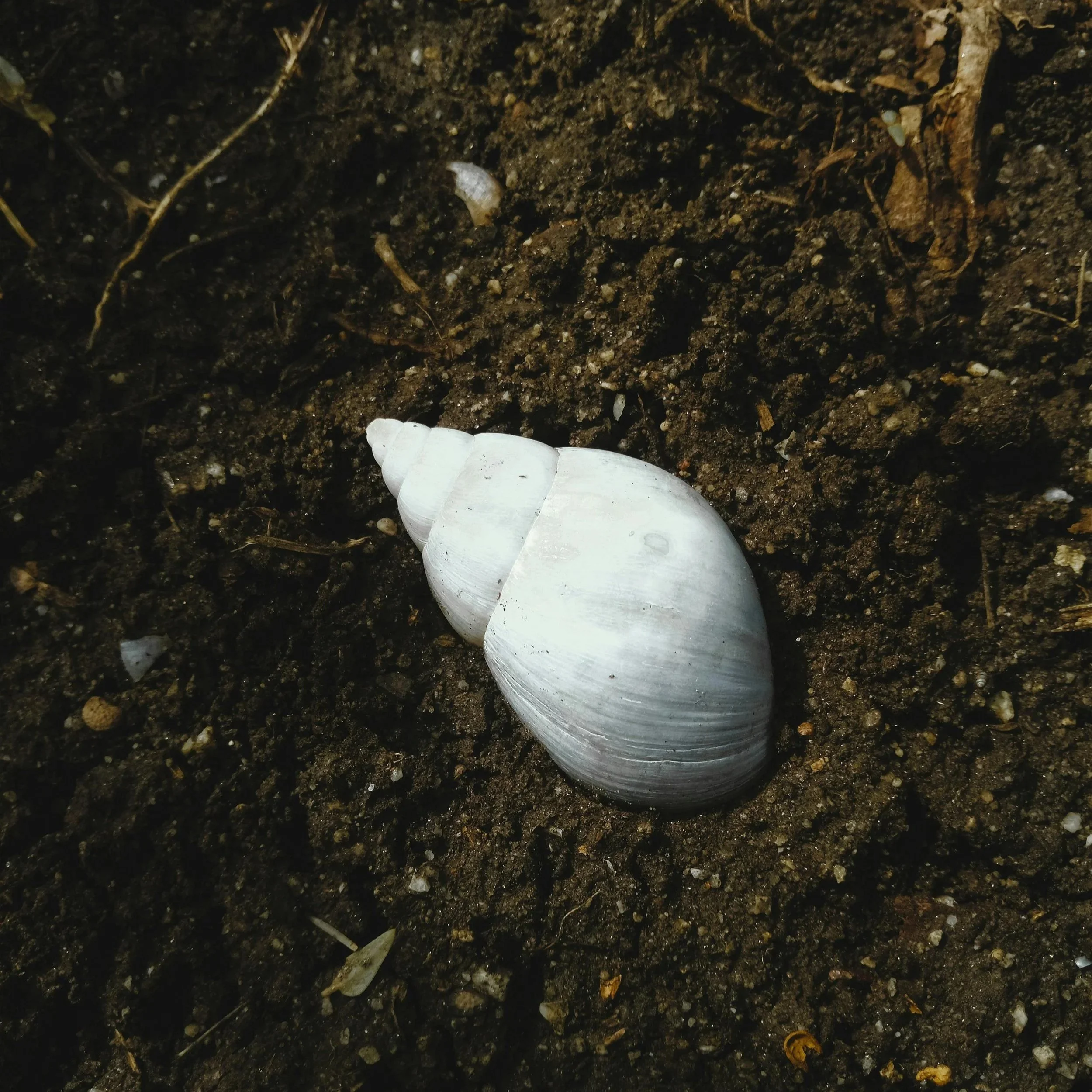
Then she let go of my hand and crouched down—impossibly graceful in those heels. She picked up something from the grass and held it out to me. It was a seashell no bigger than a quarter. I took it without speaking.
It was warm. Smooth. White on the outside and baby pink on the inside. It was something that belonged to a dream. We were nowhere near the ocean. And still, here it was, nestled in the sunburnt grass like it had been waiting.
Cher turned and walked away, cape dragging behind her like a wedding veil.
I stayed—staring at the grave, running my fingers over the seashell, trying to remember if my mother had ever liked the beach.
Sarah Chin lives in Chicago, IL. Her work has been nominated for Best of the Net, Best Small Fictions, and Best Microfiction, and has appeared in places like The Cincinnati Review, Electric Literature, Wigleaf, and SmokeLong Quarterly. Find her at sarahchin.net.
Photo by: Fandy Much