
“When was the last time you saw her?” Jason demands one Saturday morning when we arise to find the kitchen cold and dark. No bacon sizzling or pancakes on the griddle. Not even that warm earthy smell of coffee brewed.
For the past few days there’ve been a couple of dish stacks going on the counter. In the sink, dirty saucepans with lids sucking countertops. This is strange. Usually Mother gets to them. She must.
Jason faces the three of us. How had we come to line up before him? It’s as if he were a drill sergeant, all of us sockless in our pjs, tumbled hair, bare feet on the cold hardwood kitchen floor crosshatched by the marks of our chaos. We know now as we shift foot-to-foot, it is the seriousness of the matter, for otherwise we tended towards the conglomerate—the shapeless, shifting group of us, now here, now there.
“Ummm,” Loren’s little brow is furrowed, big eyes cast to the ceiling. “Yesterday or, um, the day before?” As the youngest of us, he constantly amuses us, is the generator of all our guffaws, our healthy egos, our frustration.
Jason looks at Loren. “Are we sure?”
From the way we are lined up that morning, tallest to shortest in the cold dark kitchen, a person would think we come from a strict family—rules and regulations and “yes sir/no sir.” Nothing could be farther from the truth.
Father acts in fits and spurts, at times full of juvenile whimsy (think fart jokes, slapstick, psych-outs—such good fun!); mostly quite distant, distracted by work where he is very important; other times inflamed by our tendency towards unruliness. What can we say, we are four boys, and why, on God’s green earth, who can be sure; whether we were all intended or not is anyone’s guess. We think of things, do them, and then we are on to the next thing. Like snap, which is Mario Kart or Mario Bros or Sports Illustrated for Kids on the downstairs couch or basketball in our driveway with the neighborhood kids, all of which are accompanied by heaps of requisite snacks.
After a particularly delicious meal, we pick up our plates and lick them, slather them with our tongues spread wide, top to bottom, side to side. Mother has said, “No, I don’t like it,” but Father was the one who started it, and really, it’s just for fun. Mostly, we go around with more important things to think about, until the day when Father’s mood, his sudden realization that there must be some modicum of order in the house shouldn’t there? And for God’s sake hasn’t your Mother been saying so, compels him to issue a “you, dishes, now!” At which point we jump, because even though we know it will be coming sooner or later, it gets us every time.
Yesterday we suddenly noticed again the list on the fridge that Mother put together a while ago, we can’t remember when. When was the last time we even looked at it? Names, days, chores. Father on it too. Was it overkill? Had Mother succumbed to her irrational feelings for cleanliness and order again? Did it make us feel like servants to her neurotic quest for the most perfect, cleanest house as if she didn’t understand that we were not meant to live in a sanitized state all the time? Of course it did! But still, we followed it for a week or so just so she wouldn’t get silent and sad-looking.
At dinner, we felt somewhat uneasy when sometimes she sat and stared into space, one mouthful at a time. Her body, then, seemed to buzz and flicker, coming and going, once, twice, like static on a TV station. We’d lose her for half a second and then she’d be there as if nothing had happened at all. And then, “C’mon,” Father would be quizzing us as he slurped up his pasta. “What is the equation for circumference? You should know this.” Or, “Who can be the first to solve this problem?” And he’d spout one off as we felt our brains clicking into high gear, a surge of adrenalin obliterating anything else. “C’mon. You should know this.”
The thing is, even when we remember having seen Mother, there was always the sense of her presence without her exact presence. Understand? Cooking, cleaning, signing our permission slips, in the doctor’s office with one of us squirming on the noisy paper covering the patient’s chair, at sport’s games with a pompom in one hand and a book in the other. Did she really watch us, we’d like to know, like Father did with his body straining towards the field and his voice impressively loud? There were probably other things she did. Before dinner we’d hear the comforting sounds of pots being withdrawn from cupboards, lids clacking, spoons stirring, music or public radio on low, suddenly the smells of garlic roasting, tomatoes crushed. Oh, how we couldn’t wait, how our stomachs rumbled! “When is dinner?” we’d moan. When we’d arise to grab a snack, just a small one to tide us over, we’d have a sense of her there out of the corner of our eyes as we grabbed fistfuls of string cheese from the fridge, but sometimes her body seemed to be leaking out, stomach melding into stainless steel, kneecap into the glass of the oven door, feet sucking up the hardwood of the kitchen floor. Other times, we’d discover that she had become almost perfectly see-through, the view out the kitchen window coming through the crystal clear-ness of her neck and shoulders though she’d be standing perfectly unaware, washing the kale in the sink. We’d blink or turn away and then mark her again, and there she’d be. A perfect trick of the strange light.
Now we stand in this ridiculous line tallest to shortest in front of Jason, the oldest, the stacked counter and sink accosts us just the slightest bit, that underlying smell of food gone nasty, like a little pin pricking our tender cheeks, our sensitive noses.
Matthew says, “After my basketball game and Michael’s indoor soccer practice, we went for burgers, remember?”
“All of us?” Jason looks at Matthew as if he were demanding CIA-level intelligence.
“Uh yeah, I think I’d remember bruh,” Matthew’s lip curls. “We won that game dude.”
“Yeah, I know.” Jason drops his head and starts pacing. “So she must have been there. What did she say? Just one thing. Anyone?” The way he’s glaring at us you’d think we were the ones who made Mother disappear, as if he didn’t understand that the we included him, too.
But none of us could. None of us could exactly remember when we had last seen or even heard Mother.
*
The next day, little leaks start appearing, suddenly, from ceiling corners that had otherwise been dry; from behind toilets and sinks; one from the very center of the fourth stair between floors, soaking a small spot in the blue carpeting there. There is no order to them. We tear around as if in a game, trying to find the next leak.
“Behind the couch!” Loren yells from the den.
“What the hell?” Father grabs the overstuffed arm of the couch, bares down, and yanks the couch from the wall, which makes him release a hilarious grunt that we will imitate for days to come. “Uhn!” The couch is one of those mega things that sucks us in after we descend on it, and the carpet acts like a brake. “Uhn!” Father goes again. And there, a mark the size of a quarter down near the baseboard, occasionally emitting a single drip that appears, balances, falls, then disappears into the shaggy carpet.
Loren pushes his finger into the carpet.
“Is it wet?” Father is crouching down there with him. The rest of us are kneeling on the couch, peering over.
“Ummmm,” Loren deliberates.
“Here,” Michael tosses a leg over and nudges Loren out of the way and into Father’s knees.
“Hey!” Loren yells.
Michael jabs the carpet, once, twice.
“Yeah,” he says, satisfied “It’s definitely wet.”
Father rises and crosses his arms.
“This is bad, boys,” he says. “This is very, very bad.”
And, for the first time, we see that he is deadly serious. We have never seen something matter this much to him. We can barely breathe; we are holding our breath. We stare at the spot, hoping it will just go away. Instead, Father sighs.
What to say?
Finally, “I wish Mom was here,” Loren whispers.
“I hope she wasn’t the cause of all this,” Father mutters. We can barely hear him, but nevertheless do. “I hope she didn’t flush something down the toilet,” he says, “or down the kitchen sink.”
“What should we do?” Jason looks concerned, and none of us have ever yet been concerned in our lives in this particular possible-end-of-world way.
Father rubs his face and looks at Jason.
“If we don’t get this taken care of, we may not have a house to live in anymore.”
And we are all absolutely shocked, distraught, terrified. We stare wide-eyed at Father and let him be.
“If Mom did this, she’s in big trouble!” Matthew gasps. He is on the verge of tears, his arms extended like planks by his side.
Father leaves the den. “This will cost us a fortune.”
“Will we be homeless?” Loren asks.
*
We are not homeless. We would never have been homeless.
Father, shall we say, freaked out.
Father finds the number of the plumber Mother used once who was good and reasonably priced. We can’t understand why Father was always concerned about money when Mother seemed to be saving him money all the time.
The man comes promptly. He is a jovial bearded fellow, clean and well-dressed with the company name on a patch on the pocket of his crisp white button-up. He asks Father many questions and listens thoughtfully. We think he is most impressive, the way he leans his head towards Father as he listens, the way he nods along in understanding, the way he carries his tool case with him wherever he goes in our house, grasping it assuredly in one hand. He checks the faucets, runs the water, ventures down to the basement to inspect the pipes, which he says are top-of-the-line.
Of course, by this time the leaks have mostly vanished, which annoys Father because where is the proof now? Still, there is the wet spot in the middle of the stairs, and the spot behind the couch is the size of a nickel.
“Now this here,” the plumber stops on his way down the stairs, pointing to the spot on the stairs that Father has just mentioned, “this here isn’t even near any piping!” He’s the happiest plumber we’ve ever seen. “So, you know,” he eyes Father plaintively, as if he sympathizes completely, “I just wouldn’t know.” He looks up. “Ceiling’s fine.” He eyes us and smiles. “Maybe a little rascal?”
“Don’t think so,” Father continues leading the plumber downstairs.
And the plumber finds nothing and refuses to charge us.
*
One week in, we grow restless and on edge. We suspect this belies something, something we will not name. Father checks in with the grandparents, the aunts; the occasional friend group, even Mother’s personal physician. But the personal physician has never met Mother—she was only recently assigned to her after a string of others left—and the friends say that in fact they have all been so busy lately that it’s been months since they’ve seen Mother and how is she? The aunts are tied up, and the grandparents are on a cruise in Antarctica, and everyone reassures us that Mother just took herself off for a brief break, isn’t that about right? That we’ll be hearing from her shortly.
It doesn’t help.
For a moment, we become frantic. We open every closet door and tear through them, hiding our panic, our tears if they come, throwing out all the musty clothes found, the coats on hangers, our old toys Mother saved and Loren is delighted, can’t believe such cool cars and trucks have been hiding this whole time! We find all kinds of nonsense—Father’s broken sewing machine, his two bins of saved cloth for future projects, a bag full of saved toilet paper rolls, for some possible project? Old bike tires and chains he says he will get to, leave them be. Stacks of frames needing pictures. Shoes with creases across the toes. We haul out bins of saved school projects and Halloween costumes we thought Mother had sent to the Goodwill.
We become ridiculous. We peer under the sinks into unreasonably tight, dark spots that smell damp, sour, and soapy. We flick on the basement lights and scour its corners of rodent poop, pierce through its curtains of spider webs. We startle a little mouse that for a second simply stops, turns, and looks at us, and it is actually one of the cutest things we’ve ever seen. We open the car doors and trunks. We yell, “Mother!”
At last, we collapse on the couch in the den. Matthew fires up the PlayStation—thank God. Father gets take-out. We are starving.
*
Not long after, the house does a settling thing. We feel it.
It trembles at night while we’re in bed, as if it were settling itself into the cold, hard foundation like a bird over its eggs. Each time it feels like a tiny earthquake, rocking us so indiscernibly so that when it stops, we wonder if we had really felt it at all. We had just imagined it. But once it settles, we feel it in our bones. The shadows inside grow long and wide like magical soft planks of anti-light, stretching, reaching for opposite baseboards and corners; laying themselves down across swathes of dusty carpet, kitchen countertops; down the center of the dark downstairs hallway that connects bedroom to bedroom to bedroom to bathroom to the den at the very end, and the shadow stretches and elongates up over the lips of the three stairs to the den and enters the den—that room that has not been cleaned in weeks and so sits in the funk of boy smell and play and endless snacks and occasional leaks—without a single sound. The shadows feel to us as if they are delighted; they stretch and widen and encroach regardless of the outside sun, in spite of it. They seem alive with purpose and wonder. The house becomes a tapestry of light and dark, and the dark feels softer and more alive like something breathing and kind. The shadows, the house, seem to love us. There are corners where Loren now occasionally nestles throughout the day, a picture book in hand, his knees up, his blankie across his nose; corners that have deepened and darkened where the walls bulge and warp toward him as if in tentative embrace.
*
At night, we are awakened by cracks and creaks, tappings, occasional bangs.
“It’s an old house,” Father tells us. “There are wild animals outside.”
Our outdoor wildlife camera shows us many passing coyotes or the same one over again; a family of red foxes; many, many deer; a ghostly image of an owl, sweeping down to nab something, and in its wake, the camera image shows a streak of silver light, the owl’s invisible cape revealed.
But we are convinced we hear other things at night. Tappings and sighings and singing and creaking. In fact we do, we do hear things, and one night we get up to see.
Jason leads the way in a pseudo fashion, for we all are buoyant around him, really, hovering at his shoulders and elbows, one of us slightly ahead of him and then falling back and then another, and we move like an amoeba, as if one organism. We make our tour of the dark house, hearts racing, sweat on upper lips. Jason has Loren’s hand. When we arise, the house seems to suddenly go quiet. We can only hear the shuffle of our feet across the carpet. And a penetrating silence.
When has the house ever been so quiet? The darkness is a malleable thing, sucking us in, until it’s not and we can see just fine. Oh so carefully, oh so quietly, trembling, sweating, we open bedroom closets; we venture into the dark bathrooms; we open the door to the angled storage space below the stairwell. As we pass, we peer cautiously up the dark, dark stairwell, knowing we must go there next. Foot by foot, we watch the den come closer and closer. At the threshold, we raise our knees, take one stair and the next.
There, in the middle, is a dark figure standing facing the other way, shoulders slumped, arms loose by its side. Its head is hanging. We knew it—we knew it!
“Hey!” Jason whispers. “Hey hey!” We know Jason feels like he may die, that we are prepared to fight like hell before we die. Our hearts are speeding. We clench our fists. There is a roaring in our ears.
The figure turns. It is Father. Why is he just standing there? Why do his eyes seem to shine in the darkness? Father stares at us, and the silence and darkness between us is like something we will have to get over.
Finally. He lifts his shoulders and draws up the muscles in his arms. The crown of his head stretches.
“You boys go back to bed, now,” he walks towards us like the Father we know, gently ushering us into the hallway. “The old house creaks.” And we are assured.
*
At times these days, we wonder about Mother. We wonder about missing her. We did, we think, at the beginning. But it also perplexes us. We cannot remember missing her. We cannot remember, exactly, when we noticed her gone. It could be about half-a-year now, but when we really stop to think about it, it could in fact be longer.
We try to remember Mother. Memories of her in the kitchen, baking something delicious—the homemade mac ‘n cheese only she could make so good, the pies, the cakes, the pastas. Smoothies when the summer got so hot; ice cream on cones bought in special. We know she snuck in the frozen spinach, but the smoothies tasted so good it didn’t matter. Memories of her vacuuming, dusting; carefully picking up each item, dusting underneath. Sweeping the decks, collecting the oak leaves in bag and after bag. Memories of her folding the laundry, one item after another, over and over again. Reading, tucked up on the living room couch, a mug of tea in hand. The slurp slurp of sipping, her lips on the lip of the mug. We used to watch her eyes move, line by line by line, so mesmerizing. Memories of time outs, occasional fights and crying. Her cool hand on our forehead; the way she pulled us all the way in, surrounded us with her arms, pressed our bodies against hers. Memories of singing and dancing when we were little, mid-day across the span of the living room, rocking our knees and butts like crazy people—Mother laughing and dancing too. Memories of her sitting like a pillar at the table while we talked, eating her spaghetti one forkful at a time, body buzzing, bzzz there, bzzz gone. There.
Where is Mother?
*
These days we crack our towels at each other after showers. We run like madmen through the house barefoot bare-chested in our sleeping shorts, tumbling silently across the furniture, leaping the stairs three at a time, smiles wide and frantic, breath coming hot and fast. Loren, once running away from Matthew down the hallway to the den, tripped on the stairs and landed on his arm, snapping it like a twig. On their way home from the ER, Loren’s cast an awesome color black. Father stopped off to buy tubs of unsweetened yogurt, said we needed stronger bones. We would eat yogurt every morning for breakfast, he said, which is what we did for precisely three days, with huge mounds of chocolate syrup snuck in after he left the room.
When the sink gets full, the pans all used up, Father yells, “you, dishes, now!” and we scatter like the cockroaches we’ve read about in graphic novels, scattering in the light, descending in the dark. Which is often us during very private times—times we yearn for like we have yearned for nothing else—when we tuck ourselves into the shadows of our house, which holds us and rocks us in occasional midnight settlings; soothes us and hides us under black planks of magical anti-light.
You’d have to experience it to understand it, the descending and settling into our home of a cool, soft, black, silent nothing, an ephemeral anti-matter that at times seems to sparkle, at other times to weep, other times to sleep, which, regardless, is a magnificent, if perplexing, something to us.
Sommer Schafer is Senior Editor of The Forge Literary Magazine and widely published, including a Distinguished Story in Best American Short Stories 2019. Her first book, THE WOMEN, a collection of short stories, was released by Unsolicited Press in November 2023. Her second book, HOPE, a novel-in-stories, was released in November 2025. She lives on Coast Miwok land with her family, a rescue dove, and a bearded dragon.
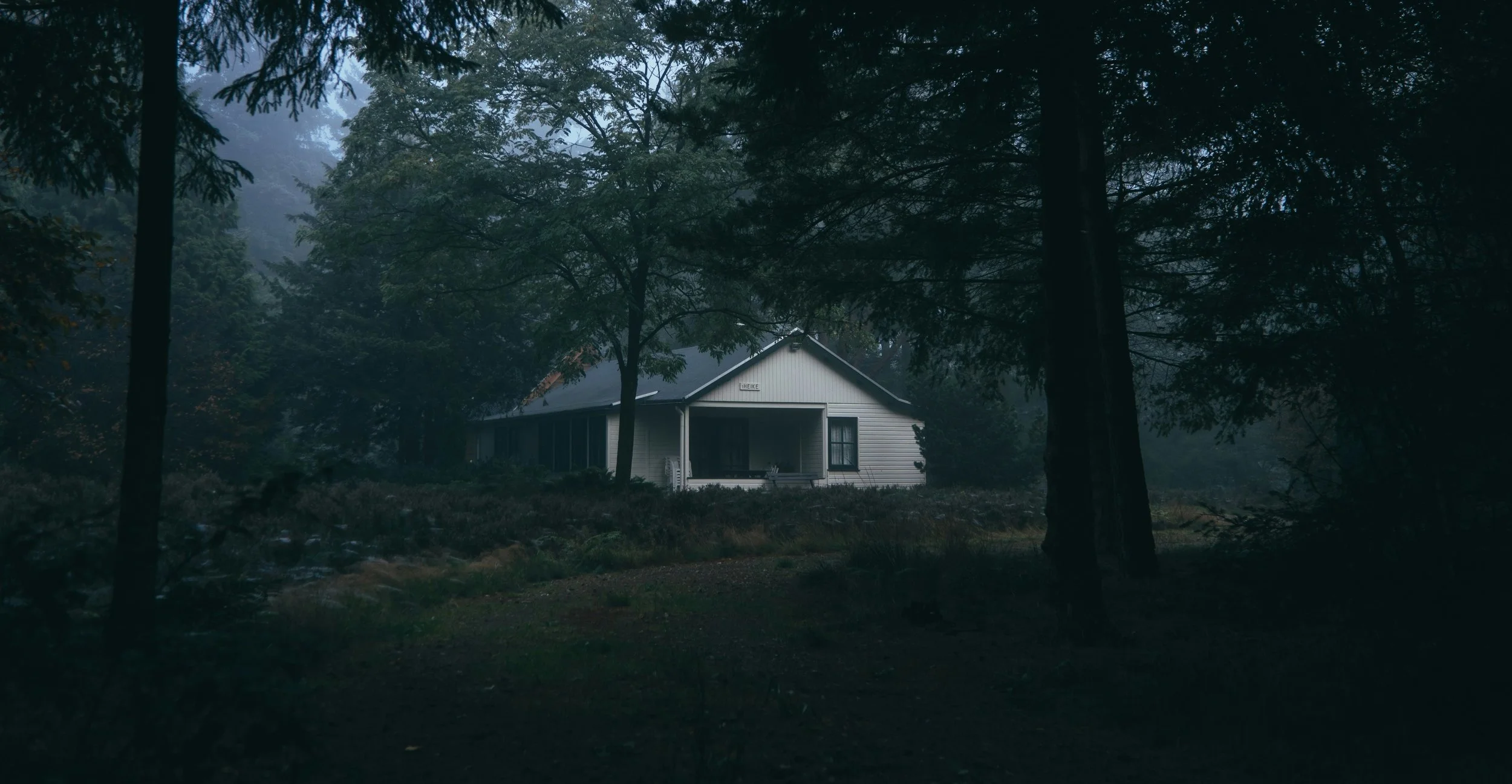
Photo by Quenten Janssen on Unsplash