
Less is less is less and more is more than more. Give me more than less.
Read More
PLUS ONE BY GIANNA STARBLE
“Is this seat taken?” asks an older white man. He is built like a bulldozer, wearing jeans and a pullover that reads Allergic to Idiots. Perspiration builds on the bridge of his red forehead.
“No…go ahead,” says The Woman. She is also white, somewhere in her mid-30s, wears a black no-iron travel suit, and is listening to atmospheric, ambient music through noise-cancelling headphones. She is flying Southwest, which she hates, but it is the cheapest flight to Denver, where she needs to go for her younger brother's wedding.
The man stows his backpack underneath the seat in front of him and puts his tray table down to eat a prepackaged ham sandwich. The Woman can feel the force of his chewing; he makes the effort of chomping tall grass. Despite facing away from him, she can feel the man turn toward her, asking a question. She removes her headphones.
“Sorry, what was that?”
“Coming or going?”
“Oh…going. I’m going to Denver.”
“Nice! Me too.” He smiles, inhaling a corner of his sandwich. “Business or pleasure?”
“My brother’s wedding. So, neither.”
The man laughs, sandwich crumbs spray from his mouth. “That’s funny. Weddings are a pain, huh? Especially when you’re going alone.”
The Woman smiles uncomfortably, uncrosses and re-crosses her legs. The man’s face looks regretful.
“Oh—I didn’t mean to assume.”
“You’re right,” she says, sustaining a tight smile. “I’m going alone.”
A flight attendant comes down the aisle, hands folded like paper cranes. “Excuse me, sir, please put your tray table in the upright position.”
“Of course,” he mutters, fumbling the second half of his sandwich in his hands, eventually managing to push the tray upwards, turn the small knob, and lock it. He looks at The Woman.
“You do stand-up comedy? You have that dry humor thing down…”
“I’m a teacher, mostly—”
“What do you teach?”
“Writing and composition—”
“Neat! I bet you’re a writer, huh?”
“Yes.”
“Well, you know what they say: those who can’t do, teach!” The man chuckles, stuffing the last bit of sandwich into his mouth, leaving a yellow pustule of mustard at the corner of his lips.
The Woman runs a thumb over her dry, cracked cuticles. On the intercom, a smooth voice announces to please direct attention to the flight attendants as they go over safety precautions. The Woman watches a flight attendant demonstrate putting on the emergency inflation vest, hold the straw, and pretend to blow. The Woman’s chest seizes. She realizes she has never seen a flight attendant actually inflate the vest. How is she supposed to know how to do something if she’s never seen it done, never done it herself?
She looks down at her hands—a swell of blood where she peeled back a long strip of dried hangnail along her left pointer finger. She puts her finger in her mouth like a child might, embarrassed. The familiar metallic taste sullies her tongue.
—
“They lost your luggage?!” asks the mother, placing her cocktail forcibly on the quartz countertops.
“We don’t know if it’s lost,” says The Woman. “They said they’d reach out to me by tomorrow with an update.”
“I just can’t believe it,” says the mother to an audience somewhere else.
“I’m sure they’ll find it,” reassures the father.
The Woman’s older brother (the one who lives comfortably in New York) enters the kitchen with her brother-in-law.
“Heyyyy,” they greet her in chorus, leaning in for hugs.
“I heard your luggage is lost. That sucks,” says the older brother.
“If you need me to get a lawyer on this case, I will,” says the brother-in-law, looking at his phone. “They owe you money.”
“I’m sure it will be fine,” says The Woman, a pressure building around her shoulders. “Let’s just eat.”
At an ovular oak table, the mother passes around white and blue ceramic bowls full of beef stroganoff, placing a special bowl of vegetarian stroganoff in front of The Woman. The sound of sterling silver spoons splashing through bechamel sauce and the slight rubbery squeak of overcooked beef amplifies against the dining room walls.
The mother gulps her mango KeVita and vodka. “While you guys are here, we want you to go through your stuff in the basement,” she says.
“We want it gone by the end of the weekend,” says the father.
“Geeze, dad. Harsh…” says the older brother.
“Well, you know we’re moving. We need to downsize. We’ve been holding onto your stuff for way too long.” The mother is about to say something, but the father shoots her a look; she sips her probiotic cocktail instead. “It’s time.”
—
That night, The Woman borrows a night gown from her mother—flannel with pink and purple flowers, a ribbon and lace collar. She feels like a possessed Victorian doll. In her childhood bedroom (converted to an office), she blows up an air mattress.
There is a knock on the door. “Hey, it’s me,” says the father from the other side.
“Come in.”
He opens the door, carrying a white binder. “You need help with the air mattress?”
“I got it.”
“Good, good.” The father stands in the door frame, smiling. “I just—well, I was pulling out the box with your stuff in the basement and found this,” he says, offering the white binder. “It’s your short story. The one that won the competition?”
“I remember, dad.” The Woman stares at him, not taking the binder. He extends his arm further toward her.
“I thought you might want to look at it because—well, you know—it is a really neat story.”
“It was, dad. It was a neat story—”
“Have you thought about reusing it? Maybe someone would want to make it into a Netflix series or…who knows!”
“You know, I’ve written a lot of other stuff since then—”
The dad shifts his weight from one side to another. “Oh, I know, sweetie—”
“And I’m currently working on a novel—”
“Oh, I know, sweetie. The one that’s based off that movie starring Reese Witherspoon?”
“You’re thinking of Wild, which has nothing to do with my novel except the fact that there’s a woman in the woods.” The Woman runs her thumb over her left pointer finger, presses against the residual pain of the scabbed-up hangnail from earlier.
“It sounds very…interesting.”
The Woman lets out a breath. A dog barks somewhere in the night. She reaches out, takes the binder. “Thanks, dad.”
He smiles, leans over to kiss her forehead before leaving. The Woman opens the binder to the first page: “The Girl knew it was a strange habit: collecting her own scabs. But the sensation it gave outweighed her worries about strangeness—she was creating a map of her past self, one she could return to if she ever felt lost.”
A red dot drips onto the right-hand corner of the paper. She absentmindedly picked the hangnail scab on her left pointer finger. She puts her finger in her mouth. The bleeding doesn’t stop.
—
“Here, I want you to try this one,” calls the mother from the other side of the door. The Woman is inside a handicap dressing room at Macy’s. She stares at herself in an Anne Klein navy blue pant suit that is one size too small.
“Could you open up so I can hand this to you?” her mother raps on the door with white knuckles. When The Woman opens the door, her mother’s sunny disposition cracks like an egg.
“What’s that?”
“It’s a suit.”
“For work?”
“No, mom. For the wedding.” The mother’s eyes scan The Woman, wanting to understand.
“You would wear that to the wedding?” She eyes what her mother is holding: a velvet emerald-green cocktail dress with long sleeves and a plunging neckline. The Woman is suffocated just looking at it.
“Mom, I don’t wear dresses.”
“Oh…you don’t?”
The Woman rolls her eyes, begins taking off the suit. “When was the last time you saw me in a dress?” The mother thinks about this as she helps The Woman get out of the jacket, struggling to shake her pale triceps from the sleeves.
“I guess I never noticed.” They successfully release The Woman from the jacket. The mother places her hands on The Woman’s shoulders and they look at one another in the mirror—an intimate moment that causes The Woman’s skin to itch.
“I still think you should try it on. Just for me. Please?”
In the car, The Woman holds a paper Macy’s bag in her lap with the carefully folded emerald dress, 5 pairs of Calvin Klein underwear (“They’re 5 for $30!” her mother insisted), a sports bra, a black pair of joggers, a grey pullover sweater, and a pair of black cotton pajamas. Exiting the mall parking garage, The Woman stares at two young girls trying to avoid a puddle of slush as they cross the intersection, but it is too big. She watches their faces droop as their New Balances get soaked.
“What a steal! Can you believe that dress was half off?!” asks the mother.
The Woman watches a young man in khakis get splashed with slush from a passing car. His jaw drops. The slush is getting everyone.
“Honey?”
“No. I can’t believe it.”
“And it fits you perfectly. Shows off that cute figure! You gotta flaunt it while you still got it! Before you have kids. That totally fucks up your body.”
The Woman ignores this comment. She continues thinking about slush—If slush were a character in a story, what would it symbolize? What would it say?
“You have your speech ready, right?” asks the mother.
The Woman’s butthole clenches. “Yep.” Rubbing her chin, her fingers land on a burgeoning zit. She presses the blemish with her pointer finger and thumb, feeling it release. She examines the evidence—a glob of sickly white mixed with blood.
—
“Oh my god, I totally forgot about this!” croons the older brother, holding a small trophy mounted with a gold baby.
The brother-in-law tilts his head. “What is it?”
“When I was 6 months old, my mom entered me in a baby pageant. I won first place!”
They pause as The Woman comes into the kitchen and retrieves a container of leftover lo mein and a Heineken from the fridge. She shovels tendrils of noodles into her mouth, followed by a long swig of beer. The older brother and brother-in-law stare for several moments, watching The Woman chew and swig.
“Hey, do you remember this?” the older brother asks, holding up the golden baby.
The Woman squints her eyes, mouth full of noodles. “What is it?”
“My award for cutest baby!”
The Woman finishes chewing, swallows. “Oh, yes. How could I forget.”
“Have you gone through your stuff yet?” asks the older brother, separating a pile of swim meet ribbons by color.
The Woman swallows, sips. “No. Not yet.”
“Hey, what happened to that story you wrote? The one that won that competition? That’s gotta be around somewhere…”
“Yes, you’ve told me about this story!” says the brother-in-law, gingerly patting the older brother’s thigh. “I’d love to read it!”
“I don’t know why on earth you would want to. I wrote it when I was 16.”
“But it was a big deal! I remember we all thought you were gonna be the next JK Rowling or something.”
The Woman’s left eye twitches. The brother-in-law spies the Macy’s bag on the counter. “Ooo show us!”
The Woman’s phone vibrates. A message from Southwest: “Thank you for your patience as we continue to search for your luggage. We are doing everything in our efforts to find it. Reply YES to opt in for text updates or STOP to opt out at any time.” She replies YES, sighs, and polishes off the beer.
“You’ll see it on the big day.”
—
In her childhood room, The Woman scrolls through Tinder on her phone while lying on the air mattress. She turned on the app for her short visit, changing her bio to, “Wanna be my plus one to my brother’s wedding?” So far, she’s received zero matches. She swipes right on a couple of people, then left for a while. She is about to continue rolling her thumb clockwise when a face pops out. Electric sparks sputter down her spine.
It’s Emmie, Emmie Horowitz. There, on the small screen. Caught mid-action in tiny spandex shorts and roller skates while elbowing another woman in roller derby. Her bio reads, “Looking for someone to keep up with me” followed by a roller skate emoji, a disco ball emoji, and a rock-climbing emoji. The rest of Emmie’s pictures include one of her in overalls amidst raised beds holding a bunch of Swiss chard, one of her scaling a large rock, and one of her in a red vintage go-go dress, white feather boa, and bug-eyed sunglasses posing against a gold wall with a friend dressed in a similar disco fashion. The Woman remembers taking AP English with Emmie her junior year of high school. They were partnered to do a presentation on Ms. Dalloway.
“I just don’t really get it. It’s so dense,” said Emmie, sinking into a large sofa at the neighborhood coffee shop frequented by high schoolers pretending to do work on the weekends.
“I’m not sure I do either. But it’s pretty,” said The Woman. Emmie hunched over a blank page of her spiral notebook and stared into the pool of her drip coffee.
“I can’t help but think that Mr. Alberts assigned us this book because he thinks we’re lesbians,” said Emmie. The Woman had just taken a sip of her chai latte, almost sprayed it everywhere, but managed to swallow the hot liquid.
“Oh,” said The Woman. A long pause hung between them. “Because Virginia Woolf was…kind of a lesbian?”
“Exactly! It’s so annoying that everyone keeps spreading that fucking rumor. Just because I’m on the rugby team and wear my hair short.”
The two got an A on their presentation, focusing primarily on the modernist movement and themes of existentialism specific to female interiority. She remembers Emmie telling her “Nice work,” when they got their grade back. They didn’t speak again until senior prom. She ran into Emmie in the bathroom, leaning against the stalls with a flask of strawberry vodka. She offered it to The Woman, who accepted it gladly. When she asked Emmie about her date, Chris Wheeler, president of the mathletes, Emmie said, “He’s sweet enough.” The Woman watched from the chocolate fountain as Emmie made out with Chris on the dancefloor to “Chasing Cars” by Snow Patrol.
The Woman goes through Emmie’s profile pictures 10 times, then looks up at the white, orange peel ceiling, blinking and breathing. She looks back at her phone, at Emmie in overalls— her face burns. She swipes right on Emmie’s profile, puts her phone on the floor, lets out a mangled sound. What’s done is done.
After a few moments, The Woman gets up to retrieve her bullet vibrator from her messenger bag, which is packed away in a velvet case, inside her toiletries bag, within a secret zipper compartment. Situating herself on the air mattress, she turns the vibrator on and conjures Fantasy Emmie, who materializes next to her in muddy overalls, the perfect pucker of her mouth done in matte red. Fantasy Emmie breathes heavily into The Woman’s left eardrum, tickles her collar bone with a bright green leaf of rainbow chard. Fantasy Emmie’s nipples peek out beneath the overall straps, proud and pink, like French breakfast radishes. The Woman turns up the speed of her vibrator, rubs it furiously against her clit, building heat. Fantasy Emmie makes tiny animal noises; chard tickles The Woman’s neck and nearly sends her over the edge. Her breath quickens. The vibrator stops. She tries turning it off and on again.
“What happened?” asks Fantasy Emmie.
“It’s dead,” says The Woman. She goes to her messenger bag for the charger, checking every compartment. Her phone pings. She almost trips reaching for it. A text message from Southwest: “We are sorry to inform you that the charger for your vibrator is inside your luggage that we currently cannot find. Reply YES to continue receiving updates. Text STOP to opt out.” The Woman replies STOP, throws her phone on the floor.
She turns back to the air mattress. Fantasy Emmie is gone. The Woman flops on the bed, a low grunt leaks out of her like car exhaust. Somewhere in the night, a dog barks.
—
At the rehearsal dinner, there are chalky, pastel-colored mints in small mesh bags scattered everywhere. Several servers mill about taking drink orders. The Woman tries making eye contact with one of them when a stiff slap hits her on the back.
“Heyyyya! If it isn’t the bigwig writer!”
“Hello, uncle Steve,” says The Woman, the opportunity to order a drink now gone.
“How’s it going out east? That’s where you are, right? Ohio?”
“Oklahoma.”
“Oooohhh, that’s right, always get those two confused,” he says, his calloused claw still gripping her shoulder. Another server walks by. She opens her mouth to address them when her uncle uses his hand to swivel her toward a tray of canapés.
“You gotta try these! Little puff pastry thingies with—is it caviar?” he grabs one, stuffs it in his mouth. “Your brother must’ve dropped some money for this rehearsal dinner, I’ll tell you what.” He washes his food down with a swig of beer. “You still working on that book?”
“Yep, working on it.”
“What’s it about again?”
“A woman living off the grid attempting to escape the technology fusing with human life. It’s thinking about posthumanism.”
“Right! Kinda like that book about the young kid who goes to Alaska and dies?”
“Sure. Excuse me, I have to go ask my younger brother something.” She turns swiftly, squeezes through guests milling about, and beelines to the bar. The Woman orders two shots of whiskey and a beer. She downs the first shot, scans the room. She doesn’t know most of her younger brother’s friends. Most of them are heterosexual couples. She watches women in cocktail dresses throw their heads back in laughter at things their husbands say. The Woman downs the second shot, secures her beer. Behind her, there is a shrill sound like a fire alarm.
“HIIIII CUUUUZZ!” her cousin’s arms squeeze her, straight jacket style.
“Hey, Jessica.”
“Oh my god, I didn’t know you were going to be here?! I wish my mom told me—god knows she tells me every other pointless detail in the universe.” Jessica laughs at herself, rosé from her glass sloshing on the floor. “Tell me, are you just loving the new teaching gig?!”
“Yeah. It’s going great,” says The Woman, searching the dim lit restaurant for an excuse to walk away.
“And the writing? How’s the writing going?!”
“Oh, you know,” The Woman sips her beer.
“Are you still working on that novel? The one that’s like a sequel to Wild?!”
“Actually, it has nothing to do with—”
Jessica’s husband walks up with a small plate artfully stacked with appetizers. “They’re out of the shrimp cocktail already, I can’t believe it.” He pops a bacon wrapped date in his mouth. “Oh, hey! We didn’t know you were gonna be here! We thought you became a total recluse or something after that breakup—”
Jessica elbows her husband in the stomach, causing him to almost spill his appetizers. “You know how the aunties make shit up,” she smiles apologetically.
The Woman grips her beer bottle, its sweaty surface fusing with her clammy palm.
“How’s the book coming along?” asks Jessica’s husband, chewing a mini crab cake.
“Good—if you’ll excuse me,” says The Woman, making her way to the bathroom, forcing down the bile squirming up her esophagus.
The Woman splashes cold water on her face repeatedly until the hot, burning pressure leaves her gut. She hovers her face above the sink, letting the water drip slowly, grasping both sides of the ceramic bowl. She looks at herself in the mirror—it could be worse, but it wasn’t great. She reaches for a paper towel, eyeing the scabbed-up zit on the equator of her chin. Drying her face, she runs her pointer finger over its craggy surface. It’s the perfect specimen, just begging for it.
“YOU GONNA PICK ME? OR WHAT?!!”
The Woman jumps, looks around the bathroom. She checks underneath the stalls. She leans close to the mirror and quickly tears off the scab. A crimson dot blossoms in its absence. She evaluates the scab crust in her hand—a volcanic layer of Tertiary red.
Her phone pings. A Tinder notification. She matched with Emmie. Opening the app, she sees a message that reads: So when’s the wedding?
—
In the basement of her childhood home, The Woman kneels before a giant plastic tub. Heineken in hand, she attempts to make sense of the random odds and ends of her youth that her parents have held onto all these years. Report cards from 2nd through 5th grade that all convey The Woman was a remarkably average student. There is a girl scout vest and a plastic bag of excess badges for achievements like junior first aid and horseback riding.
There are a handful of bad poems—about the snow, about leaves in the fall, about love. A few short stories where her teachers had made comments like: “VERY creative! Work on spelling and grammar.” She throws most items in a giant trash bag. She decides to keep: a short story based on her grandmother, 3 poems written in the 4th grade, the girl scout vest, and a Ziplock bag of random pictures.
At the bottom of the bin is a white binder—the short story that won the competition. She could’ve sworn it was in her old room. She opens the binder, letting it fall open to a random page: “Tossing her collection of scabs into the night, they fluttered then twinkled—the map of herself now a constellation of bright, burning stars.”
The Woman’s phone pings. “This is Southwest with an update: We’re sorry to inform you that the short story you wrote two decades ago is better than anything you’ve written in the past five years. We are still looking for your luggage. Text STOP to opt out.”
The Woman replies STOPSTOPSTOP.
—
On the morning of the wedding, The Woman paces the floor, reading her messages on Tinder. Emmie: I have a random work event until 5, but I could meet you after? The Woman sighs, looks at the emerald-green cocktail dress hanging in the closet like a deathly fungus. She weighs the pros and cons of Emmie coming.
“Oh, come on, it’ll be fun!” says Fantasy Emmie, who lounges slantwise on the air mattress in her go-go dancing outfit, complete with feather boa.
“Easy for you to say. You get to just drink endless amounts of booze.”
Fantasy Emmie sits up on the edge of the mattress, crosses her legs. “What’s the worst-case scenario?”
The Woman considers. “Well…I’ve built you up in my head for a long time. Everything I’ve imagined could be false, which might be worse than finding out if some of it could be true.”
Fantasy Emmie tilts her head, considers this, then gets distracted by the green dress in the closet. “Oooo, is this what you’re wearing?!” She gets up and pulls it out, places it over The Woman’s body, turning both of them toward the full-length mirror hanging from the bedroom door.
“Not by choice,” says The Woman.
“I think it’s cute.” Fantasy Emmie holds The Woman’s eyes in the mirror. “And what’s the best-case scenario?” she asks, low and slow into The Woman’s right ear. The Woman’s groin tingles as Fantasy Emmie traces her right arm with the velvet sleeve of the dress. The Woman closes her eyes, bites her lip. There’s a loud knock on the door.
“Honey? You gonna be ready in an hour? We have to leave early because of this shit weather,” her mother projects from the other side.
“Yes, mom!” calls The Woman. She opens her eyes; Fantasy Emmie kneels in front of her.
“Didn’t your therapist say that you should work on balancing your expectations with reality?” asks Fantasy Emmie. The Woman sighs. “So what if it’s a little awkward!” Fantasy Emmie stands, hangs the dress back in the closet, and leans against the wall with her hands on her hip. “At least you can say you tried.”
The Woman stares at her phone, begins to type a response: Perfect! The address is 321 17th St. Looking forward to seeing you.
Fantasy Emmie squeals like a baby pig. “See you later, stud,” she winks, then falls into the wall. The Woman looks at herself in the mirror—still in her pajamas, her cropped hair greasy and unwashed, a new meaty scab on her chin from where she had picked the one from the night before.
“COME ON ALREADY!” says a crusty voice. The Woman clenches her hands into a balled-up prayer, flings herself onto the air mattress, repeats the mantra “Don’t pick, don’t pick, don’t pick!” into the pillow.
—
A plate with pink prime rib and its weeping juices is placed in front of The Woman. She stands up (a trying task in the skintight dress) and squeezes her way through the round banquet tables until she finds a server.
“Excuse me,” she says, “there’s been a mistake with my meal. I was accidentally given prime rib, but I RSVP-ed requesting the salmon.”
The server blinks at her. “Oh, I see. And is that a problem?”
“Well, yes—I’m a pescatarian.”
The server blinks again.
“I don’t eat red meat.”
“Oh! Okay, let me go find my manager.” The server disappears behind a wall of burgundy curtains. The Woman keeps pulling at the hem of the dress, as if the act could make it lengthen an extra 3 inches.
“There you are! Ready to give your toast?” asks her mother, appearing beside her with a glass of champagne. “Your brother says you’re first.”
“That wasn’t discussed with me,” says The Woman. Her mother forcefully guides her through the large banquet hall to the front of the room. A server walks by with a tray of champagne flutes; The Woman manages to grab one. She identifies the best man, holding a few note cards and a microphone.
“You're the sister, right?” The Woman nods her head. “Here,” he hands her the mic. “I’m all nervous. I heard you’re a professional writer. No way I can live up to that!” He chuckles politely. The Woman tries to laugh, but the sound is more like a rabbit screaming. She downs her glass of champagne.
Scanning the room, the 150 guests close in on her with their flush-drunk faces and loud chewing of prime rib. She locates her younger brother and new sister-in-law. She has barely spoken to them the entire weekend, but here they are now, at their own small table, glowing in the light of amber votives and floral arrangements of white roses, peonies, and greenery. They hold hands with one another, look into each other’s eyes, and smile with tenderness. They are the spitting image of two people in love.
The Woman looks at the notes she wrote on her phone riding over to the venue: story about baseball bat, sister-in-law welcome to family, line from sonnet 116. Someone dings their champagne flute with a fork. It becomes impossibly quiet.
“My brother,” she begins, but her focus is stolen by someone entering the room. It’s Emmie, Emmie Horowitz—looking like starlight in a taupe silk shift, leaning against the back wall. She locks eyes with The Woman, smiles, and gives a small wave.
The walls of the room collapse like set pieces; bright white lights pierce the edges of The Woman’s vision. She is a car wheel spinning against nothing. She cannot prevent what happens next: a fountain of vomit exits The Woman’s mouth in an impressive arch. Guests gasp from their seats, but The Woman cannot hear them. Curled over on her knees, she stares at the pool of yellow bile. It is swimming with scabs. Dozens of them, with tiny faces and mouths, buzzing like molecules under a microscope.
The scabs chant, their voices the itchy frequency of one thousand flies swarming. “WHAT HAPPENED TO THAT ONE STORY YOU WROTE???”
The Woman faints.
Gianna Starble (they/them) is a writer and performer with an MFA in Creative Writing from the University of Idaho. Their work has been featured in Fruit, Outskirts Literary Journal, Foglifter, and Little Patuxent Review. They live in Idaho with their dog and partner.
Photo by DOMINADOR KEBENG on Unsplash
TOOTH DECAY BY KELLY DASTA
Lorraine had screamed back: Because you are a baby! You’re my baby, and I hate you too!
Read More
WHERE IS MOTHER BY SOMMER SCHAFER
When has the house ever been so quiet? The darkness is a malleable thing, sucking us in, until it’s not and we can see just fine. Oh so carefully, oh so quietly, trembling, sweating, we open bedroom closets; we venture into the dark bathrooms; we open the door to the angled storage space below the stairwell.
Read More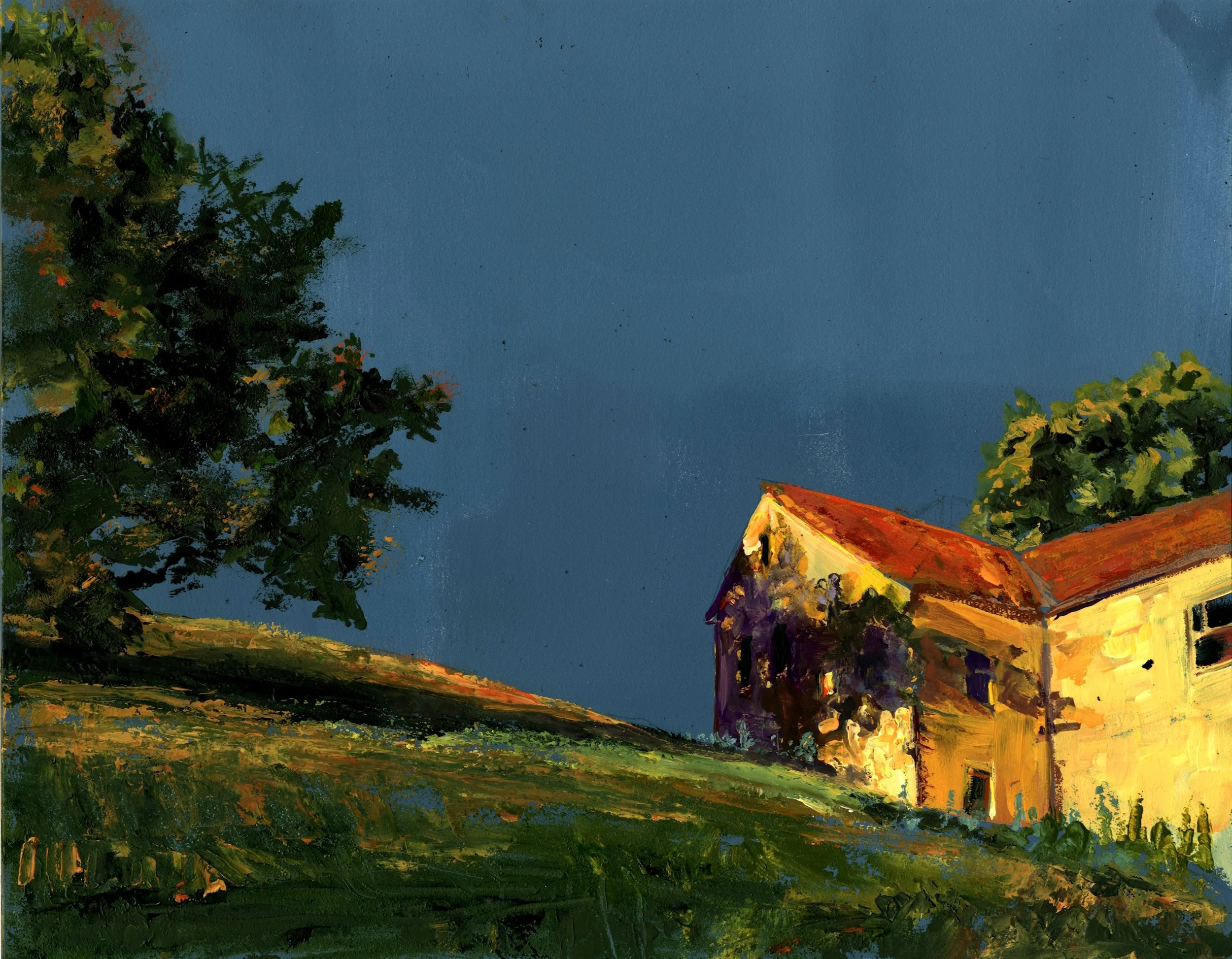
Painterly image of the side of a yellow house, with a red roof, perched into a hillside. One tree on the left in the foreground, and one behind the home. All images sit against a clear deep blue sky.
"Pond House" by Susan Solomon
Susan Solomon is a freelance paintress living in the beautiful Twin Cities area of Minneapolis/Saint Paul. Her work is a search for a light in the dark. It is always rooted in images from the natural world. Susan has paintings in the permanent University collections of Metropolitan State and Purdue. her newest work in on Instagram at solomon.painter.
Two Pieces by Erin Power
“Sideways Escape”
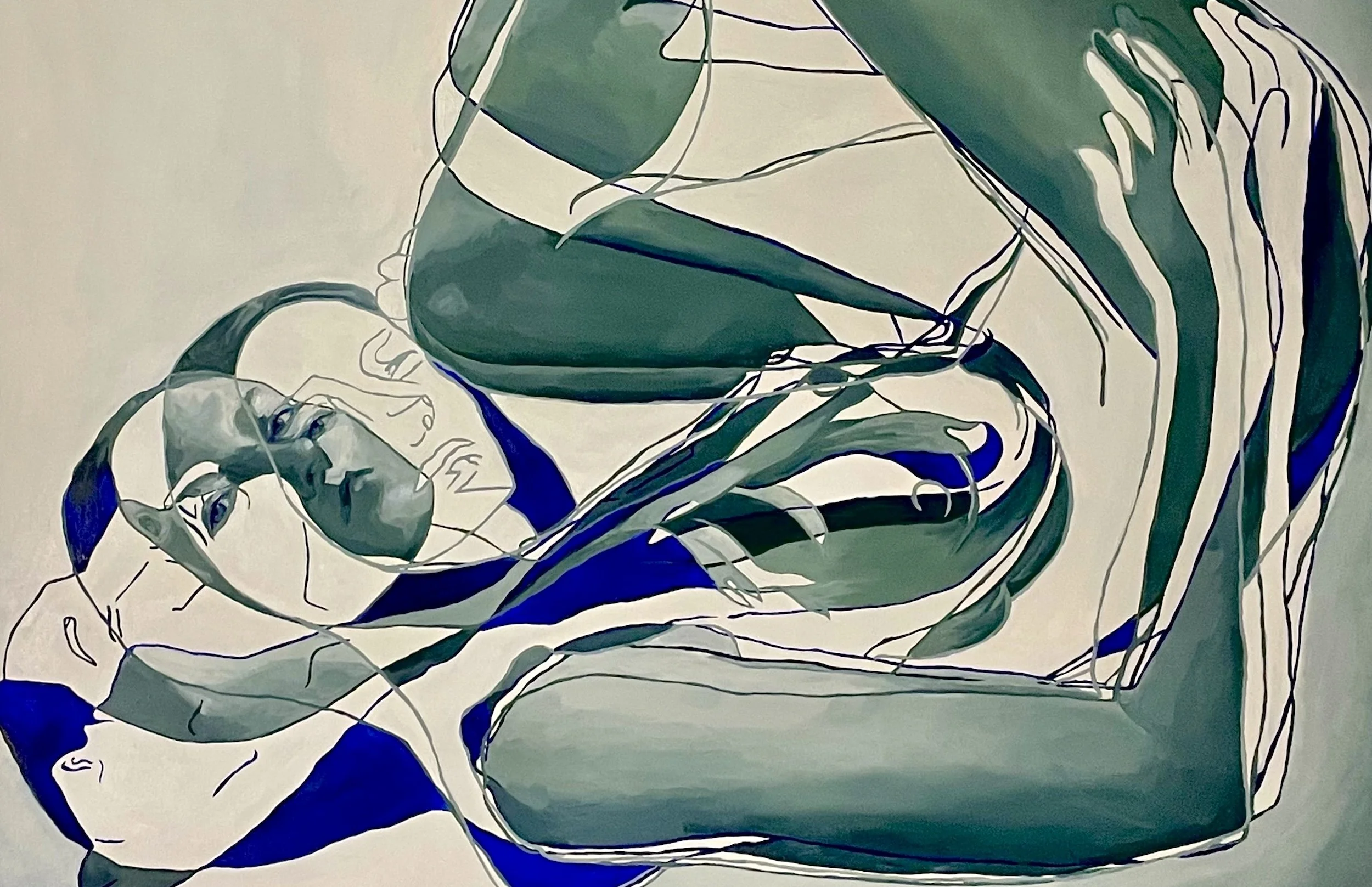
Image of a woman, laying on her back, turning her head to the right to look at the viewer, overlain with teal, white, and navy blue lines and brush strokes.
“Kat’s Big Pink Couch”
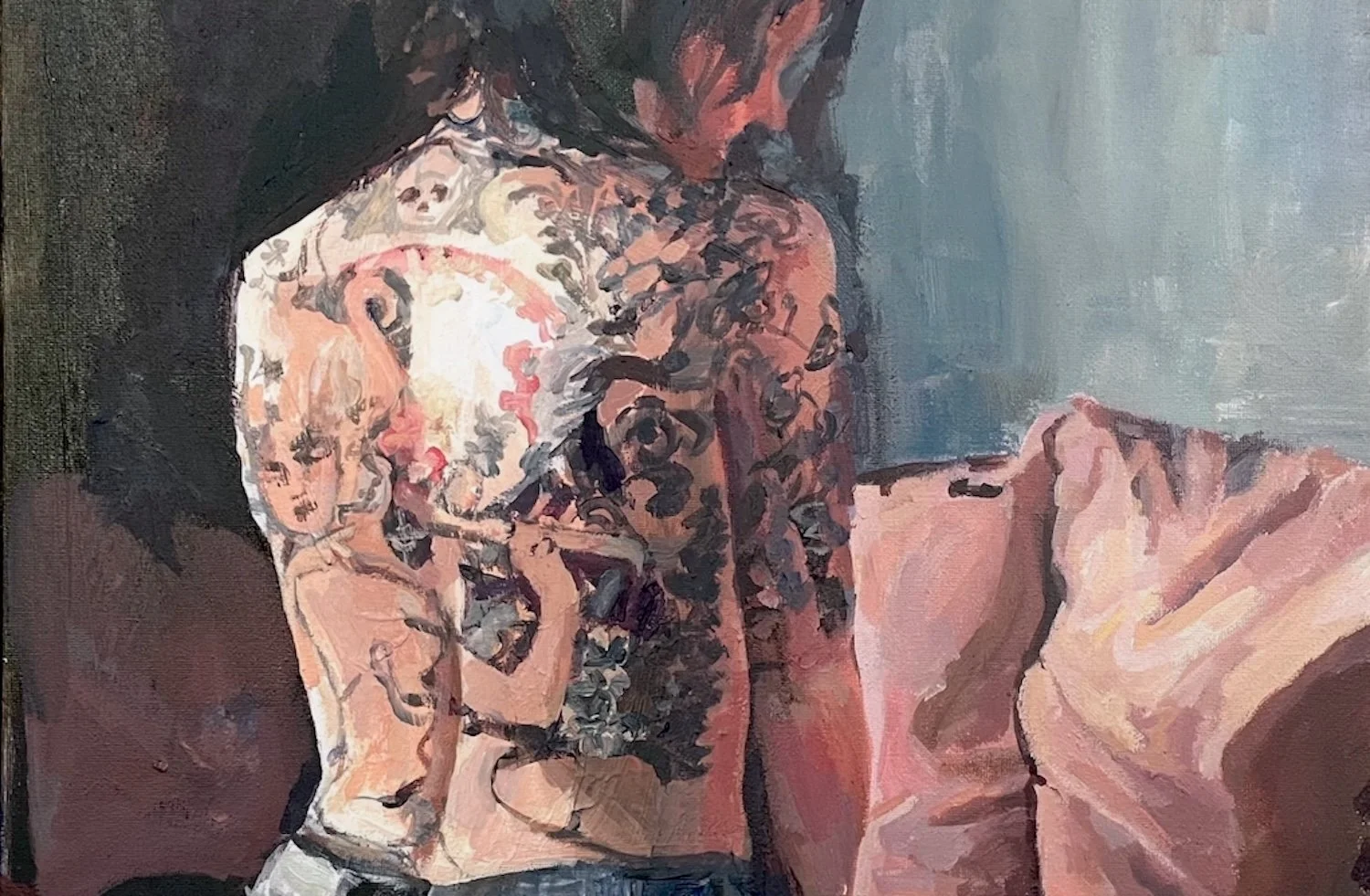
Painting of a shirtless woman with her back towards the viewer, sitting on a pink couch. Her back and right arm are covered in various tattoos.
Erin Power is a visual artist and writer in Portland, Oregon. Her oil paintings center the human figure through intimate portrayals of light-kissed, tattooed subjects and layered, abstracted compositions. Her work has been exhibited at the Oregon Art Center, Ford Gallery PDX, and the People's Gallery at Austin City Hall, where one of her paintings was also featured in promotional materials for the exhibition. In 2026, she received an honorable mention and the People’s Choice Award in the Oregon Art Center's juried Figures exhibition. Her artwork was featured in Maker Magazine in 2024 and selected as cover art for Pithead Chapel's November 2026 issue. She is currently preparing for a 2027 art exhibition and essay reading in collaboration with Our Bold Voices at the Oregon Art Center.

Shot of a black CD rack in front of a large bookshelf.
The One Who Needs to Know: A Conversation on Writing Selves, Research, and Failure in Creative Nonfiction with Jessica Johnson and Mike Copperman
Jessica Johnson and Michael Copperman first met on the board of the Portland literary organization “The Whitenoise Project,” but they first started talking about their literary nonfiction projects: Mettlework: A Mining Daughter on Making Home (Acre 2024) and Seeking Kenny: A Wrestler’s Journey (University of Iowa Press 2026) at the NonfictioNow conference in 2025. Those conversations persisted as they read for the newly revamped Northwest Review, where Mike acts as nonfiction editor and Jessica reads nonfiction, runs the interviews and special features section, and edits poetry. They met up online for a more focused exchange in advance of the June 2026 release of Michael’s book.
JJ: As the title of your new book suggests, Seeking Kenny: A Wrestler’s Journey has a question at the heart, or maybe a cluster of them. The inquiry that guides the book is less about what ended Kenny Cox’s life prematurely and more about what drove him to extreme ways of living in the years and months before he passed—and what kind of peace he might have found in his last weeks. This is a searching story about someone who was himself a searcher. In the book, we see you interviewing those closest to him and traveling to Kauai to look for his final campsite. It seemed to me that you also treated your shared past as wrestlers as a kind of research material, a piece of the puzzle that engaged me in a different way because you had firsthand access to the experience. These multiple kinds of research came across as organic and balanced when I was reading the book, but I can imagine all the ways moving between them might have been challenging to pull off. Making it look easy can be hard!
While we’re writing books, we’re also figuring out how we’ll write them. I’d love to hear the story of how you figured out how to write this story. Was the central question clear early on? Were there forms of research besides interviews and travel that are less prominent in the finished book but still important in the process? Did you run into obstacles and have to change tactics?
MC: I love how you frame this question by saying that it’s a book about Kenny’s search by someone who himself was a searcher, because the most important part of writing this book, for me, was finding the narrator’s voice and perspective– WHO exactly is engaged in the process of inquiry and discovery, and what’s at stake for them. In any book or individual piece of writing that’s written in the first person, the narrator is not actually the same as the author– they are a version of the author, that part of the author that needs to know. To write this book, that part of me who wanted to be a championship wrestler– who looked to Kenny Cox for example– had to be brought out to guide this book, to act as its engine, and to lend urgency to the search. And to do that, I had to make myself vulnerable in ways that weren’t comfortable. I try not to think about wrestling too often, because I will stay up all night going over one of the three state championship finals I lost, or be haunted by dreams of cutting weight. But to write this book, I had to reckon with that part of myself who was and always will be a wrestler driven to extremes.
The process of the book itself, and the research, was ultimately cathartic and even healing for me. Travel to Kauai to retrace Kenny’s journey into the Na Pali wilderness and to visit the church he attended after returning and search for his campsite also ended up offering a sort of self-reckoning with my own physical limitations, thanks to my attempt to run the entire Kalalau trail in one day after a minor monsoon.
What’s perhaps less visible are all the interviews I did with Kenny’s parents and friends that became the adventure stories of Kenny’s journey from Florence to Baja and back, as well as my recreation of his seventy days in the jungle on Kauai and what happened in its aftermath. I had to take detailed notes to get as many particulars of every event and story as was possible– and then engage in the imaginative and creative work of trying to bring those moments to life.
JJ: I love what you said here about needing to spend time with the part of yourself who needs to know, that version of you being the guide. I understand the self on the page of nonfiction projects as a partial self, a version, but I hadn’t exactly thought of that self as the one who needs to know. I bet many people writing nonfiction will relate to the sensation of spending time with a version of themself with whom they’re not entirely comfortable.
MC: You include research source notes at the end of Mettlework: a Mining Daughter on Making Home, which considers your life growing up the daughter of miners always moving in search of the big win—and the ways you now can understand your mother’s life differently as you’ve charted your own path through marriage and motherhood. The book, which also considers the history and impacts of mining on people and place, reflects an immense and varied amount of investigation. Can you talk a little about some of the different approaches and sources you went to in writing this book?
JJ: When I started, I just had this pile of my mom’s letters and a lot of vague feelings about my own life as a mom. There was a long period of time where I was looking for the framing that would help me develop a picture that other people could see. I was reading a bunch of anthologies of women’s writing from the so-called American West, settler women’s letters and journals and some scholarly things too that helped me see patterns in my mom’s writing and my own. I would write a little, then read a lot, then write something else, including many chapters that didn’t make it into the final version of the book. I was also interested in the sociology and history of Portland, the setting for large parts of the book, so a good deal of my early reading had to do with that. I spent time trying to learn about the places in the book that I don’t personally remember, and even some of the ones I do. Eventually, I came to be researching as I think a lot of poets do–for image and language. I remember when I found Works Progress Administration oral histories from women who had been schoolteachers in Granite, Oregon, during its first goldrush. The continuities between some of the things they described and some of the things my family experienced, especially around the weather and the mud, gave me the feeling that I was onto something. Readers comment on how much research I must have done, but the researching process was so much a part of me figuring out my approach to the material that it didn’t feel like a project because I was doing it for my own understanding.
Speaking of immense amounts of research, a thing I admire about Seeking Kenny is how many perspectives and characters you included, and how you treated the interviews as events in the book. It was as if you weren’t simply seeking information but were exposing the process of finding it, along with the details and questions that come with that kind of research. The act of seeking information became part of the book’s story and structure. What advice would you give to someone who is considering a nonfiction project in which interviews play a big role?
MC: I really like how you name the way that including the concrete interactions of the interviews exposes the process of this sort of seeking. I honestly couldn’t have written the book without the generosity of time and memory coming from all the people who knew Kenny and loved him best. I got to understand him from the perspective of his parents, sisters, uncle, coaches, teammates, best friends and girlfriends– the project became a many-sided reflection of each of their versions of Kenny, which is to say, who he was to them and how they saw him. And since I’d lost eight state championships to the different elite Oregon wrestlers (who went on to become Kenny’s teammates and best friends) I interviewed, I was able to revisit and reframe my own complex relationship with wrestling.
My best advice for someone thinking about interviews in a nonfiction project would probably be this: you must share enough of yourself, your intentions for and investment in the project to create a relationship built on trust. In several of the interviews with people I knew less well, especially Kenny’s sisters and uncle, and also his former romantic interests and girlfriends, it took me talking to them and telling my own stories and personal history for them to feel comfortable sharing their memories and reflections, which often left them vulnerable. A good interviewer gives something of themselves first– the relationship, which I at first thought of as one-sided, must be reciprocal.
Speaking of exchanging perspectives to create a single narrative, one thing that particularly struck me about Mettlework was the way you juxtaposed your childhood experience of growing up following your parents as they moved from mine to mine with your mother’s direct experiences as she recorded them in letters that you sometimes interpolate into the text. As you do so, they also help inform your understanding of your own experiences of motherhood. Can you tell me about the reasons you chose to use the letters, and how you worked them into the text?
JJ: At first, I really thought the letters were the contents of the book! It was hard, though, to find a stance in relation to them that would sustain a story. Was I commenting on them? And if so, from what perspective? There is an entire draft of Mettlework in which I was simply writing back toward the letters and that’s it. In successive drafts, the letters became more and more minimal and more and more integrated into my own narration. I had to develop the story I wanted to tell before I could decide which parts of the letters would be important, and how to position them.
Speaking of piecing together narrative structure, I first read parts of what would become Seeking Kenny in short, decontextualized pieces you would post periodically on Facebook. I wonder if some of these essentially flash pieces became the short chapters that I think of as the book’s connective tissue. I’m curious about flash as a craft decision. How did you think about integrating short pieces into the larger narrative, and what made you decide to take this route?
MC: I love this question– and I love flash nonfiction! What’s interesting about the process of writing this book is that it’s the ONLY project I have ever even partially planned out ahead of time. I was on sub with a memoir project proposal, and an editor at Simon & Schuster read one of the three sample chapters, which is in Seeking Kenny (the chapter about cutting weight), and said, “I want a book about Kenny Cox, give me a proposal and a couple sample chapters and it’s completely greenlit.” So, I started interviewing Kenny’s parents and friends and wrote a few of those interviews up as chapters, and I came up with an idea– that I could have two narrative lines, one following Kenny’s trip to Baja and back and then into the Na Pali Wilderness for 70 days, and another that would include the interview material and also try to talk about different stages of his life. By the time I came back to the editor two months later, he no longer was interested at all–because it looked at that moment like Simon & Schuster was going to be acquired by Bertelsmann International, putting his job at risk and giving him less latitude to take a risk on a book like this one.
At any rate, I’d decided by then that I was interested– that I wanted to pursue the project. That left me with the two threads to write– the interviews, which I had no idea about regarding content, each one distinct, and the adventure part of the book, tracing Kenny’s journey(s). Sort of naturally, then, I found myself writing each interview up as a sort of self-contained interaction– meeting the person, hearing their story and retelling it. And then the chapters that cover his journey, which are imagined reconstructions of every single story and moment that I know happened, as well as attempts to write about the places he passed through, I also wrote as sort of– flash chunks, I guess, story by story and place by place? I’m glad that line acts as connective tissue, because it’s the part of the narrative that’s chronological. Figuring out the order of interviews, on the other hand, was a particular challenge that my initial planning did little to help with– after I interviewed everyone, I had a jumble, but once I’d written the journey, which I did second, I sort of felt my way through an order that made sense.
While we’re talking about intuitive formal choices, in Mettlework, I was particularly struck by the formal choice to shift, near the end of one of the sections where you’re quoting from your mother’s letters, to second person epistolary, addressing your daughter directly. It’s a really moving and powerful section. Why did you make that choice in that section?
JJ: I am so delighted that you like this part. I also like this part. I am a huge fan of the epistolary as a reader and a writer. I feel like it somehow focuses the voice and the stakes. I wrote one draft of Mettlework as an extended letter to my mother. I love how Kiese Laymon wrote Heavy to his mother. Terese Marie Mailhot uses this address, too, at times, in Heart Berries. I am influenced by both of these books. For me, the task of writing is more comprehensible and more approachable when it’s to or for someone particular. There can be something lonely or uncertain about one’s own voice without a clear sense of who it’s for. Some part of me is always a kid in a cabin not knowing who else is out there. I think the letter form alleviates some of that basic anxiety for me. And I wanted to turn the narration toward what I knew mattered most to me, which is my ability to raise my children well and mother the future through them.
MC: One moment that struck me, and that has some connections with a similar moment in Seeking Kenny, is when you write about trying to find the site of your old home along with your parents outside the town of Granite– you include the search, even though you don’t find the site, but the moment is still meaningful. I also wrote about trying to find the place Kenny Cox camped in the last month of his life– and leaving off the search, as finding the place itself ultimately wasn’t really necessary (or was impossible). Can you talk about the decision to include that moment?
JJ: Yes! I remember reading that part in Seeking Kenny and noting the similarity. In both cases, I felt like the search itself was revealing something important. So much of Seeking Kenny is about looking for something elusive, whether in wrestling or in post-wrestling life. It seemed perfectly fitting that at the end, you were content not to find the exact spot and to be okay with that. The ending aligned with the sense of resolution I found at the end of the book.
When I was writing that last piece of Mettlework, I could see how the search for the Granite cabin and my parents’ inability to remember where it was indicated the way they regarded places in general as temporary and almost disposable. For them, these were places to move on from once a job was done; for me, though, they were all I knew. The search for the cabin was in some ways more telling than if we had found the cabin. If you’re not getting what you came for, look around. You might be able to notice something better.
Michael Copperman is an assistant professor in the Department of Writing, Rhetoric and Cultures at Michigan State University. His work has appeared in Oxford American, Guernica, The Sun, Creative Nonfiction, Boston Review, Salon, Gulf Coast, TriQuarterly, Kenyon Review and Copper Nickel, among others, and has won awards and garnered fellowships from the Munster Literature Centre, Bread Loaf Writers’ Conference, Oregon Literary Arts, and the Oregon Arts Commission. His memoir Teacher: Two Years in the Mississippi Delta (University Press of Mississippi 2017) was a finalist for the 2018 Oregon Book Award in CNF. He is the Creative Nonfiction editor for the Northwest Review. Copperman was once one of the best wrestlers in the Western United States, and attended Stanford on a wrestling scholarship. His new book Seeking Kenny is about the extremes of the American subculture of wrestling as seen through the story of five-time national champion Kenny Cox’s pilgrimage deep into the wilderness of Kauai’s Na Pali Coast (University of Iowa Press 2026).
Jessica E. Johnson is the author of the book-length poem Metabolics (Acre Poetry Series), the chapbook In Absolutes We Seek Each Other (New Michigan Press), and the memoir Mettlework: A Mining Daughter on Making Home (Acre Books). Her poems, essays, and reviews have appeared in The Paris Review, Tin House, The New Republic, Poetry Northwest, River Teeth, DIAGRAM, Sixth Finch, and Off Assignment, among others. A community college instructor in Portland, Oregon, she’s the Poetry editor for The Northwest Review and co-founder of the Constellation Reading Series.
Photo by Hümâ H. Yardım on Unsplash
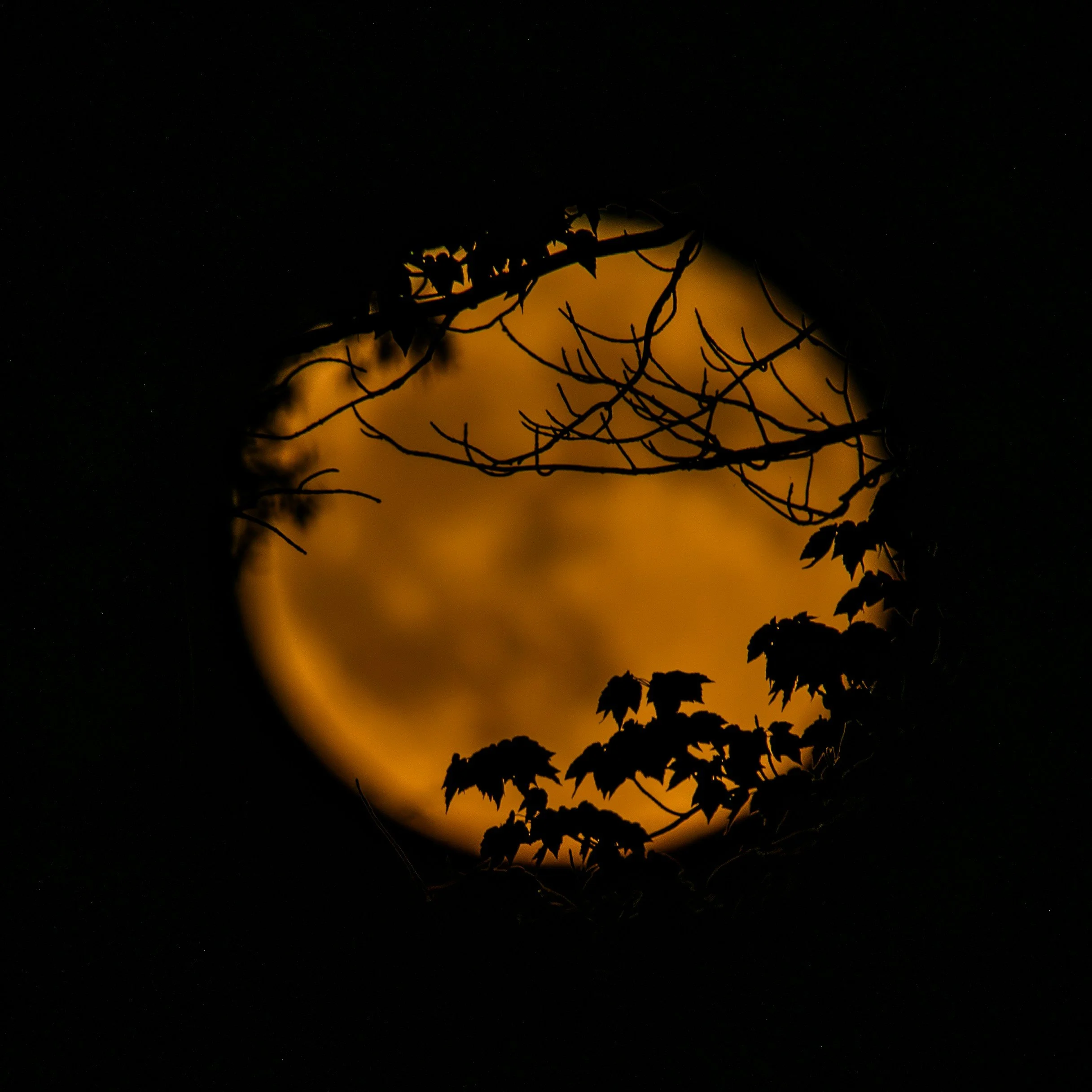
Orange moon seen through silhouetted tree branches.
Two Poems by Hannah Hanes
When the corn moon finally came / it ballooned like lava in a lamp / and rose from my belly / where it had swollen to the size of my pain
Read More
I REMEMBER SNOW BY SARA WAINSCOTT
There was snow on the ground, I’m sure about that, for now still a safe enough bet for Northwestern Wisconsin in winter. Maybe it was snowing. If I noticed the weather, I didn’t think to write it down, and now the fact escapes me.
Dad was dead, no changing the facts, and death didn’t seem reason enough to call a stranger out of bed over the Christmas holiday. Dad was dead, but this had been going on for a while. Like the old tale of the boiling frog, who doesn’t leap from a pot of tepid water being heated and so is gradually cooked, we had gotten kind of used to it.
+
Remembering is difficult. I gloss over how it was. How Dad didn’t realize he was sick, how the limits of his comprehension slowly vanished inward, backward, and went on narrowing. How tiring it was to pretend for him, to repeat and to be repeated to, endlessly circling the truth. How tired and fearful I felt. How impossibly strong his hands remained, gripping and wringing my wrists and fingers, how it seemed he might break them when he clung. How young for the disease, and how I thought he could live for years and decades, live and live and live. How relieved I was, how heartsick, how selfish, how tired.
How I love the smells of engine grease and cut grass, late summer tomato leaves, hot steam wafting from ironed cotton, damp snow on a coat collar. How I always notice the price of bananas.
Later, I realized I should have been writing it down.
+
We were outsiders. When I was born, my parents moved to a small town where everyone knew everyone, and most people were related in one way or another. We, my parents and my brother and I, weren’t related to anyone, and my dad’s thoughts about independence and nepotism, sometimes shared at town meetings, didn’t win him any popularity contests. My entire life until I left for college was in this town, and I never felt like I fit there. I felt too seen and also too invisible. Maybe I would be a writer and go to a city and disappear and be famous. Maybe I would never look back.
I believe my dad would have recognized those feelings, the longing to escape, and some of his biography bears out this belief. But he didn’t talk about it much, and he didn’t write it down.
+
My parents, like lots of couples who married young (she was twenty-two, he was twenty-five) had their share of ups and downs, though they stayed married until my dad’s death, forty-some years in all. For all the years I can remember, something was going on with Dad, something unnamed that caused him sometimes to emanate a cold, pressured silence, a silence that might simply dissipate or else be broken by shouting or, I figured out, a well-timed joke. When he was happy, everyone was happy, or so it seemed to me, but happiness was not a steady state.
Something was going on with Dad. He worked a lot, his back hurt, he wanted everything for us. He was stressed, depressed, deprived of sleep. He cut out meat, lost twenty pounds. He bought capsules and supplements and a water distillation unit. His colonoscopy, he was proud to say, showed the colon of a person half his age. He was strong as the proverbial ox.
Later, I realized he must have been afraid.
+
In most of the memories I have of my dad, he is working.
For the work he did outside of his job—gardening, canning, preparing our meals—there were plaid button downs and two or three sets of bib overalls in various stages of decay. In the small-engine repair shop he ran out of our garage, he wore navy blue work pants and matching shirts, carefully ironed by my mom, with his name embroidered on a patch over the breast pocket. The shop smelled of grease and engine oil and gasoline and dust, though it wasn’t an especially dusty place considering that my brother and I were regularly tasked with keeping the floors swept and the shelves, the counter, and the sale display of new lawn mower engines wiped clean with squares of our old clothes cut into rags.
The shop was a just-so kind of place, with boxes of machine parts classified according to a numeric system that matched those listed in a set of large three-ring binders, with tool cabinets so organized that Dad could reach for and locate a specific wrench without taking his eyes from the repair. Dad believed that a tidy shop showed customers the care they could expect from his repair work.
Later, I wondered whether this carefully controlled environment had helped him compensate when he could tell that something wasn’t right.
+
On a typical day, Dad would be up early, measuring grounds into the 12-cup countertop drip unit so he and Mom could enjoy a coffee and some quiet minutes together. Dad took his with two spoons of sugar and a splash of half-and-half, and I learned to like coffee by stealing sips from his mug.
Then he’d be fixing breakfast, scrambled eggs with sausage or biscuits and gravy, and even on the coldest winter days, taking Mom’s car for a spin to gas it up and get the heater going for her. Once she waited and waited for him to return with her car, growing increasingly pissed as the start of her workday grew closer. When he finally returned, he didn’t grasp her irritation. He’d stopped for milk, picked up the mail, was it some kind of big deal? It wasn’t really like him to lose track, but with a household to juggle and a small business to run, things were bound to get mixed up.
He’d always been a little scatterbrained, forgetting to drop my brother off at kindergarten, leaving his wallet in various hiding spots around the house, or squirreling cash in a coat pocket and then forgetting where it was: my mom tells a story of my Sunday School teacher letting her know how the class had prayed for my dad at my request, related to “a lot of money that he lost.” The teacher was polite but clearly horrified, probably assuming he had gambled it away.
My dad never gambled, said he worked too hard to hand it off that easily. But once, when my grandma to visit, we stopped at a casino. Did my brother and I stay in the lobby or in the car? Were we allowed to wait in the restaurant sipping Cokes? In any case, my mom and grandma played five or ten bucks at the nickel slots, and Dad walked out with a few coins he’d found scattered on the floor, pleased to be the only one to come out ahead.
+
Dad prided himself on frugality and never spoke of generosity. But every summer, when I was seven and eight and nine and ten, he sent me to the elderly apartments across the street, where I had to pull our red wagon full of garden produce from door to door, giving away cucumbers and rhubarb and tomatoes to very many very old-seeming ladies, only a few old men, and have my braids tugged and be called pretty and plied with Country Time lemonade and frosted cookies from a plastic clamshell.
He made weekly batches of homemade soup for a terminally ill friend who couldn’t eat much else.
He would plow the sidewalk for the entire block.
He always went to the funeral.
+
Dad loved wacky, sometimes elaborate jokes, often performed early in the morning before any witnesses were stirring.
He set up a campsite in the neighbors’ yard, waking them at sunrise to the clatter of their breakfast being cooked over a fire.
Another neighbor was meticulous about his lawn in a mostly friendly competition with my dad, who mowed ours all the time to test repairs. In the dead of winter, my dad built a six-foot snowman in the yard next door, gloved stick arms pushing a Lawn Boy, pencil dangling like a Marlboro where a snowman’s mouth would be, in clear resemblance of his rival.
+
When we got a new stereo, he tested the speakers one dawn by playing at full volume a compact disc of freight train sounds next to my visiting grandma, asleep and unsuspecting on the hide-a-bed. She was terrified and then furious, but he laughed like a gleeful teenager until she could see the joke and laughed with him.
Around the time I started middle school, he created arrangements of more than sixty plastic flamingos, a flock which appeared to migrate each morning on their own around the yard of our Main Street house, sometimes wearing costumes: American flags and paper hats on the 4th of July, backpacks on the first day of school. Once, a long row of flamingos peered over the lattice rails of our broad front porch, a single bird lying on the lawn among the shredded remains of a pink feather duster beside a seven-foot inflatable alligator. They were on clearance, my dad shrugged, and when in their natural habitat does one see only one or two flamingos?
+
When I was thirteen, my mom earned her master’s degree and got a better-paying job, and this must have allowed my dad some personal permission to occasionally relax. In those years, he took meandering country drives, sometimes met a friend for coffee, and perfected his banana bread recipe. At some point, he taught himself to tie fishing flies. Tying flies was fussy, delicate work performed through the lens of a lighted magnifying glass. Maybe he used the flies to fish, but mostly I remember the glint of the barbed hooks, the contrasting softness of feathers and fur, the slight movements of his strong hands winding a nearly invisible thread. I suppose the point is that he was enterprising, industrious, could study and observe and figure things out.
+
We generally got along, Dad and I, particularly if there wasn’t too much talk involved. With his friends and customers, or with servers or salespeople, he could be charismatic and hilariously quick-witted, and babies were drawn to his solemn winks. But he tended to quiet contemplation when he was tired, or stern monologues if he perceived my behavior or attitude merited correction, or simmering silent rages for entirely unpredictable reasons. I don’t think he was always this way, but this is the way I knew him.
Sometimes as a teen, I would accompany him on quiet evening outings. In the spring, we would crawl along the country lanes in his station wagon, “bunny hunting,” he called it, watching for the frolics of tiny fawn-colored baby rabbits, stopping the car when we spotted them and sharing a laugh over their adorable antics, their absolute tininess. In the summer, I lounged across the station wagon’s bench seat reading my paperback copy of Ovid’s Metamorphoses while he cast a dozen times into a trout stream. In the winter, we took turns breaking trail on our snowshoes along the fence line of a tree farm. On cold days, we saw our breath. We saw deer and hawks, broken furniture and abandoned television sets. I don’t remember whether he caught fish. I don’t remember what we talked about, if we talked at all.
+
After I was off to college, my brother told me later, Dad came back from the funeral of an elderly friend who, toward the end of his life, forgot his work, his friends, his children, his wife. “Take the shotgun,” Dad wanted him to promise, “and shoot me if I ever get like that.”
+
The summer of 2001 was officially the future, and I had recently graduated with a BA in English Literature, so I was back at home, living in my childhood bedroom and reading poetry books from the library, applying for MFA programs, waiting tables to save up money either on the chance I’d go to grad school or the chance I wouldn’t. In the meantime, my dad and I decided to take a class together at the community center: lacing snowshoes.
We sat beside each other in the circle of students, and the instructor first demonstrated, then buzzed around, answering questions, troubleshooting. I no longer remember the technique, just that we were weaving neoprene strips into pre-built frames. No, I was weaving. The instructor stood for a moment behind my dad, then showed him once more how to twist the strips into a pattern. In this moment, Dad would have cracked a joke balanced with the right amount of self-deprecation, and the instructor would have chuckled and moved along, satisfied.
Except Dad couldn’t figure out what to do. His hands and his brain, so used to solving far more complicated tasks, couldn’t coordinate to weave the pattern. Back and forth, I moved between our frames, tidying his web and then completing mine, smiling too much, keeping up a light chatter between me and my dad in the space where before was our comfortable understanding with silence.
+
I think my brother has it now, the little stepstool that Dad built for us when we were small. Simple but sturdy, it stayed tucked under the bathroom sink long after we didn’t need it to wash our hands and brush our teeth. Before we were born, before work took all his energy, Dad built a lot of things–jewelry boxes, cabinets, all the tables in our house. His own dad died when he was sixteen (steel mill, lung cancer), and though he didn’t talk about it much, it was clear that this trauma put into him a terror of lacking money, food, security. Work feathered the nest, protected us, and he worked for long hours in every season. Even at mealtimes, customers might knock on the door, and Dad would leave his dinner to help offload a busted snowblower from a pickup or swap a toothy skein of freshly sharpened saw chains for a folded square of cash. As I lay drowsy in my bed at night, I could often hear the long screech of the bench grinder, picture the amber sparks spitting from the blade’s edge.
+
The last year my parents lived in my childhood house, I was home with my own kids for a visit. My son was five years old, my dad’s pal, and Papa would help him build his own little stepstool. After an hour, my son wandered away for a snack, to play with trucks, to see what his toddler sister was doing. My dad was frustrated: damn thing wouldn’t come together. He fumbled with the wood, a four-piece puzzle that wouldn’t fit, but by that afternoon, or maybe the next, a little step stool was complete, if just a bit off-kilter. It might be the last thing Dad built on his own, this little stepstool he and my son painted fire-engine red, a project that should have taken maybe thirty minutes to complete.
+
Mom’s work was busy and fulfilling. She excelled at it and earned a new position and sometimes had to travel. My dad managed the house, the meals, the grocery shopping. He reveled in the bargain-hunting element of grocery shopping, and if we spoke on the phone in those days, it was either about my kids or a good price on bananas.
One weekend, Mom went searching for something in the back storage room of the basement and came across rows upon rows of boxed cereals and pastas and a huge assortment of canned goods, several years’ worth of groceries, many items already expired. An enormous, overwhelming, totally bonkers hoard, a sheer amount that made her sob, because making this discovery was the moment when she knew.
+
And so, my mom retired, and my parents moved from the edge of the countryside out to the middle of it, to a ranch house on an idyllic apple orchard where they could see foxes and deer cross the backyard, an Edenic spot where in fact they posed for their holiday card as Adam and Eve, bare skin peeking out from behind carefully arranged apple leaves.
For me, the joke didn’t land, not with my dad both there and gone, both laughing and maybe not always in on it. After they moved to the orchard house, it was like his mind could never be unpacked. The new place had a large garage with a workspace for his shop and that was never unpacked either. Over the years, imperceptibly to the rest of us, his tall red Snap-On cabinets had slowly lost their perfect order, and no one now could set them right. Dad might slide a drawer open but never seemed to know what he was looking for. The sockets weren’t organized by set, the wrenches not ordered by size, and he would be frustrated and angry and close the drawer. Without the familiar surroundings of his shop, the small town, the house he’d lived in nearly 40 years, the muscle memories of his usual places, he became increasingly agitated, increasingly childlike. The first year, they planted a garden, but without Dad’s careful tending, it grew disheveled and weedy, and after that there was no more garden.
Eventually, he could no longer cook or drive or understand money. Spoons vanished regularly from the kitchen drawer, and Mom would find them all around the house: in the desk cubbies, in the basement freezer, tucked inside his folded pairs of clean underwear. He tried to wear two pairs of pants or put socks on his hands instead of gloves. He took a pot of black-eyed peas off the stove and tried to carry them to the garage “for the people who live out there.” Television confused him; he thought the shows were happening in the house with him, and he despised Pat Sajak for giving all that money to other people and never to him.
It was sad, of course, but sometimes it was funny.
+
When she was packing up their house, my mom found a sticky note on the back of the coffee maker, the one they’d had for years, the one he used every morning. In his careful, Catholic-school handwriting, he had listed the steps for brewing coffee.
+
Once, as I was heading to my car at the end of a visit, he handed me his handkerchief, carefully folded into a packet, with two or three wheat pennies and a dime inside, a little something for the kids.
It was funny, of course, but sometimes it was sad.
+
Later, I would wonder if what I had understood to be his personality was some truer self, the one who loved to laugh and read and cook and care for us, already being eroded. I like to think about his younger, carefree self, the one who borrowed his unsuspecting mother’s car to go fishing and ended up instead on an impulsive weeks-long road trip to see the far-off desert and the redwoods and the California coast. Or better, the ten-year-old fishing the dam with his dad, or the toddler he once described in his earliest memory: eating a cookie and being pushed in a stroller along sunny squares of sidewalk by his grandmother.
+
To remember, one must accept the version that really happened, the ways in which life changed us, despite our efforts otherwise.
He intended self-reliance to safeguard him, to protect my brother and me, to break a cycle of family trauma and alcoholism and anyone’s guess about the other things because he never said. He wouldn’t like me telling any of this, but it’s my story too, even if it disappoints the dead. It’s the story I want my kids to know. Writing down these memories is my version of feathering the nest.
+
My dad died from complications due to Alzheimer’s disease on December 26, 2017. It was almost midnight. It was snowing and it was dark. It was dark. I don’t remember if it was snowing. I was in the next room, and my mom came to get me, and we called my brother to come. The house was very quiet, and the world was very quiet, and I don’t remember how I felt. One by one, we sat with him, and I told him things I won’t write down. The sky grew pale and pink, and my mom called the hospice nurse, and someone called the coroner, and the black van came, and the white van came, and then they drove away.
Sara Wainscott is the author of Insecurity System (Persea, 2020), winner of the Lexi Rudtnitsky First Book Prize, and The Star Cabins (Rescue Press, 2026). She is the recipient of a fellowship from the Civitella Ranieri Foundation, a Newcity “Lit 50” honoree for Chicago literary influencers, and the former co-curator of the Wit Rabbit Reading Series. She lives in Chicago.
Photo by: Aditya Vyas on Unsplash

Two people sitting by the water behind a black fence.
Two Poems by T. R. Poulson
They shot your mother and you screamed / until she explained, go back to sleep. / Allentown’s south side was a jungle, / hockshops, drug corners, always cars / “backfiring.”
Read More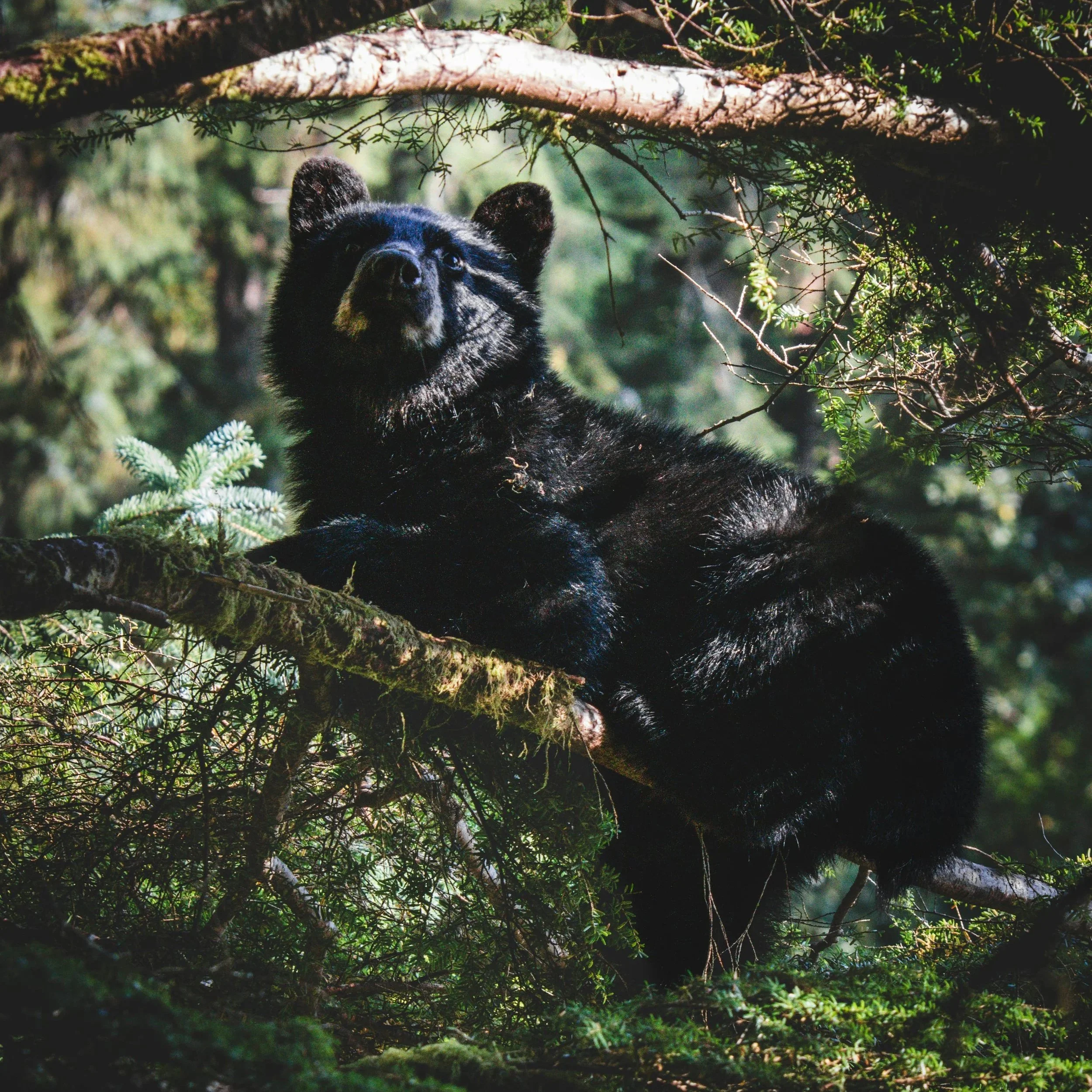
Image of a black bear cub in a tree, surrounded by forest foliage.
BEAR by Caleb Jagoda
downtown we see the vigil a crowd of towns- people
gathered like candle flame twitching in the absence of light
on tuesday a truck met two dead kids on a state highway
crunching their car frame making them dead which
they weren’t before but now are forever two dead kids
at dinner we talk about Camus and politics and death and I
tell you the caçoila I’m eating the floral upholstery fabric I’m sitting
on remind me of my vovó’s kitchen who is dead her house sold
but in the all- spice the red pep- per in the slow-cooked beef shank
I am there she is there I can feel her smoking a cigarette
in the slow persistent breeze while thinking of asking again
of your dead friend the one you were telling me about
minutes before when our waiter interrupted I instead
tell you what I saw that morning:
a black bear, hulking, graceful,
its snout steaming
in morning cool, its snout sniffing
the air, and seeing me just as I
see it, understanding, for the first time,
what we were,
slipping into forest,
all that green
obscuring the darkness.
Caleb Jagoda is a poet and journalist who uses real names at fake hotels. His work has appeared in Blue Earth Review, The Shore, South Florida Poetry Journal, and Down East Magazine, among other places. His debut chapbook, "Hunting," was published by Bottlecap Press in 2025. He lives in New Hampshire, and is big on the internet: www.calebjagoda.com.
Photo by Eric Hooper on Unsplash
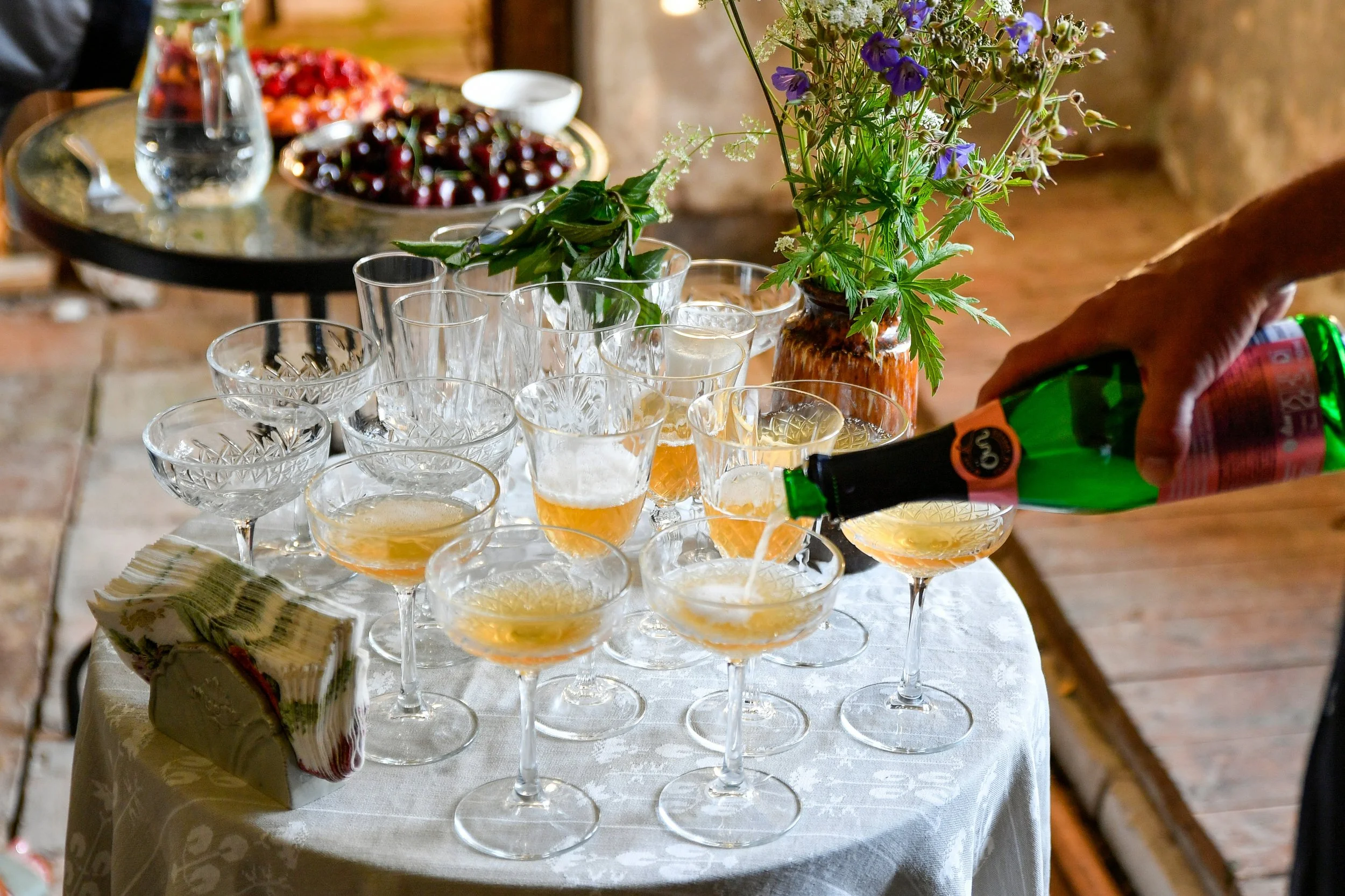
A close-up of a waiter pouring refreshing sparkling wine or cider into elegant vintage crystal glasses on a festive party table decorated with summer wildflowers.
garden suburb hermit After Romy Rhoads Ewing by nat raum
i want someone to say that one, there. that / little freak, and point to me and mean it / for once. mean it for keeps.
Read More