
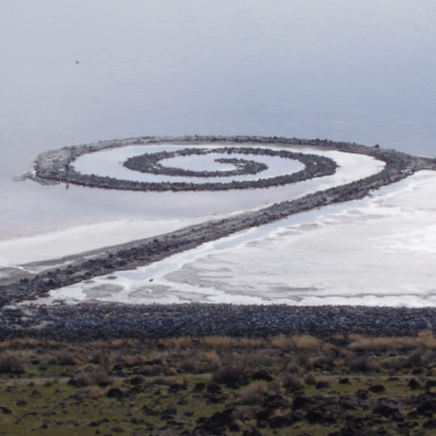
From the dusty shore, a strip of faded land juts out, then curls, spiraling inward. This earthwork is famous for its shape: a question mark extended. A raised path of mud, salt crystals, rocks, and water, the Spiral Jetty is 1,500 feet long and 15 feet wide, and for over fifty years it has stuck out like a cowlick onto Utah’s Great Salt Lake. Sometimes submerged and invisible, often cresting and walkable, Robert Smithson’s sculpture repurposes over 6,000 tons of rock and earth from the remote Rozel Point peninsula to create, in Smithson’s words, “the edge of the sun, a boiling curve, an explosion rising into fiery prominence.” All that land was already present, but moved, reconfigured—what does it say? How does this coil force us inward? How does it fling us out? It’s the type of art that makes suburban dads roll their eyes and ask, “So what?” but it also sparks, crackles, and burns in the lungs, a swirling forest fire that can’t be doused. When I asked if you wanted to see it with me, you said, “What’s that?” and then, or maybe before, you said, “Yes.”
Plenty of images exist of this earthwork, often aerials capturing the context, the pink-crusted lake and the coast the color of dried wheat. The images depict the sculpture’s scale: its impressive size, but also its relative unobtrusiveness to the greater shore; zoom out far enough, and it’s only a blip on the water, then a glint, gone. You can trace its curves with your cursor, magnify its edges into pixels, click through different angles until Google quits refreshing, but the still frames can’t escape stagnancy. You never forget you’re looking through a window. It’s like being given a miniaturized replica of the Eiffel Tower by someone who won’t shut up about their trip to Paris. Over time, the photos frustrate me.
It felt important to see it in person and important to see it in person with you. A photo mutes part of art’s experience. In a college geography class, I sat at a long table with my roommate as light streamed in behind us and spilled onto our notebooks, a carton of orange juice overturned. Places, I learned, are discrete and distinct; you can point to their unchanging boundaries: here is this city, and this street, and this address. Spaces, though, are porous, personal, and overlaid with emotion: this is where I grew up, and this is where I learned to drive, and this, here, is where I fell in love. Spaces are created by bodies. So when I say it’s about your body, I don’t mean just the sex or the way you touch my hair—it’s about your bodily presence, your embodied presence. It alters every space we enter: the café where we buy coffee and scones, the hiking trail where we count fighter jets and birds, your apartment where you cover me with a faux fur blanket because you know my feet get cold. I don’t need to touch you, to be touched by you, to feel you. You’re here; I know. The reality of space can’t be captured in an image; it can’t be felt without presence.
We make plans to visit the Jetty, and from afar, I do what I can. On a cold, sunny afternoon, I brace against the wind, pushing open a large glass door. Inside the library’s special collections, an archivist says, “I almost went to the Spiral Jetty, but then I didn’t. How’s that for a story?” I sit in a hard chair where two desks meet, facing a wall and glowing computer monitor. I put on bulky headphones. No one else is in the room when I click play. Onscreen, Smithson’s Spiral Jetty film wavers.
Shall I describe it to you? A little over thirty minutes long, the video feels separated into three movements. The first part is the most overtly poetic, opening with a grainy solar flare, liquid lava rising like an arm, then snapping to a drop. This section is cut through with maps: a map of the Great Salt Lake, bits of torn map snowing over land, a global map of the Jurassic period. Yes, Smithson seems to say, place is important. More than simply place, though, he captures space. He wants to “trace the course of ‘absent images’ in the blank spaces of the map [so that] one is liable to see things in maps that are not there.” We inhabit the images, the space, its possibilities. The openness is generative, not empty. Shots from the front and back of a pickup move us to and from the jetty site, always down a dusty road during daylight. Time is kept by kicked-up rocks from the road, by a ticking clock, a wheezing respirator. In a red-lit museum, the camera follows the curves of dinosaur bones. “Nothing has ever changed since I have been here,” croons the voiceover, “but I dare not infer from this that nothing ever will change.”
The next portion of the film details the Jetty’s construction, though at times it feels more like destruction. I think of how often progress requires deconstruction—dismantling, pain. I think of my muscles tensing when men in trucker hats pass too close, of my nerves electrifying the night, of the hours I spent shaking in therapy, reliving it, of how everything got worse before I got here. My ears hurt from the tight over-ear headphones, but I don’t remove them. In the video, trucks roar over land, dumping mud to be sculpted by the blunt blades of bulldozers. The only voiceover: “Ripping the Spiral Jetty.” The machines’ engines sound louder when spliced between scenes of shallow water tinkling like a crystal chandelier. The quiet reinforces the loudness. I realize what it is that bothers me about this video: the framing always cuts something off, reminds the viewer that something’s missing, that there’s more off-screen, that it’s too big for the camera to comprehend.
The film’s third and final part absorbs me most. Long shots from a helicopter trace the spiral path. (It’s while filming this type of shot, an aerial from a plane, that Smithson would die in 1973.) Curling in and out, the movement dizzies viewers as we follow a man who follows the path. His hair is longer than yours, but his build is the same: tall and slim, with an ease of motion belying taut muscles beneath. In a long-sleeve white shirt and straight-leg jeans, he sometimes walks but mostly jogs. Water licks big rocks lining the path, staining dark the places it’s touched. When the man reaches the center, he breathes. It’s Smithson.
As we pull away to see the Jetty’s full spiral, the totality of its curves and curl, the man disappears into distance. The narrator recites, “From the center of the Spiral Jetty: / North—Mud, salt crystals, rocks, water / North by East—Mud, salt crystals, rocks, water / Northeast by North—Mud, salt crystals, rocks, water / Northeast by East—Mud, salt crystals, rocks, water.” The voiceover repeats this classification for sixteen other directions. Mud, salt crystals, rocks, water. It’s hypnotic. Mud. Incantatory. Salt crystals. It conjures place. Rocks. Pulling me closer. Water.
Mud, salt crystals, rocks, water. This geologic description can be traced to William Carlos Williams (yes, the Plum Poem guy), who was, in fact, Smithson’s pediatrician. The video’s voiceover echoes the found poetry in Williams’s Paterson, an epic set in an abandoned industrial town, where he transports readers by including an inventory of materials found at different depths of a well: “Depth […] Description of Materials / 65 feet… Red sandstone, fine / 110 feet… Red sandstone, coarse / 182 feet… Red sandstone, and a little shale / 400 feet… Red sandstone, shaly,” and so on and so forth, down to 2,100 feet, each depth paired with a material description. For Williams, this lifted page functions as a synecdoche: the part suggests the whole. The page suggests the book, and the elements suggest the place. But more than the part suggesting the whole, this synecdoche asks readers to strain for the whole. Can you see it? Can you feel it? Williams’ found section acts, as scholar Brian L. Gempp puts it, as “a self-reflexive mapping that comments upon both the world and the limits of the word.”
Suddenly, it’s Valentine’s Day, and we sit at my dining room table and exchange gifts. The moment is warm with seeing each other, being present together. You give me three books, socks, a tea towel, and a photograph. They all mean something to me. I give you hand cream, a letter, and a bottle of wine. “It’s from the winery we went to in Sedona,” I say. We stumbled onto the place accidentally, after meandering between high walls of red sandstone and into a convenience store, where we found a bottle from a different winery and decided, based solely on the label, to visit. This winery, the one that produced the bottle you’re holding, was simply close by, an impromptu stop off of an impromptu stop. That day, we sat on a wooden patio overlooking a lush valley and hills lined with vines. A deer danced through grapes and disappeared over the horizon. The sommelier wore a T-shirt and brought us extra tastings for free. I watched you split open the burrata, watched it ooze out like happiness, and in the sunlight, on that wooden patio, I could not have loved you more, until I did.
It happens in a fraction of a second: the look on your face, the memory, the feeling. At my collapsible dining room table, we’re back there, at that winery, in that moment, and yet we’re here, in my adobe home, holding each other without touching.
Smithson, too, was interested in the palimpsest of space, in how to stretch and layer time and place like a bite of pulled taffy. Not everyone can visit the Spiral Jetty, so how might viewers be transported in non-physical ways? For Smithson, the answer lay in the distinction between “sites” (non-gallery exhibits) and “non-sites” (gallery exhibits). You can travel to sites, like the Spiral Jetty, to experience their scattered information all at once, while non-sites, on the other hand, are dislocated information stored in abstract containers, things like films, photos, and rocks stacked in clear bins, representations of the initial site in a new space, perhaps a more accessible one. I’ve been submerging myself in non-sites, watching Smithson’s film on repeat, devouring books, and staring at photographs, but it isn’t the same as being there. It’s not the Spiral Jetty; it’s something else. According to Smithson, non-sites are closed limits, inner coordinates, and no place, while sites are open limits, outer coordinates, and some place. Sites and non-sites, places and spaces, Sedona and white wine—these pairs are inextricably linked, but to fully understand either, we have to travel the range of their convergence. “Between the actual site… and The Non-site,” writes Smithson, “exists a space of metaphoric significance.”
In the summer of 1997, the Spiral Jetty became “an icon…a virtual reference that beckoned” Tacita Dean. “I wasn’t even making an artwork at that point. I was just going to see it out of interest,” says Dean, “but for some curious, unconscious reason, I put my DAT recorder on… [and] I subsequently realized that I had to make it into a sound work because something about that journey had been so extraordinary.” She and a friend set out to find the Jetty, but it’s the pilgrimage itself that enthralls her. Throughout the twenty-seven-minute recording, we hear the rumble of gravel (like that of Smithson’s film), the click of a camera, coughing, sneezing, and Dean reading out directions. The pair note cattle guards, a locked gate, oil-drilling relics, and an amphibious war machine. “Should we continue or not?” They do, we do, but after parking the car and braving the wind, Dean laughs: “I’m not sure this is the Spiral Jetty.” The high lake level probably covered the sculpture, as it did for decades (Smithson was explicitly interested in entropy, in the ways the Jetty would naturally disintegrate and recombine through time), but perhaps the pair simply were lost. The directions are so specific as to be confusing, referencing landmarks both present and absent (i.e., “Another 0.5 miles will bring you to a fence but no cattle guard and no gate”), and as the tape meanders, we, as listeners, are lost too. In some museums, this sound work is looped, creating a constant and comfortable lostness—everything in hyperfocus yet soft, like cashmere. For Dean, the work creates “a conceptual space where I can often reside.” We’re lost, dislocated from the familiar, embedded in an abyss.
We inhabit the blank spaces of the map.
Let me put my psychology degree to use: cognitively, humans navigate by landmarks. Craggy mountains and gnarled trees and sun-weathered gas stations become north stars, and our brains draw maps around these points. Back East, I followed the river to high school, walked uphill to college, turned left at the floodplain Piggly Wiggly on my way home. In the West, though, land is a flat scroll unrolled in all directions, openness its most salient landmark. (Cue Bon Iver, “I could see for miles, miles, miles.”) Neither of us is from here, and, at first, the open distance disoriented us. We had to reorient to panoramic sunsets, blue-dyed afternoons, the maw of the night sky speckled with spit. We had to reorient to open space, and we did it in different ways. I learned to accommodate lostness, while you imprinted openness. I swish through place, lost, until I arrive, miraculously, at home, at your apartment, or the base of a mountain, but you navigate by openness itself, directing me when I drive: “turn right,” “take a louie,” “stay in this lane.” For you, what was once an unyielding horizon became a trail. It’s a marvel to me, the way you’ve inscribed this tabula rasa into your mind, how you navigate by the absence of obstruction.
I’m reminded of Nancy Holt, the earthwork artist and Smithson’s wife, who also embraced Rozel Point’s “Western spaciousness.” For her, this openness was freeing. “As soon as I got to the desert,” she says, “I connected with the place.” Perhaps, like me, when she first stepped onto its red sandstone soil, the hot wind, thick with dust, reminded her of her skin, and, as she looked toward the unending and unblemished horizon, she opened. In Utah Sequences, a silent, roughly ten-minute video, Holt explores the geography around the Spiral Jetty but, as in Dean’s recording, never shows the earthwork itself. She captures the space, its atmosphere. Throughout the film, her lens focuses on light, how it glints and gleams, shines and shies away. There are wide sweeping shots of landscape: an open road crossed by a flock of sheep and miles of empty shoreline pierced by a faraway figure and driftwood joists. But Holt also trains her attention on small things: the dead pelican in repose, salt crystallized into glittering globs, her husband’s feet kicking up silvery mica. It’s violent and beautiful, the way his body disturbs the land, upsets natural order.
I never thought I’d fall in love. In the morning, your white sheets glow, light burning through shades. My jaw aches from teeth-grinding, and I wonder if you feel the muscle clenched beneath your shoulder blade, the knot that hardly ever leaves. In the still-life of your room: a green plastic water cup atop a stack of books, a large map of New Zealand on the wall, an archipelago of clothes dotting the floor. I stare at the blank ceiling, the expanse of it, and you stare at me. I’ve wanted to tell you for a while but didn’t know how to form the words, how to let something terrible into something that is only good. Of course, it has always been here, inside me, a layer buried beneath time’s newer sediments, a deep deposit of metamorphic rock I can’t discard. But in the moment, right now, I’m not thinking about geology or philosophy or the body as palimpsest—I’m not thinking at all. When I tell you I was raped, I’m back there, in that basement with the slow-spinning fan, but I’m also here, with you, in a light-drenched bedroom that feels like the taste of fresh-pressed juice, and I’m also months away, in the future, walking the Spiral Jetty, holding your hand as you hold mine as we hold each other.
So even though I’m not thinking about it—I’m only feeling the heat our naked bodies shed—it’s still true that my body is a topographic map, all of time’s layers pressed flat into one document: me. Except, as Smithson says, “By drawing…a topographic map, one draws a ‘logical two dimensional picture’ [which] differs from a natural or realistic picture in that it rarely looks like the thing it stands for. It is a two dimensional analogy or metaphor.” I’m not flat, and places are not spaces, but there are limits to the word, and maybe this is the closest I can get to describing what the Spiral Jetty is teaching me about my body and its place in the world.
On our way to the Jetty, we stop by the Grand Canyon, though “stop by” distorts the nature of our visit. We plan to hike fifty miles in two days, down into the canyon, and out, and down into the canyon, and out. You’re attracted to the distance and time of the challenge—the endurance, which my brain can’t help but trace to endure, meaning remain in existence, to last. With a hike like this, the destination is the journey; I mean the journey is all there is. Miles, miles, miles.
At four a.m., we crawl out of our tent with jackets and headlamps on. As we descend, the sun rises, heat accumulates, and different habitats hold us. Because of its depth and breadth, the canyon collects five ecosystems, the same kinds found between Canada and Mexico, distance compressed in the fissure. Coyotes howl as we leave the Ponderosa pine forest, and a string of cowboy-led mules kick up dust as they pass us in the woodlands. In our familiar desert ecosystem, red dirt mixes with sweat and sunscreen, drying to a perpetual drip that makes our legs look like they’re bleeding. The riparian biome, with its shady high walls and gentle, cooing stream, is our favorite, and we walk through it and then back up through all the rest, trudging our way into the North Rim’s boreal forest, where the next morning we split a packaged stroopwafel, sweet and crisp, before climbing down and out once more.
We pass through each ecosystem individually, and though it’s impossible to view them all at once, they’re contained in a singular space: the Grand Canyon, and now, additionally, our bodies. We experience place and create space through our bodies. It’s where physical transformation takes place, where art comes alive. Without our limbs and trunks and sun-drenched skin, the Grand Canyon is just a place, a postcard we’ve seen on twirling stands. Our bodies friction out space: the early-morning trail that forces me to wear your dusty socks as gloves; the bottom camp where a hatful of water drips down your head and slaloms your nose; the hutches of rocks that shade us as we hydrate and fall more in love. So maybe the body is the site itself, with its open limits and outer coordinates—the space of change.
Yet as we leave the Grand Canyon, driving north toward mud, salt crystals, rocks, and water, we carry our experiences inside us. Driving north, our bodies become a non-site, complete with closed limits and inner coordinates. The sound of the woman’s cowbell at the North Rim still rings inside our bones, and we will never not feel the sweet collapse of our legs upon return, packs slung from shoulders into red dirt. The body is the site of experience and the non-site of memory. It’s both, and this intersection in the Venn diagram opens a new dimension, a different framework, an abyss of possibilities.
On the drive to the Jetty, bodies full of lactate and frayed muscles rebraiding bigger, we ache. We walk like off-brand cowboys at gas stations, legs stiff and unyielding under neon “Bud Light” signs. We split a bagel breakfast sandwich with fresh tomato outside a punk coffeeshop, and it’s the most tomato-y a tomato has ever tasted. As we near the edge of cell phone service (your favorite limit to pass), we pause to tour the Golden Spike Railroad site. The sky’s underbelly is gray and full, on the verge of ripping open. We circle replica train cars and pass over the last tie to be laid, the one that connected everything. Only one plaque alludes to the violence borne on the railway’s back, but it’s in the soil, unavoidable. On our way out, we grab a free map to the Spiral Jetty. The flimsy printer paper advises, “Travel is at your own risk.”
As the car’s GPS slides into an empty grid, we enter the blank spaces of the map. We roll past rotting farm equipment and rusted auto parts. The overcast sky bleaches the golden stubble of shrubs to dull straw. The kicked-up rocks from the road punctuate the silence, and I count your sneezes, as I always do. “Two!” I say, and you smile. “Two.” As we approach the shoreline, I swell. Partially because I’ve wanted to see the Jetty for so long, but mostly because I want to share it with you. I want you to love it as I’ve grown to love it, not in the same way but with the same emotion: two offset stereogram images looked through to create dimension, space.
We park. As we step out of the car, the salt air surges over us. There are others here—a photographer, a family, a couple with a son and a dog off leash—but the wind drones, quiet and constant, and the overcast sky stretches flat over land like fresh canvas. We feel alone. We trace the absent images with our steps. Picking our way down the rocky hill, you say, “It’s like a comforting abyss.” We step onto the black rock path, and distance surrounds us. In front is only land and sea, prostrating itself in offering. Mud, salt crystals, rocks, water. It’s not blankness but freedom. We follow the path as it curls tighter, and its shape disappears; we’re too close to see it; we’re in it.
Wittgenstein says, “If we take eternity to mean not infinite temporal duration but timelessness, then eternal life belongs to those who live in the present. Our life has no end in the way in which our visual field has no limits.” You teeter, wearing flip-flops, and we hold hands to steady ourselves. Your palm is warm and soft. Your fingers, picked raw, ground me. On the back of your head, where hairline slips to skin, is a cowlick, and before haircuts, I circle the spiral with my finger. Mud, salt crystals, rocks, water. The tightness curls as we spiral closer to the center, and so does the openness. Mud, salt crystals, rocks, water. Here is your body and mine, together in a single place and infinite space, dislocated from time and thus full of it. Mud, salt crystals, rocks, water. We don’t know, in this moment, that we won’t last—not in this partnership, not in this shape—but the future doesn’t matter. We won’t last, but this moment will; we carry it in our bones. Mud, salt crystals, rocks, water. We hold hands, stranded in eternity. Mud, salt crystals, rocks, water. We breathe.
Maddie Norris, author of The Wet Wound: An Elegy in Essays (UGA Press), earned her MFA at the University of Arizona and, before that, was the Thomas Wolfe Scholar at the University of North Carolina at Chapel Hill. Her essays have won the Literary Award in Creative Nonfiction from Ninth Letter and been named Notable in Best American Essays. Her work can be found in Guernica, Fourth Genre, and Territory, among others. She is a Visiting Assistant Professor at Davidson College.
Photo from: Commons
